


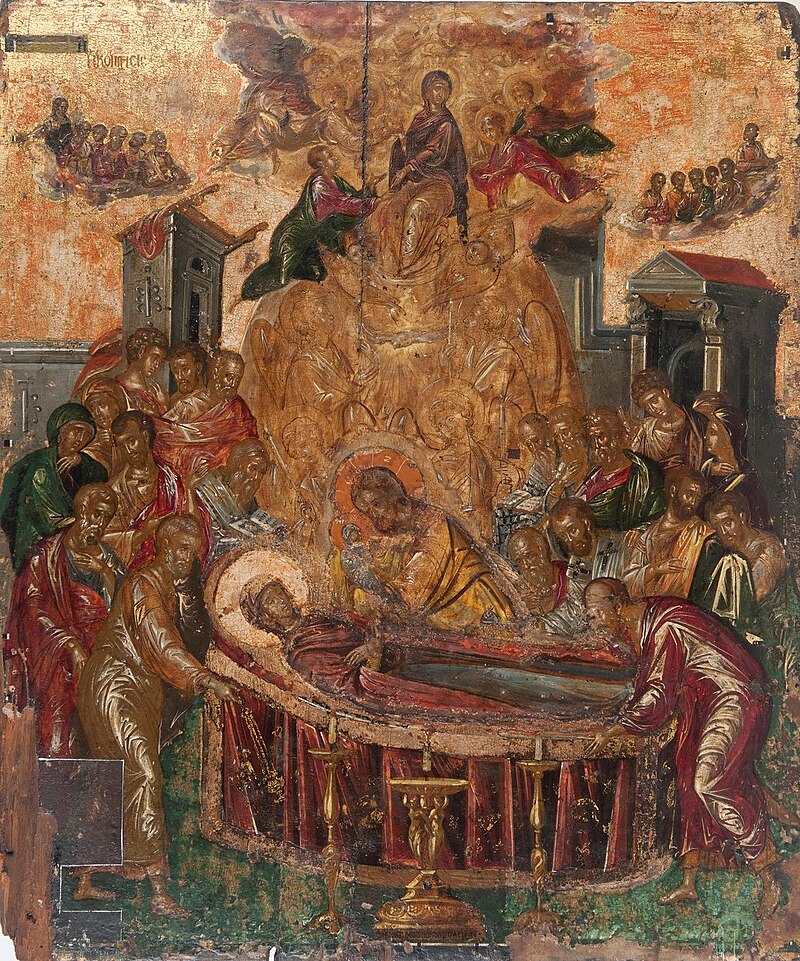
PHOTO: Dormition of the Theotokos, by El Greco, Ermoupolis, Syros
By Maximos (Lavreotes), Peter House, Cambridge, UK
In Christian antiquity, only the term “Koimisis” (Dormition) of the Theotokos was known. With this term, the first Christians alluded to the death of the most Holy Theotokos as a human. There were NO other words which express the same meaning. With the passing of time, the theory that Christ himself came down to Gethsemane and received the soul of His Mother was developed. Let us recall the most popular hymn chanted for August 15th (exaposteilario, 3d tone of the feast) “Apostles from all expanses (of the earth) gathering there, bury my body in the town of Gethsemane, and you, my Son and God, receive my SOUL.” This descent of CHRIST was considered to be a transition (μεταβασις) from the earth to heaven. Thus the term “METASTASIS” started to be used in the Middle Ages for the rising of both the soul and body of the Theotokos to heaven.
Over the course of the centuries, and with the dominance of Scholasticism in the West, this transition (μεταβασις) of the Theotokos’ soul and body started being interpreted as her Αναληψις (Ascension), WITHOUT her Dormition (koimisis). This was NO different from the Ανάληψις of Christ, the Prophet Elias, and Enoch. After the dominance of Scholasticism (10th c.) in the West, the Papists started to think that Panagia never died, and for that reason that she was immortal and incapable of dying. This opinion was mainly based upon Augustine, who was the first to present the argument that death is a punishment from God, and His revenge for the sinfulness of mankind (Augustine never accepted the Resurrection of the dead). In other words, those who are sinless never die! Out of fear that perhaps Panagia would be considered a sinner, the Papists started believing that it was never possible for the Panagia to die as a human being. However, they NEVER considered that the Panagia had as Her role to transmit mortality to the Body of Christ. The next conclusion that the Papists ought to normally derive would be that it would be impossible for Christ to have ever died!!!!
Of course, they didn’t think of this (unintended consequence) and merely allowed the inference that Christ wasn’t able to die, even if he was crucified. This perception negates ORTHODOX FAITH entirely, that Christ died for our sins. A God-man Christ that could not ever die would also not equally be able to provide freedom and Salvation to common mortals. This matter was silenced and was never discussed in any Papist Synod. And we finally arrived at the point where the Papists are NOT aware whether Christ died upon the Cross or not. The heretical perception that Christ was unable to die upon the Cross led to total confusion as to whether or not the God-man died for us or not.
The confusion is preserved up until our days, since no Pope of Rome was able to clarify if Panagia really died or not. Therefore, nobody among the Papists was ever in a position to say if truly Christ trampled death by His death. This impasse led to a complete inability for Christians to be able to confess that Christ trampled death by His death. It was something that slowly did not appear as likely to have occurred. And thus, we have arrived at today’s condition, where Papism no longer believes in the Resurrection of Christ, because Papism is not sure if Panagia truly died or not, in which case, the entire mystery of Christian Faith is some sort of…deception.
=======================
ΚΟΙΜΗΣΙΣ Η ΜΕΤΑΣΤΑΣΙΣ;
Του Μάξιμου ΛΑΥΡΙΩΤΗ
Peterhouse, Cambridge UK
Στην χριστιανική αρχαιότητα μόνον ο όρος ΚΟΙΜΗΣΙΣ της Θεοτόκου ήταν γνωστός. Με αυτό τον όρο υπονοούσαν οι πρώτοι Χριστιανοί τον θάνατο ως ανθρώπου της ΥΠΕΡΑΓΙΑΣ ΘΕΟΤΟΚΟΥ. ΔΕΝ υπήρχαν άλλες λέξεις που να εκφράζουν ακριβώς το ίδιο νόημα. Με την πάροδο του χρόνου αναπτύχθηκε η θεωρία ότι ο ίδιος ο Χριστός κατέβηκε στην Γεσθημανή και παρέλαβε την ψυχή της Μητέρας Του. Ας θυμηθούμε τον λαοφιλή ψαλτικό ύμνο του Δεκαπενταύγουστου (εξαποστειλάριο, ήχος Γ´ της κυριωνύμου εορτής) “Απόστολοι εκ περάτων συναθροισθέντες ενθάδε, Γεθσημανή το χωρίον, κηδεύσατέ μου το σώμα, και συ Υιέ και Θεέ μου παράλαβέ μου το ΠΝΕΥΜΑ.” Αυτή η κατάβασις του Χριστού θεωρήθηκε ότι ήταν μία μετάβασι από την γη στον ουρανό. Ετσι άρχισε από τον Μεσαίωνα να χρησιμοποιείται η λέξις ΜΕΤΑΣΤΑΣΙΣ για την άνοδο της ψυχής και του σώματος της Θεοτόκου στον ουρανό.
Στο διάβα των αιώνων και με την επικράτηση του Σχολαστικισμού στην Δύσι, η μετάβασις ψυχής και σώματος της Θεοτόκου ερμηνεύθηκε ως Ανάληψίς Της ΑΝΕΥ Κοιμήσεώς Της. ΔΕΝ επρόκειτο για κάτι διαφορετικό απο την Ανάληψη του Χριστού, του Προφήτου Ηλία και του Ενωχ. Μετά την επικράτηση του Σχολαστικισμού (10ος αι.) στην Δύση, οι Παπικοί άρχισαν να σκέπτονται ότι η Παναγία ουδέποτε πέθανε και γι’ αυτό τον λόγο ήταν αθάνατη και ανίκανη να πεθάνει. Αυτή η άποψη βασιζόταν κυρίως στον Αυγουστίνο, που πρώτος παρουσίασε το επιχείρημα ότι ο θάνατος ειναι μία τιμωρία του Θεού και η εκδίκησή Του για την αμαρτωλότητα του ανθρώπου (ο Αυγουστίνος ουδέποτε απεδέχθη την Ανάστασι των νεκρών). Επομένως όσοι αναμάρτητοι ουδέποτε πεθαίνουν! Απο φόβο μήπως η Παναγία θεωρηθεί αμαρτωλή, άρχισαν οι Παπικοί να πιστεύουν ότι δεν ήταν ποτέ δυνατόν να πεθάνει η Παναγία ως άνθρωπος. Δεν σκέφτηκαν ΠΟΤΕ όμως ότι η Παναγία είχε ως ρόλο Της να μεταδώσει την θνητότητα στο Σώμα του Χριστού. Το επόμενο συμπέρασμα που θα έπρεπε κανονικά να βγάλουν οι Παπικοί ηταν ότι ο Χριστός ήταν αδύνατο ποτέ να πεθάνει…!!!!
Αυτό δεν το σκέφθηκαν βέβαια και άφηναν να υπονοηθεί ότι ο Χριστός έστω και αν σταυρὠθηκε δεν μπόρεσε ποτέ να πεθάνει. Αυτή η αντίληψις καταργεί τελείως την Ορθόδοξο Πίστη ότι ο Χριστός απέθανε υπέρ των αμαρτιών ημών. Ένας Θεάνθρωπος Χριστός που δεν μπορούσε να πεθάνει ποτέ, δεν μπορούσε εξ ίσου να προσφέρει και την λύτρωση και Σωτηρία στους κοινούς θνητούς. Το ζήτημα αυτό αποσιωπήθηκε και δεν συζητήθηκε ποτέ σε καμμία Σύνοδο των Παπικών. Και τελικά φθάσαμε στο σημείο να ΜΗΝ γνωρίζουν οι Παπικοί αν ο Χριστός απέθανε επί του Σταυρού η όχι. Η αιρετική αντίληψις οτι ο Χριστός ηταν ανίκανος να πεθάνει επί του Σταυρού οδήγησε σε πλήρη σύγχυση αν πράγματι ο Θεάνθρωπος απέθανε υπερ ημων ή όχι.
Η σύγχυση διατηρείται μέχρι και τις ημέρες μας αφου κανένας Πάπας Ρώμης δεν μπόρεσε ποτέ να αποφανθεί αν πέθανε όντως η Παναγία η όχι. Επομένως κανένας ανάμεσα στους Παπικούς δεν ήταν ποτέ σε θέση να πει αν όντως ο Χριστός επάτησε τον θάνατον δια του θανάτου Του. Αυτό το αδιέξοδο οδήγησε σε πλήρη αδυναμία τους χριστιανούς στο να μπορουν να ομολογούν οτι ο Χριστός δια του θανἀτου Του επάτησε τον θάνατον. Ηταν κάτι που σιγά-σιγά δεν φαινόταν καθόλου πιθανό να έχει συμβεί. Και έτσι φθάσαμε στην σημερινή κατάστασι όπου ο Παπισμός δεν πιστεύει πλέον στην Ανάσταση του Χριστού, διότι δεν είναι σίγουρος ο Παπισμός αν πράγματι απέθανε η Παναγία. Οπότε ολόκληρο το μυστήριο της Χριστιανικής Πίστεως είναι ένα είδος …απάτης.
Μαξιμος ΛΑΥΡΙΩΤΗΣ
Peterhouse
Cambridge UK













The assertation that Catholics do not believe in the resurrection of Christ is a slanderous lie. Take a look at the CCC, it clearly states that the resurrection of Christ is the crowning and central doctrine of the Catholic Church. Though there are many false doctrines in Catholic theology, you should not mislead people with your faulty accusation.
It appears that this article is using the well-known high-school technique of “logical argument proofs” to highlight the philosophical disconnect that has resulted from the influences of Scholasticism in the West, using a conditional statement… the central “logical equation” presented in this question is “if A = True then B must = False”…
However, the main focus of the controversial part of the article is on “A” in this case (the question on whether the Roman Catholic church feels that the Theotokos didn’t physically die, but “Ascended”, as a result of influences from Scholasticism)…it doesn’t appear that this article is actually primarily focused on “B” (Christ’s resurrection), but deduces the controversial conclusion as a consequence of the “logical equation” If “A=True THEN B=FALSE” (if one accepts the belief that the Theotokos didn’t die, but was “Ascended”, then “conquering death by death” could not be fully achieved by the Resurrection in accordance with Orthodox understanding). That’s the crux of what the author is trying to highlight. It’s a conditional statement.
The article seems to be inferring that multiple “Papists Synods” and “Popes” may have long been silently side-stepping the obvious dogmatic paradox that has emerged from any Western “understandings” that the Theotokos underwent an Ascension, because they clearly can’t possibly / officially reverse the long-taught position that “B=TRUE” (and that’s why they still list it in their CCC), even though maintaining the dogma that “A=True” would normally lead to a contrary logical conclusion that “B=FALSE” based on Maximos’ analysis… He’s pointing out that Scholasticism about the Theotokos may have caused the Roman Catholics to “paint themselves into a dogmatic corner” about the understanding of the Resurrection.
So that’s the big question…Is that what the “Papists” really believe and teach about “A”? That the Theotokos did not die physically, but underwent an “Ascension” (vs a “Koimisis” and “Metastasis” that the Orthodox Church teaches)? If yes, then the logical paradox that Maximos is presenting via his argument would have merit for further dogmatic debate.
Either way, it is clear that Maximos uses caustic language to refer to the “Papists”. He’s not into diplomacy, that’s for sure…