
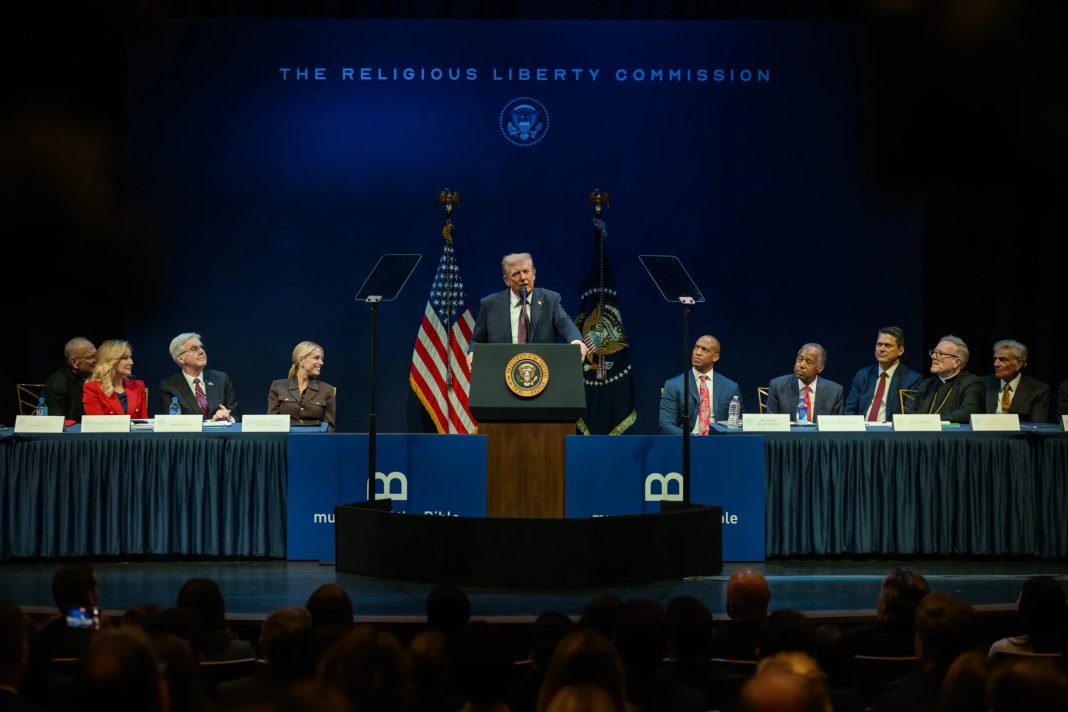
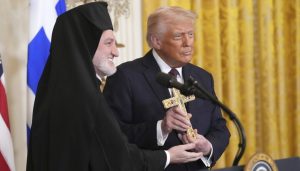
EDITOR’S NOTE (Nick Stamatakis) The glaring absence of Archbishop Elpidophoros from President Trump’s September 8 speech at the Museum of the Bible raises more questions than it answers. Let us not forget: this is the same Archbishop who offered Trump a large ornamental Cross—claiming afterward that it had cost him $6,000. Yet when the Trump administration convenes a major religious liberty event, the Archbishop is nowhere to be found. Why? The answer may lie in the deep and total ideological disconnect between Elpidophoros (and Pat. Bartholomew) and the Trump administration on nearly every issue (including Ukraine): diversity and DEI initiatives, fossil fuels versus “green” energy, open borders versus national sovereignty, and even the broader culture war battles over religion in public life.
The Ecumenical Patriarchate and its representatives in America have consistently aligned themselves with globalist, progressive currents that clash head-on with Trump’s “America First” agenda. While Trump doubles down on “drill baby drill” and protecting Christian prayer in schools, Elpidophoros speaks the language of climate activism, identity politics, and global governance. Against this backdrop, his absence is perhaps less surprising—it may even have been deliberate. Still, it is telling: when faith leaders of many traditions gathered to support Trump’s vision of religious liberty, the Greek Orthodox Archbishop of America was conspicuously missing. The question remains—was he not invited, or did he choose to stay away? Either way, the faithful should take note.
BELOW IS THE NEWS REPORT
=====================================
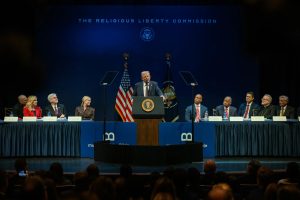
Trump at the Museum of the Bible: “America Prays” and New Push for Religious Liberty
In a fiery September 8 address at the Museum of the Bible in Washington, D.C., President Donald Trump presided over the second hearing of the Religious Liberty Commission—a body he himself created to defend what he calls America’s “identity as a nation under God.” Surrounded by prominent allies including former HUD Secretary Ben Carson, Texas Lt. Governor Dan Patrick, and Attorney General Pam Bondi, Trump announced sweeping new initiatives aimed at strengthening religious expression in public life.
The centerpiece of his remarks was a fresh Department of Education directive reaffirming the right of students to pray in public schools, a move Trump described as vital to protecting the First Amendment from “anti-Christian bias.” He also unveiled “America Prays”—a nationwide initiative timed to coincide with the 250th anniversary of the Declaration of Independence in 2026. The program calls on citizens of all backgrounds to come together in prayer for “strength, peace, and prosperity.”
In a symbolic flourish, Trump donated his own family Bible—used at both of his inaugurations—to the Museum of the Bible for permanent display. He also tied his vision of religious liberty to broader themes of crime, culture, and morality, suggesting that “when faith gets weaker, our country seems to get weaker.” At the same time, some of his remarks drew sharp criticism, particularly his comments minimizing domestic violence statistics, which survivors and lawmakers called dismissive and troubling.
For Trump’s base, however, the message was clear: religious freedom remains central to his platform, and prayer must be restored as a public, visible cornerstone of American life. The absence of certain church leaders—most notably Archbishop Elpidophoros—was noticed, but the gathering nonetheless underscored Trump’s continuing alliance with conservative faith leaders as he charts a path toward 2026 and beyond.
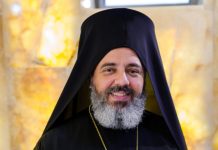








I’ll give credit where credit is due, Elpidophoros actually came out with a statement that wasn’t cringe