source – Peloponnese News
December 6, 2025
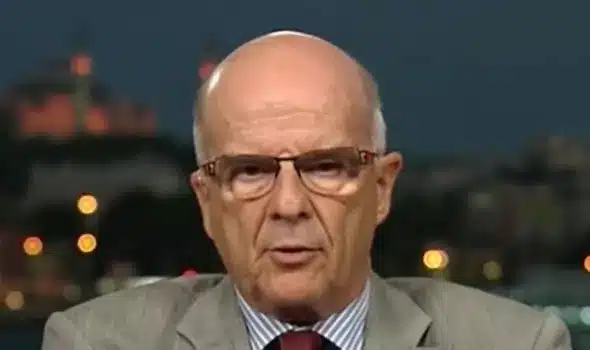
Leonidas Chrysanthopoulos
Interview by Kostas Proimos
Flattering introductions are unnecessary when a man’s character has long been tested in the “marble arenas” of international diplomacy and tempered in positions of high responsibility within vital state institutions, which by their very nature must safeguard the nation’s achievements and, in many cases, protect national security.
To confirm this, the distinguished Ambassador ad honorem Mr. Leonidas Chrysanthopoulos speaks frankly in the following interview about the key events that have “marked” Greece since the restoration of democracy up to today—while openly characterizing the current government as a criminal organization that for six and a half years has been plundering public funds uncontrollably and without moral restraints, at the expense of the majority of severely afflicted Greek citizens.
Kostas Proimos: Mr. Ambassador, you have experienced almost all the major political events of the post-dictatorship era, including through institutional roles. Which do you consider the ones that gradually “shaped” Greece’s course?
Leonidas Chrysanthopoulos:
In my opinion, there are four political events after the restoration of democracy that shaped the country’s course:
• Turkey’s invasion of Cyprus
• Our accession to the EEC
• The imposition of the memoranda on Greece in 2010
• The 2015 referendum, where “no” became “yes”.
a) Greece’s lack of substantial military response to Turkey’s invasion of Cyprus laid the groundwork for Ankara’s intransigence in UN-mediated bicommunal negotiations, culminating today in its insistence on a “Two Independent States” solution.
b) Our accession to the EEC was necessary at that time to stabilize democracy and counter Turkey. This is why Karamanlis prioritized the political aspects over economic ones. For that reason, the Kyriakidis-Varfis negotiating team resigned at the start of talks because they emphasized economic issues—and ultimately, they were proven right.
c) The Greek government’s failure to resist the first memorandum in 2010 marked the beginning of our economic disaster. The prime minister could have countered by demanding repayment of Germany’s wartime debt from occupation reparations, which Berlin refused and still refuses to pay. The debt was roughly €400 billion then and now exceeds €1 trillion. The Greek PM did not choose this option, and parliament adopted the memorandum without MPs even having read the text, as many later admitted, citing lack of time. The results were devastating. Austerity increased mortality: before 2009 annual deaths ranged between 60,000 and 70,000; now about 128,000. Austerity was imposed supposedly to reduce public debt, which was 128.9% of GDP then and now stands at 152.5%.
What makes the memoranda tragic is that EU officials later admitted their errors—and Greek governments did not react at all. Dijsselbloem stated in Ta Nea (27 Aug 2018):
“Mistakes were made by Europeans in managing the Greek crisis. In the beginning, they experimented and it took four years to establish crisis-management mechanisms… A different policy should have applied in Greece, because the programs were too strict and very difficult to implement.”
The Commissioner for Greece, Moscovici, wrote on his blog (20 Aug 2018):
“The IMF’s economic expertise was initially necessary, but some of its positions were very harsh and personal… The Eurogroup made final decisions without any democratic oversight… It was a democratic scandal.”
And yet, serious mistakes that cost lives must eventually be paid for. Thus, Greece entered a state of subjugation that persists today.
d) Then came the 5 July 2015 referendum, where the Greek people rejected the institutions’ agreement with 61.31%. The people spoke, but “no” became “yes.” We entered total submission.
► Which government do you consider the most successful to date—with proportional regard to conditions and social-political context?
Leonidas Chrysanthopoulos:
I consider the first two PASOK governments the most successful, especially in foreign policy—which I experienced closely. It was a period when Greece “soared” abroad due to Andreas Papandreou’s multi-dimensional diplomacy. We minimized US bases in Greece, renegotiated our EEC accession terms, and created the Integrated Mediterranean Programs benefiting mainly farmers. We took initiatives everywhere, such as the Mitterrand-Gaddafi meeting in Elounda, Palestinian initiatives with Papandreou-Arafat meetings, excellent relations with the Non-Aligned Movement and the Soviet Union, and the first steps—by the late Yiannos Kranidiotis—towards Cyprus joining the EU. The Greek fleet confronted the Turkish fleet during the 1987 crisis, forcing the Turks to back down. It was a time when Greece enjoyed international respect, and we were all proud of it.
► Do you agree with the Prime Minister’s narrative that Greece is on the right side of history? If not, will we be held accountable for our careless choices and national commitments soon?
Leonidas Chrysanthopoulos:
History has no sides; it is a straight line toward the future. If it did, our prime minister is on the wrong side—mainly regarding Ukraine. It is a grave mistake for a Greek PM to declare we are at war with Russia and to weaken our islands by sending armaments to be used against Russia. To align with other EU “fools” imposing sanctions that harm Europeans more than Russians. A wiser policy would resemble Turkey’s—maintaining good relations with all. Or at least not presenting Greece as more zealous than the major EU powers in fostering hostility toward Russia.
The PM should also take seriously the statements of the US ambassador in Ankara predicting a modern re-establishment of the Ottoman Empire and claiming the nation-states created in 1919 were failures. Generally, the prime minister must be held accountable for wrong decisions that cost us dearly as Greek citizens.
► Greek citizens are under attack from all directions. The State displays unprecedented cynicism, and democracy’s institutions are in deep crisis. Simply put—where is this heading, Mr. Chrysanthopoulos?
Leonidas Chrysanthopoulos:
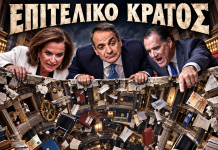
The State no longer exists. It has been replaced by a corrupt criminal organization that steals from Greeks through constant scandals. Justice has been abolished—supposedly independent judges take instructions from government, crimes are covered up, evidence disappears, witnesses die under strange circumstances, mainly car accidents, and let us not forget journalist Giorgos Karaivaz was murdered in April 2021 and the perpetrators are still at large. And, of course, the Tempi train disaster, where the cover-ups are limitless and politicians escape responsibility under Article 85 of the Constitution regarding ministerial accountability. So far, only the stationmaster is blamed for killing 57 people, mostly youth.
What we need is the immediate removal of this government before it causes further damage. If all opposition MPs resigned, the government would fall and elections would be called—but they do not dare. So, we wait for when the prime minister decides.
► Maria Karystianou—her “heart is in it,” to put it simply. Could the mother of Tempi lead a new political movement, given worsening geopolitical conditions?
Leonidas Chrysanthopoulos:
I have met and spoken with Maria Karystianou. She is a charismatic person—cultured, innately polite, sensitive, a fighter seeking to restore Justice and Democracy in Greece after what she witnessed in the Tempi disaster. She is supported by experts with whom she works to gain knowledge so that her citizens’ movement can speak responsibly. As journalist Manolis Kottakis wrote in Estia (4 December) titled “The original and the generic”:
“If Mrs. Karystianou creates a party, with the silent groundwork she has built all these years, she has very good chances of surpassing many—including the experienced Alexis.”
Whether she transforms her movement into a political party is up to her. But if she does, it will spark a revolution for restoring sovereignty, Justice and Democracy—values already in her founding declaration. A revolution that cannot come from politicians who brought Greece to this state. Given worsening geopolitical conditions, leadership requires intelligence, courage, competence, and integrity—and Maria Karystianou possesses these qualities.
► Do you believe the current government, with the accusations it faces daily, will complete its four-year term? Unions and collectives seem to be awakening—led by farmers…
Leonidas Chrysanthopoulos:
The only way the government can complete its term is if drastic changes occur within New Democracy—namely removing the prime minister and replacing him. Otherwise, with scandals continuously emerging, I doubt it can stay—especially with the awakening of social groups, as you note, led by farmers. Perhaps, facing this threat, the prime minister may call early elections to salvage what he can. So the hopeful movements should accelerate their preparation.
Mr. Leonidas Chrysanthopoulos served as Greece’s ambassador to Armenia, Poland, and Canada, as Secretary-General of BSEC (2006–12), and as Director-General for European Affairs at the Ministry of Foreign Affairs.
Due to his anti-memorandum stance, his honorary ambassador title was revoked by presidential decree in 2013, but reinstated in 2016.