


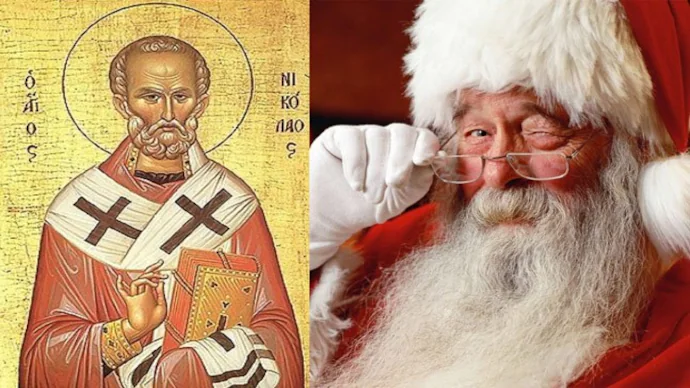

 Saint Nicholas died December 6, 343 A.D.

 In 988 A.D., Vladimir the Great of Russia converted to Eastern Orthodox Christianity and adopted Nicholas as the “patron saint” of Russia.There was concern that the grave of St. Nicholas would be desecrated, as years earlier, in 846 A.D., the thousand Muslim Saracens sailed up the Tiber River and sacked Rome, desecrating the remains of St. Peter and St. Paul.

In a panic, Christians in Myra, Asia Minor, shipped the remains of St. Nicholas in 1087 to the south east coast of Italy, to the town of Bari.

Pope Urban the Second dedicated the church, naming it after St. Nicholas — Basilica di San Nicola de Bari. 
Once St. Nicholas’ remains were in Italy, western Europeans quickly embraced the gift-giving traditions associated with him.

 In 1517, Martin Luther began the Reformation.

The German pronunciation of Christ Child was “Christkindl,” which over the centuries became pronounced “Kris Kringle.”

England had a different story. Henry the Eighth brought the Reformation, but not because he had a spiritual experience like Martin Luther, he just wanted another wife. He went on to have six wives.

If you remember the Christmas Carol by Charles Dickens, the Ghost of Christmas Present is depicted as a big guy with robes, a wreath on his head, and a goblet of wine.


 Puritan leader, Rev. Cotton Mather told his congregation on December 25, 1712:
Puritans considered theaters dens of iniquity so they forbade Shakespeare from mentioning God in his plays, considering it taking God’s name in vain or casting pearls before swine, so he began writing plays with mythological Greek gods and fates, such as A Midsummer Night’s Dream, 1595-1596.

Puritans took over England in 1642, and forced Shakespeare’s Globe Theater to close, and then, in 1644, pulled it down.

A year later, at the end of 1621, Pilgrim Governor William Bradford recorded in Of Plymouth Plantation, of another boatload arriving with more settlers:
So the Governor told them, if they made it a matter of conscience, he would spare them till they were better informed …”
Bradford continued:
In 1659, when the Puritans were settling Massachusetts, they instituted a five shilling fine for anyone caught celebrating Christmas:“Whosoever shall be found observing any such day as Christmas and the like, either by forbearing labor, feasting … every such person so shall pay for each offense five shillings as a fine to the country.”
Where Pilgrims, Puritans and most Presbyterians did not celebrate Christmas, other immigrants did celebrate Christmas, such as Germans, French, Swedes, English, Welsh, and especially the Dutch.

Jude 1:14: ” Behold, the Lord cometh with ten thousands of his saints to execute judgment.”

 The angels turning into elves.
Since there were few horses there, St. Nicholas rode a reindeer, which then became riding in a sleigh.

The Dutch holiday tradition is that St. Nicholas comes once a year to give presents to good children. But the naughty children had something else to look forward to.

Dutch called Saint Nicholas – “Sant Nikolaus” or “Sinter Klass,” which became pronounced “Santa Claus.”“Santa Claus” is simply the Dutch pronunciation of Saint Nicholas.
 In New York, Washington Irving, considered the Father of American Literature, wrote Legend of Sleepy Hallow and Rip Van Winkle.
He coined the name “Gotham” for New York City.”


Washington Irving wrote further:

Begun in 1628, it was the oldest corporate body in what is now the United States.


President Theodore Roosevelt attended there.
 In New York there was a Hebrew professor named Clement Moore who taught at the General Theological Seminary of the Protestant Episcopal Church in the Chelsea neighborhood on land donated by the Moore family.Clement Clarke Moore Park is located at the corner of 10th Avenue and 22nd Street. Moore helped Trinity Church establish a new church on Hudson Street – St. Luke in the Fields.
 In 1823, Clement Moore wrote a poem for his six children titled “A Visit From St. Nicholas”:


- he was a Christian;
- he loved Jesus enough go into the ministry;
- he chose being imprisoned by the Romans rather than deny his Christian faith;
- he stood for the doctrine of the Trinity;
- he preached against sexually immoral pagan temples and the killing of innocent babies;
- he confronted corrupt politicians; and
- most notably of all, St. Nicholas was very generous, giving away all his money to help the poor in their time of need, and doing it anonymously, as he wanted the credit to go, not to himself, but to God alone!
















A wonderful concise explanation of Saint Nicholas, the true Santa🎅Claus/St. Nick! A very powerful archetype imbedded in the world collective — where each of us at Christmas time🌲become a little santa.🎅🎁❄️
May It Be Blessed 🕊️
While this is a decent historical analysis of “how we got here”, the problem is that we should not and cannot legitimize neither the “broken telephone” amalgam of heretical traditions that were blended over time, nor what “Coca Cola” has achieved with an almost satiric cartoon-like (blasphemous) caricature that has nothing to do with the Orthodox bishop that it supposedly represents. And this not only includes the “image”, but also the “story” surrounding the caricature. There is nothing that reminds us of the true biography of St. Nicholas of Myra.
So in short, we are now dealing with a “stolen identity” issue that only breeds confusion, and which is even worse in the Greek-speaking world, because somehow in the last 100 years, a blasphemous “Coca Cola marketing attempt” took root, by applying St. Basil’s name to the image of the caricature in question. The reason this took place in the Greek-speaking world is simple. Who is still alive today who remembers how children would receive gifts on January 1st according to long-standing Greek tradition, St. Basil’s day, and not on Christmas Day? The “marketers” had to “adapt” the caricature to Greek reality, so they simply named him “Αγιος Βασιλης” leading millions of Greeks into a shameful blasphemy of sorts, every time they use the saints name in vain like that.
So in short, however useful this detailed summary is in explaining “how we got here”, the question for all Orthodox Christians should be, “how do we decouple ourselves and our children from this twisted tradition, so that we honor the actual St. Nicholas and St. Basil in a better way”? After all, St. Nicholas is celebrated on Dec. 6th, not Dec. 25th.
A wonderful compilation of the real Saint Nicholas, whom we love. However, let’s keep in mind, in Greece, Saint Vasilis (Agios Vasilis) is the figure who brings gifts, essentially the Greek Santa Claus, but he arrives on New Year’s Day (January 1st), not Christmas Day (December 25th). He’s based on the historical Saint Basil the Great, known for charity, and children sing carols for him on New Year’s Eve, expecting presents when they wake on New Year’s Day.
Christmas Day (Dec 25th) is less focused on gifts; New Year’s Day (Jan 1st) is when Agios Vasilis delivers presents. Saint Basil (Vasilis), a revered Greek Orthodox bishop and philanthropist. Greeks sing kalandas (carols) on Christmas Eve and New Year’s Eve and have the tradition of Vasilopita, a special cake with a coin hidden inside for good luck in the new year, linked to Saint Basil.
So, while the spirit of Santa is there, Saint Vasilis is the Greek’s gift-giver, and he comes with the New Year.
Saint Vasilis (Basil) was known for leaving gold coins in the stockings of the poor families who had trouble giving dowries for their daughters to marry well.
Saints Nicholas and Vasilis are equally beloved….. ❤️
A Blessed Christmas week &
may everyone find a coin in their Vasilopita cake this new year 2026!