

The arrival of HS Kimon in Greek waters marks a defining moment for the Hellenic Navy—not only as the induction of a cutting-edge surface combatant, but as a symbolic return to a tradition of maritime dominance rooted deep in modern Greek history.
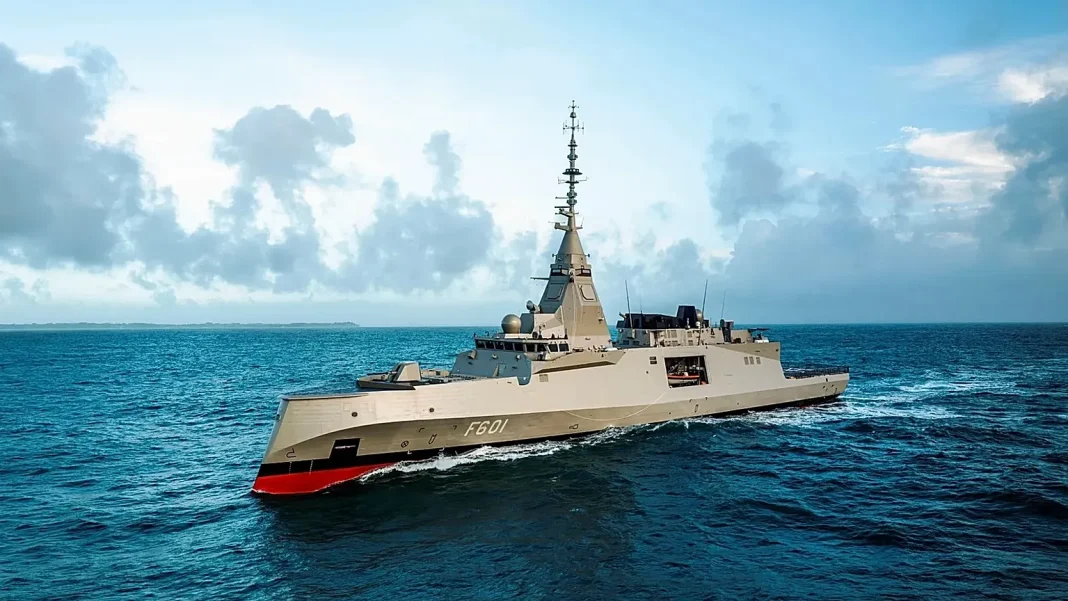
As Kimon enters the Saronic Gulf, her silhouette immediately commands attention. The most striking feature is her inverted (wave-piercing) bow—a thoroughly modern naval design choice that nevertheless evokes powerful historical memory. To Greek eyes, it recalls the aggressive forward lines of the armored cruiser Georgios Averof, whose speed, autonomy, and decisive maneuvering secured Greek naval supremacy during the Balkan Wars of 1912–1913. Then, as now, technology paired with bold doctrine altered the balance of power in the Aegean.
The Inverted Bow: Engineering and Memory
From a technical standpoint, the inverted bow reduces pitching, improves seakeeping, and allows the ship to maintain higher sustained speeds in rough seas—critical for sensor stability and missile employment. But symbolism matters in navies. Just as Averof famously broke formation and acted independently to defeat a numerically superior Ottoman fleet, Kimon embodies a philosophy of initiative, reach, and dominance, translated into 21st-century naval warfare.

PHOTO: The historic “Averoff” – now a museum at Faliron.
Technical Capabilities: A Quantum Leap
Built by Naval Group, Kimon is the first of the FDI HN (Frégate de Défense et d’Intervention – Hellenic Navy) class, representing a generational leap in combat capability:
Air Defense
Sea Fire AESA radar (fixed-panel, 360° coverage)
Aster-30 missiles, providing area air defense well beyond the fleet
Designed to counter aircraft, UAVs, and ballistic-like threats
Anti-Surface Warfare
Exocet MM40 Block 3C anti-ship missiles
Advanced combat management system enabling network-centric targeting
Anti-Submarine Warfare
Hull-mounted sonar and CAPTAS-4 compact towed sonar
Optimized for deep-water and littoral ASW—critical in the Eastern Mediterranean
Survivability & Stealth
Reduced radar cross-section
Advanced electronic warfare suite
Compartmentalized damage-control architecture
Aviation & Unmanned Systems
Flight deck and hangar for naval helicopters
Prepared for integration of UAVs and future unmanned maritime systems
In operational terms, Kimon is not merely a frigate—it is a fleet command node, capable of acting as an air-defense umbrella, ASW hunter, and strike platform simultaneously.
Continuity of Sea Power
The parallel with Averof is not nostalgic romanticism—it is strategic continuity. In 1912–13, Greek naval superiority ensured control of the Aegean and shaped the outcome of the war on land. In 2026, Kimon arrives at a time when air-sea integration, missile ranges, and information dominance define deterrence.
Then, Greece had one ship that changed everything.
Now, Kimon inaugurates a class designed to do the same—this time with sensors, data links, and missiles instead of coal and guns.
For the Hellenic Navy, the message is unmistakable: history is remembered—but it is also upgraded.
January 14, 2026, n.stamatakis@aol.com www.helleniscope.com
DISCLAIMER: The views and statements expressed in this article constitute constitutionally protected opinions of this author.















That’s impressive! The Kimon is the first frigate in a class of five. Greece gets four of them; France keeps the fifth one.
I like the analysis that compares the Kimon with the Averof. Admiral Kountouriotis famously trapped the superior Ottoman fleet in the Dardanelles Straits and, after the naval battle of Lemnos, in January 1913, ensured the Aegean Sea is forever under Greece’s control.
Turkey points at the map and argues Greece’s dominance of the entire Aegean is “unfair” and that it should take half of it. It ignores the fact that Turkey’s entire Aegean coast was resided by Greeks for millennia, until their genocide and eviction in the 20th Century. The border should have been farther east, not at the coastline.
Turkey and Greece submitted the issue of sovereignty over the Aegean Islands to binding arbitration by the Great Powers in 1913. The arbitrators gave it all to Greece, and Turkey got stuck with that decision. It immediately vowed to take them by force but it’s navy was too weak to do so.
Turkey then ordered two super-battleships (“dreadnoughts”) from British naval yards, and Greece raced to purchase two smaller used frigates from the U.S. Navy — the U.S.S. Idaho and Mississippi. The day Greece received these frigates (renamed H.S. Lemons and Kilkis), Turkey’s officers were at hand in Britain to receive their dreadnoughts. But they ran out of time… The Great War had literally just started and the British Lord of the Admiralty, Winston Churchill, confiscated the dreadnoughts, the night before delivery.
The balance of power in the Aegean thus favored Greece in World War I, and Greece’s sovereignty over the Aegean Islands has remained intact ever since!
Greece’s naval doctrine at the time called for frigates, which are rather small battleships. They are more flexible and easier to maneuver than larger ships. They proved to be a better fit for the Aegean, a good match against bigger ships.
What I love about the Kimon class of frigates is that they have state-of-the-art technology. The surface-to-air missile systems and the unmanned air systems (sophisticated drones) that are controlled by these ships is straight out of a fiction movie!
Turkey has a superior military; it always did. These ships, however, will go a long way toward facing that threat. The H.S. Averof, Kilkis and Lemnos made Greece proud in the 1910s and a whole century thereafter! The H.S. Kimon, which has arrived, and the Nearchos, Formeon and Themestocles which are in the line of production, are already deterring the Turks and should make each of us extremely proud! May they always be safe and serve their sacred mission in peace!