




by +Chrissie Apollonia Nicolles
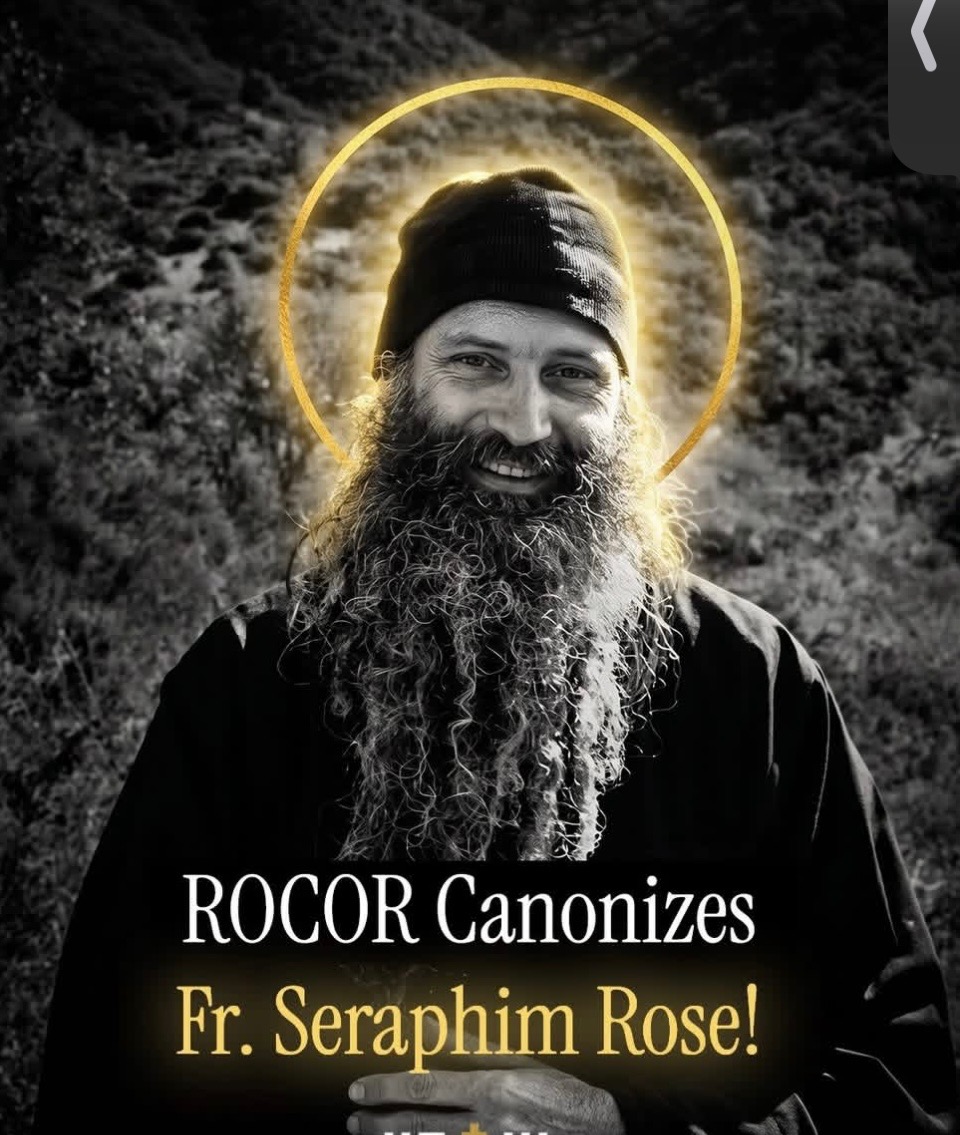
Newsflash: ROCOR is canonizing Fr. Seraphim Rose of the USA!
He is the first American-born saint of the Russian Orthodox Church.
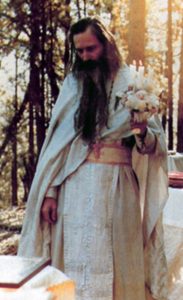
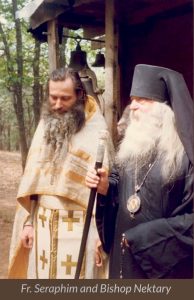
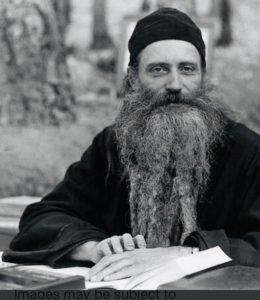
The well-known Hieromonk Seraphim Rose of ROCOR (born Eugene Dennis Rose) was an American priest and hieromonk; he co-founded Saint Herman of Alaska Monastery in California, translated many Eastern Orthodox Christian texts, and authored several books, most notably Orthodoxy and the Religion of the Future. His writings have spread like wildfire in the West, including in Russia. My late spiritual father, Hilarion, had a special fondness for him, but rather opposed his “toll house teaching,” which I heard sometimes led Fr. Rose into some contentious conflict among the Orthodox…

Nonetheless, many Eastern Orthodox Christians look up to him big time today; he’s already venerated in iconography, which is why he’s a legend! My “spiritual brother,” Fr. David Hovik from the Northwest, a former Protestant minister, is a big fan, always bringing him up and texting me his pithy YouTube videos, which have influenced millions around the world.
Father Rose was raised Methodist but later rejected Christianity, studying Oriental philosophies under British American Alan Watts, who popularized Zen Buddhism, Taoism, and Hinduism to the West in the 1950s…but eventually he dismissed Watts as a “pseudo” teacher who only offered a shallow, bohemian version of spirituality —instead of the mystical depth of Orthodoxy – where he found refuge. (The infamous Alan Watts later died an unhappy drunk)…

As well, he studied Hinduism’s Vedanta under some famous, monastic Hindu gurus, as did I …before finding it lacking a personal God, and we ultimately discovered Orthodoxy. He brought many of us born and baptized Orthodox back from our fascination with Indian guru trips, like me. So did Mother Gabrilia of Greece while living in India. He argued that many Westerners got led astray, that the only way to personal enlightenment was found in Theosis — the cross of Jesus Christ.
In fact, Fr. Rose utilized his intellectual, discerning knowledge of these figures to critique Western spiritual seekers to renounce them in his popular books, especially the one called:
“Orthodoxy and the Religion of the Future”… he referred to these Eastern paths as lacking in solid, theological foundation … + called them out as “spiritual deceptions that lured people away from the personal God of Christianity. They reject a Savior outside of themselves — they are all delusions outside of Jesus Christ.”

I’m happy to learn that Hieromonk Rose considered ‘St. John of San Francisco + Shanghai, his spiritual father, thought him to be a living saint. I read St. John’s biography long ago and was left mesmerized by his countless miracles in life and after death! In the 1960’s, Fr. Rose became a spiritual son of Archbishop John Maximovitch, who authorized him to write sermons in English for his cathedral bulletin, with a focus on the lives of the saints.
During the unfair slander of Archbishop John and the lawsuits he faced in San Francisco, Seraphim Rose defended his elder; his innocence was proven. Later, he wrote on the earliest accounts of St. John’s healings/miracles, and translated and published the ‘Orthodox Word’. Unlike others, he recognized his mystic elder, John, was actually a “Fool for Christ”.
Hieromonk Seraphim lived in the wilderness of Northern California, in a remote primitive cabin with no electricity on a mountainside (like his favorite St. Seraphim of Zarov), but not in Russia, in Northern California, near St. Herman monastery, where he died and is buried on the spot of his last talk in 1982. Curiously, he never traveled much except to visit Jordanville, NY, and never visited Greece’s holy Mount Athos – but monks at Vatopedi Monastery considered him a “new Chrysostom” due to his theological writings. In fact, many Athonite monks + Greek pilgrims venerated him, and there’s plenty of artwork depicting his image.


The British writer/poet and Orthodox convert Paul Kingsnorth has written about Seraphim Rose’s influence on him…he views him as a “patron saint” for lost Americans — and says only America could’ve made him. Especially for environmental freaks + tech-obsessed souls, relating his own journey from radical atheism to Orthodoxy. He’s now married + baptized in the Romanian Orthodox Church, living in Ireland.
Both men underwent an intensive spiritual quest before finding their metanoia in Eastern Orthodoxy; he points to Fr. Rose’s critique of modern nihilism and materialism, which remains more relevant today than when he died in 1982. In his essay in The Free Press, Kingsnorth describes Fr. Rose as a radical monastic figure who felt the “ache” of the modern world but found the “other world” through Christ.
Important to note, the original “Eugene Rose” before his spiritual monastic sojourn was homosexual – describing that period as “deep personal Hell” + advocated complete abstinence + repentance; but he “renounced even himself” according to his sister Alison. Truly, he was an example of Metanoia – a prodigal son – like St. Mary of Egypt, he transformed into a ‘new man in Christ’.
He was firm against the justification of sexual deviancy that today’s modern world normalizes, including the liberal clergy in mainline Christian churches – even some in Orthodoxy.
In his journal 1961, he wrote:
“Christ is the only exit from this world; all
other exits – sexual rapture, political utopia,
financial freedom, are but blind alleys where
corpses rot of the many who tried them.”
Towards the end of his life, he spoke in prophetic terms, warning “Apocalypse is now,” emphasizing the urgency of spiritual life in a collapsing, de-Christianized world. He warned of intense dark times ahead and urged spiritual preparation through Orthodox tradition rather than secular/worldly security. Look for signs of the end… such as globalism, moral decay, the disappearance of authentic spiritual leaders, and the coming of the AntiChrist. A must-read is his book Nihilism: The Root Of The Revolution of Modern Age.
My favorite books of Saint Seraphim Rose are The Northern Thebaid, Monastic Saints of the Russian North — also
Blessed John the Wonderworker + The Philokalia.
May his memory be eternal now that he’s counted among the saints. AXIOS!
















https://orthodox-europe.org/content/seraphim-rose-interview/
“So, the Council didn’t canonise Fr Seraphim, but it did discuss his canonisation, yes?
“Indeed, at length. And more than this: it affirmed and shared with the faithful, through our Epistle, that we are continuing the process of working towards his glorification, and doing so not as a vague wish or amorphous hope. We acknowledge that his glorification is, if I may use a popular phrase, ‘on the horizon’ of our ecclesial life, and we are actively working towards it.“
I am confused by the ROCOR synod’s statements since this news came to light. The waters are muddy over a matter that should be clear.
Obviously the glorification service has not taken place yet, but obviously at some point there must be a decision to proceed with a glorification service.
For example, with St. Olga of Kwethluk, the OCA Holy Synod proclaimed her sainthood in November 2023, and the actual glorification occurred in June 2025.
So, what is the ROCOR synod actually saying? Is this announcement analogous to the November 2023 announcement by the OCA, or is it something else? If this is big news, why are they putting on the dampers? If this is not big news but a procedural step, why mention it at all?
I want to see Fr. Seraphim glorified, but this process is quite confusing compared to how other recent canonizations have gone down. (Besides, God makes saints – if he is a saint, nothing we do/don’t do on earth will change that.)
I don’t think the process is confusing at all. But yes, it is a process, meaning it will take a year or two. The way he lived his life after he became orthodox will be scrutinized and studied in great detail, and he has to meet certain criteria to be declared a saint. There are saints that wrote things that were off at some point but then later the truth was revealed to them and they corrected themselves. Saints are not perfect, they make mistakes. But they purify their lives as best as they can and go through great lengths to achieve this. God is at the center of their lives.
Declaring saints can’t be rushed. It is a process that takes time and meticulous work. This is all good and the right thing to do. The relics will probably be examined as well. May Fr. Seraphim soon be declared worthy of being called Saint Saraphim of Platina. The book about his life was an inspiration to me and I feel a connection to him. He strengthened my faith and I do believe he is a saint, but the Church has to follow its own rules. I strongly believe it will happen but in due time. The Church doesn’t rush with declaring saints and it should not. No reason to rush.
Sandy, I understand all that. What’s confusing is the inconsistent statements of ROCOR’s synod and bishops. Where are they in the process?
I’m not champing at the bit for Fr. Seraphim to be canonized, I’m just asking them to speak clearly if they choose to speak publicly about the matter. Because it seems like things have been walked back since the original statement.
Wow. Glory be to God!
Glory to God!
That’s quite an article there Chrissie and God bless you.
The distinguished ones of any church are the visionaries who glimpse what is invisible to the eye; they occupy a rarified atmosphere and whether it’s
Seraphim Rose of Orthodoxy or St. Padre Pio of Catholicism, they’re an inspiration. The Crème de la crème.
I remember there were serious allegations that Padre Pio had bought acid from a Pharmacist to imitate the wounds of Christ on his hands. The Pharmacist, with fear of God, and many others made many things public that brought this man’s reputation into question. Yet the catholics decided it to make him a saint anyway. So it is not the same thing at all, the OC always takes its time so it doesn’t make a mistake by canonizing someone that is not a saint. We also examine relics, which to the best of my knowledge, the catholics do not. Why is it that no orthodox saints have had the stigmata? The catholics are embracing dozens of heresies, the OC does not recognize any of their “saints” after the schism and we must be cautious in thinking padre Pio is a saint. The vatican might want saints to “prove” they are the real church, but the way they declare saints is very dubious.
Sandy: I don’t know where you got that slanderous lie from?? Catholic haters?
But I read pilots from WWll were up in the sky about to bomb the hometown of St. Padre Pio & they saw him flying there waving his arms not to bomb! They could not forget his face! Later those military pilots back on land told the story & signed their names swearing to it.
It’s not a slanderous lie. Do your homework and also ask yourself why no orthodox saints have the stigmata…
Indeed. All stigmatists are post schism prelest.
This is a very readable article, but the headline is misleading. It seems clear that ROCOR intends to canonize Fr. Seraphim, but they just need a little more time to complete the process.
Herein lies my confusion. What are they working to complete?
It seems too pedantic to say “he’s not a saint because the liturgical service has not been written and the glorification service has not been performed.” Yes, obviously. But St. Olga was declared a saint by the Synod before the “actual” glorification service.
I can’t tell if ROCOR is being that pedantic, or if they are actually still weighing the matter of Fr. Seraphim’s sanctity, with no decision yet made. In the latter case, why say anything at all?
It is always like that. It is a period of “investigation”. During this period everything is sliced and diced and Fr. Seraphim’s life, especially late life, will come under a microscope. Why? To make sure he did not do anything improper, which would prevent him from becoming a saint. There is a saint that is recently canonized that in his early life wrote about incarnation. Obviously he was wrong. But his views changed in his later years and he has still been canonized because he repented and his views changed. This is not the only example. All this needs to be investigated. The Church has the last say about someone’s canonization, and she can’t be wrong. This is the time for everyone to come together and bring up any miracles or help they received from Fr. Seraphim as well. If no one would know he was proposed for canonization, most people would not come forth with testimony.
Seraphim Rose was a true ascetic yet was never a fanatic.
He said* It is better to be a little bit ‘wrong’ and have a warm heart, than to be ‘right’ and have a cold heart.
Despite not official Father Rose is still Axios!
While visiting Mount Athos, some monks had mentioned this American Hieromonk Seraphim & already revere him as a saint.
Nice. I like “They reject a Savior outside themselves — they are all delusions outside Jesus Christ.”
But what I didn’t like was your insulting Alan Watts>
(“The infamous Alan Watts died an unhappy drunk”)
Yes another informative, insightful, intelligent article by Chrissie “Apples”… not only filled with historic detail, but, told with the passion of a religious insider. Thank you for a fabulous article.
AXIOS!!!
People in our Parish were rejoicing over this news. Most people thought it was only a matter of time before the Church confirmed what many people already believed. God is wondrous in His Saints.
I am so glad he is finally canonized! He is an inspiration to a lot of American converts in the Church and his many works, such as “Orthodoxy and the Religion of the Future” and “God’s revelation to the human heart”, which are my favorite. During my pilgrimage to Athos a couple of months ago, I spoke to many monks, who had brought up Saint Seraphim, whom all recognized his sainthood.
Newsflash: Fr. Theodore Zissi who’s against ecumenism + the vax, spoke out in defense of Fr. Seraphim Rose; he went with Greek pilgrims to the mountains of Northern California + was impressed by his austere Skete in the forest that brings to mind the strict monasticism of Egypt + Palestine. When they went to venerate the wooden tomb of Hieromonk Seraphim, it smelled of holy fragrance/holy myrrh.
Fr. Zissi called him a great example of metanoia, extraordinary theologian + apologist for Orthodoxy. Saying he prays more seekers of truth read his spiritual writings.
Well done Apples! I am very fond of Father Theodore Zissis’ work and I respect his insight. I have always considered Fr Seraphim’s life analogous to Saint Augustine who also had much less than pristine beginnings but the church saw him as a beacon of great repentance! I am convinced that had Fr Seraphim chosen to work out his repentance at Mount Athos he would have reached even greater heights; but only our Lord can be the judge of that. Nevertheless, his contribution to the anglophone Orthodoxy is monumental and may the hierarchy be illumined to proceed accordingly.
Thanks for the article Chrissie! Some of Fr Seraphim’s writings, especially the introduction of Russia’s Catacomb Saints, had a big impact on me but I hadn’t been reading him recently. Your article inspired me to start reading “The Soul After Death” and it is FASCINATING!
I forgot to include in article that Fr. Hopko, former dean of SVS, visited monastery in California + said of Hieromonk Seraphim:
🌹📿
“If ever a human being lived on this earth who sought God
with his whole heart + whatever errors or sins he may have had, it was Monk Seraphim Rose.”
Apples,
Another beautiful article! Great job.
I have several favorite saints. Saint Kateri Tekakwitha (1656–1680) is the first Native American saint canonized and known as the “Lily of the Mohawks”.
Another man whom I dearly love is Nicholas Black Elk, the Vatican began looking into his life and several miracles associated with him back in 2018.
I love reading your articles Apples.
More details here:
https://spzh.eu/en/news/92956-rocor-bishop-gives-details-on-glorification-of-fr-seraphim-rose
This is an incredibly well written and researched article. The author is very easy to understand and detailed throughout. I have read her work previously and each time I read an article I learn something new.
Well done again dear Apples, but to be precise, America has had a number of Orthodox saints even in the lower forty-eight. Outside of the three Alaskan saints (Saint Herman, Saint Peter and Saint Olga), Saint Sebastian Dabovich (Serbian-American) was the first American-born priest to be canonized. What makes the imminent “enlistment” (canonization is more of a Latin term) so monumental is the fact that Eugene Rose was full of the American heretical, pluralistic and secular DNA, a DNA that was not open to Orthodoxy according to some older Orthodox priests who would never imagine today’s convert phenomenon. This is immense because it clearly shows that God does not show favoratism but reaches out to all those laden souls who seek Him out in Spirit and Truth. When traditional Orthodoxy is practiced it produces fruits. Glory be to God because the tree of Orthodoxy is finally taking root in the United States of America! In the last 35 years we witnessed the blossoming of monastecism on this spiritual arid American soil and ninety percent of the two hundred plus monastics of the Elder Ephraims monasteries are American-born; Naturally, Father Seraphim will have a lot of American company on the walls of our American Churches in the years to come! Doxa to Theo!
Constantine Zalalas
Theologian
The article states that Father Seraphim Rose was homosexual. This is the first time I’ve read something like this. And I’ve read about his life, his writings—pretty much everything he wrote. From his personality and his mindset, it does NOT appear that he was homosexual.
What evidence do you have that he was homosexual? Please, give me even the slightest bibliographic reference.