
THIS EXCEPTIONAL VIDEO IS POSTED HERE IN ENGLISH AND GREEK TRANSCRIPTION AND FOLLOWED BY OUR ANALYSIS. WE CERTAINLY ANTICIPATE – AND INVITE – YOUR REACTIONS…
By Nick Stamatakis
Says Fr. Georgios Metallinos in this extraordinary teachable moment in the video below:
Paradise and hell are God Himself. I am speaking, of course, as an Orthodox Christian at this moment. One may deny everything, but I, too, have the right to express: “I look for the resurrection of the dead and the life of the age to come.”
Christ will appear at the end of history in the uncreated light of the Godhead. To put it in “scientific” language, He will manifest the energy of the divine essence. This energy is expressed by the term light, although it has nothing to do with physical light: uncreated light, beyond everything natural.
Every human being beholds this divine energy. Western philosophy can go so far as to speak of the absence of God. In our tradition, there is no absence, only the presence of God. The presence of God is therefore expressed as the manifestation of this uncreated light, this divine energy.
Depending on the state of the human person — whether one lives in inner purification, has overcome the passions and human weaknesses, has been cultivated, and whose heart has become “good soil” according to the parable — such a person sees God as supreme beauty and radiance, as joyful light, all-gladdening light.
But the one who preserves the passions within himself — the untransformed, spiritually unformed person — sees God as a consuming fire.
This is depicted in our monasteries, in icons in the narthexes, at the entrance: there is a river. In the upper part, the river is golden, and there is Christ with all the saints. They are participants in the uncreated light of the Godhead. From the middle downward, the river becomes a river of fire. It takes on a blood-red color, and there are the damned.
This symbolizes that Christ Himself, as we said, is Paradise, and He Himself is also hell. Hell depends on the condition of the human person, not on God’s disposition to punish anyone.
Question: These extraordinarily compelling things — why are they not told to the faithful?
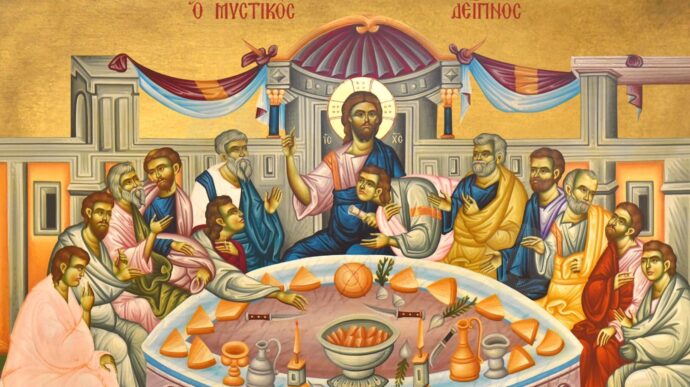
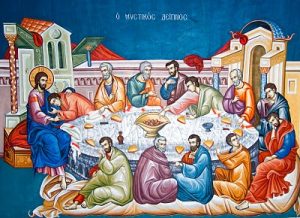
Answer: Here I agree with you. There is a beautiful scene, a remarkable icon, above the holy altar, if I remember correctly, at the Holy Monastery of Philotheou on Mount Athos. You have Christ’s disciples in the familiar depiction of Holy Communion, where they receive from Christ His Body and Blood. Last is Judas, who turns his face away and spits out Holy Communion.
What does this mean? That even if Judas received Communion, Christ did not remain within him. And the difference, I would say, is that what we said about Paradise and Hell also applies to Holy Communion.
Question: So Holy Communion does not always “work”?
Answer: Holy Communion is a foretaste of Paradise and Hell. Very rightly said: it does not always “work.” Depending on the inner state of the person, Holy Communion is either Paradise or Hell.
============
THE ORIGINAL GREEK TEXT IS HERE
Παράδεισος και κόλαση είναι ο ίδιος ο Θεός. Μιλώ βέβαια ως Ορθόδοξος αυτή τη στιγμή. Μπορεί κανείς να τα αρνηθεί όλα αλλά εχω κι εγώ το δικαίωμα να εκφράσω το “προσδοκώ Ανάστασιν νεκρών και ζωήν του μέλλοντιος αιώνος”. Ο Χριστός θα εμφανιστεί στο τέλος της ιστορίας μέσα στο άκτιστο φώς της Θεότητος. Για να το πώ με λόγους επιστημονικούς εκπέμποντας την ενέργεια της θείας ουσίας.
Η ενέργεια αυτή εκφράζεται με τον όρο φώς μολονότι δεν έχει καμία σχέση με το φυσικό φώς. Ακτιστο φώς. Είναι υπεράνω από κάθε τι το φυσικό. Η ενέργεια αυτή θεάται από κάθε άνθρωπο. Η δυτική φιλοσοφία φτάνει να μιλεί για αποθσία θεού. Στη δική μας παράδοση δεν υπάρχει απουσία αλλά μόνο παρουσία θεού. Η παρουσία του Θεού λοιπόν εκφράζεται ως εκπομπή αυτού του ακτίστου φωτός, της ενεργείας.
Ανάλογα με την κατάσταση του ανθρώπου αν δηλαδή ζει μέσα σε κάθαρση εσωτερική, έχει ξεπεράσει τα πάθη, έχει ξεπεράσει τις αδυναμίες τις ανθρώπινες, έχει καλλιεργηθεί, έχει γίνει γη αγαθή κατά την παραβολή η καρδιάα του, βλέπει το Θεό ως υπέρκαλον αγλαϊα, ως φως ευφροσύνης, πανευφρόσυνιον φως. Εκείνος όμως ο οποίος διατηρεί μέσα του τα πάθη του, δηλαδή είναι ο αμετασχημάτιστος αστοιχείωτος άνθρωπος, βλέπει τον Θεόν ως πυρ καταναλίσκον. Αυτό εικονίζεται στα μοναστήρια μας με μια εικόνα στους ναρθηκες των μοναστηρίων στην είσοδο δηλαδή που έχουμε ένα ποτάμι. Στο πάνω μέρος το ποτάμι αυτό είναι χρυσίζον και εκεί είναι ο Χριστός με όλους τους Αγίους. Είναι οι μέτοχοι του ακτίστου φωτός της θεότητος. Από τη μέση και κάτω το ποτάμι γίνεται ποταμός του πυρός. Παίρνει έναα αιματώδες χρώμα και εκεί είναι οι κολασμένοι. Αυτό εκφράζει ένα συμβολισμός ότι ο ίδιος ο Χριστός όπως είπαμε είναι παράδεισος, ο ίδιος είναι και κόλασις. Η κόλασις εξαρτάται από την κατάσταση του ανθρώπου και όχι από την διάθεση του Θεού να τον τιμωρήσει κανένα.
Ερώτηση: Αυτά τα εξόχως γοητευτικά πράγματα γιατί δεν τα λένε στους πιστούς; Απάντηση: Εδώ συμφωνώ μαζί σας. Εχουμε μια ωραία σκηνή, μια αγιογραφία καταπληκτική, πάνω από την αγία τράπεζα αν θυμάμαι καλά στην Ιερά Μονή Φιλοθέου, στο Αφιο Ορος. Εχεις τους μαθητές του Χριστού στην γνωστή παράσταση της Θείας Μεταλήψεως, όπου κοινωνούν από τον Χριστό το σώμα και το αίμα του. Εχει τελευταίο τον Ιούδα ο οποίος γυρίζει το πρόσωπο και φτύνει την θεία κοινωνία. Τι θέλει να δείξει αυτό; Οτι κι αν ακόμα ο Ιούδας εκοινώνησε, δεν έμεινε μέσα του ο Χριστός. Με τη διαφορά όμως όπως θα έλεγα ότι ότι είπαμε για τον Παράδεισο και την Κόλαση ισχύει και στη θεία κοινωνία.
Ερωτηση: Αρα δεν πιάνει πάντα η Θεία κοινωνία.
Απάντηση: Πρόγευσις Παραδείσου και Κολάσεως είναι η θεία κονωνία. Πολύ σωστά το λέτε. Δεν πιάνει πάντα. Ανάλογα με την εσωτερική κατάσταση του ανθρώπου ή είναι παράδεισος η Θεία Κοινωνία ή είναι Κόλασις
============
Analysis
This is a strongly Orthodox account of heaven and hell, rooted especially in the theology of participation in God’s uncreated energies. The central claim is not that God creates two different “places,” one pleasant and one punitive. Rather, the same divine presence is experienced differently according to the spiritual condition of the person.
The key theological distinction behind the text is the Orthodox distinction between God’s essence and God’s energies, classically articulated by St Gregory Palamas. God’s essence remains inaccessible, but His energies — His real divine life, grace, light, presence — are truly participated in. So when the speaker says Christ appears in the “uncreated light,” this evokes the Transfiguration on Mount Tabor: the light seen by Peter, James, and John is not created light but the glory of divinity.
The text also echoes Hebrews 12:29: “Our God is a consuming fire.” In Orthodox interpretation, this fire is not simply external punishment. It is God’s holiness itself. To the purified, it is illumination and joy; to the unpurified, it burns. The same sun softens wax and hardens clay — a common patristic-style analogy.
This has close links with St Isaac the Syrian, who famously resists the idea that God’s punishment is vindictive. For him, the torment of hell is bound up with encountering divine love while being unable or unwilling to receive it rightly. Hell is not God ceasing to love; it is love experienced as unbearable by a heart turned against it.
The imagery of the river of fire also has deep iconographic roots, especially in Orthodox depictions of the Last Judgment. A stream proceeds from Christ: for the righteous it is light, glory, and communion; for the hardened it is fire. This visual theology makes exactly the point of the passage: one Christ, one divine presence, two modes of reception.
The section on Holy Communion is especially important. It draws on 1 Corinthians 11:27–30, where St Paul warns that receiving the Body and Blood “unworthily” can bring judgment rather than healing. In Orthodox theology, the Eucharist is never neutral. It is always truly Christ. But whether it becomes life, healing, and deification, or judgment and condemnation, depends on repentance, preparation, humility, and the condition of the heart.
So the text’s core Orthodox idea is:
Paradise is communion with God received as light.
Hell is communion with God experienced as fire by an unhealed heart.
The difference is not in God, but in us.
The Deepest Theological Point
The ultimate point of this theology is not fear.
It is anthropology.
Orthodoxy rejects simplistic notions that:
- God externally rewards some,
- and externally punishes others.
Instead:
- God gives Himself fully.
- The issue is whether the human person has become capable of receiving Him.
Paradise and hell are therefore not fundamentally spatial categories.
They are existential responses to divine presence.
The Eucharist reveals this reality already now.
Holy Communion becomes:
- light or fire,
- healing or judgment,
- paradise or hell,
according to the condition of the heart.
The icon of Judas ultimately turns toward the viewer.
The question is not merely:
“What happened to Judas?”
But: “How do you receive the fire of God?”
===================
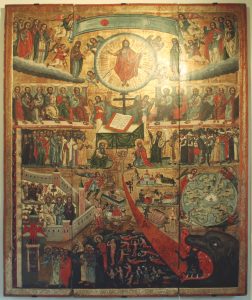
ICON ABOVE: An Orthodox Iconography of the Last Judgment (For an explanation of this complex icon, please link here)
The Narthex and the Spiritual Journey
Last Judgment scenes are traditionally placed in the narthex of Orthodox churches and monasteries.
This placement matters.
The narthex is the threshold between:
- world and sanctuary,
- repentance and communion,
- fallen existence and the Kingdom.
Historically:
- penitents stood there,
- catechumens remained there.
The architecture itself becomes theological.
The believer moves:
- from judgment,
- through repentance,
- toward Eucharistic communion.
Thus, the entire church building mirrors salvation.