


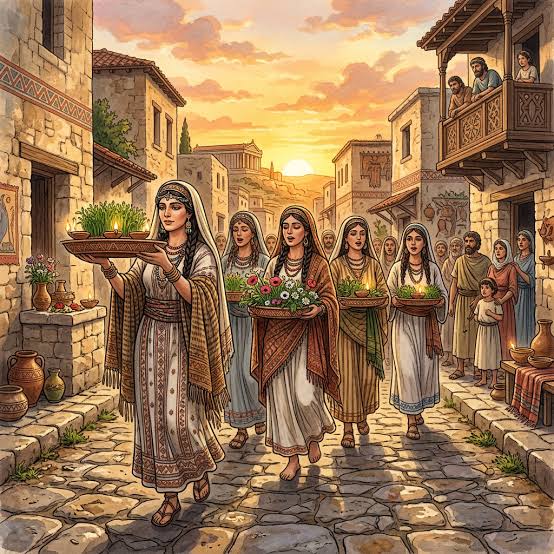
EDITOR’S NOTE (Nick Stamatakis). The resemblance between the ancient Greek rites of Adonis and the Orthodox Christian service of the Epitaphios is one of the most striking examples of ritual continuity in the religious history of the eastern Mediterranean. Although separated by more than a millennium and distinguished by profoundly different theological meanings, both ceremonies center on the public mourning of a beautiful young man who has suffered a violent death. In each, the body is ceremonially displayed, adorned with flowers, lamented through poetic hymns, and accompanied in solemn procession by a grieving community. The emotional tone, ritual choreography, and central role of funeral lament create a visual and experiential similarity that has long attracted the attention of historians, classicists, and liturgical scholars.
These parallels have given rise to an enduring scholarly debate over whether the Byzantine Epitaphios preserves elements of the ancient Adonia or both rites reflect a broader, older tradition of eastern Mediterranean funeral lament. While few modern scholars argue for a simple borrowing of pagan ritual into Christian worship, many recognize that Christianity emerged within a cultural world already shaped by centuries of ceremonial mourning traditions. Rather than suggesting direct imitation, the evidence points toward the transformation of familiar ritual forms—processional lament, floral bier, communal grief, and the expectation of renewed life—into a distinctly Christian proclamation of Christ’s death and resurrection. It is this remarkable convergence of ritual expression, rather than theology, that makes the comparison between the Adonia and the Epitaphios both compelling and worthy of careful historical investigation.
The most compelling modern synthesis isn’t that the Epitaphios is simply a Christianized Adonia. Rather, it is that both belong to a long-lived eastern Mediterranean tradition of ritual lament stretching from Mesopotamian mourning for Tammuz, through the Greek Adonia, into Byzantine Holy Week. Christianity preserved the ritual form while profoundly changing its theological meaning—from mourning the cyclical death of a beautiful youth to commemorating the once-for-all death and resurrection of Christ. This view aligns best with the work of scholars such as Margaret Alexiou (“The Ritual Lament In Greek Tradition”) and Walter Burkert, while avoiding the overgeneralizations of Frazer
========















The fancy “kouvouklion” that is used in most parishes is a more modern practice…they didn’t have that in Byzantium.
The “epitaphios” is the cloth that has the embroidered image of the Body of Christ that we are all familiar with.
Back in the day, and currently on Mt. Athos, it’s just a procession with the the epitaphios cloth, WITHOUT the Kouvouklion.
However, the concept of funeral processions, and flowers is definitely ancient.
In terms of “cultural momentum” from the distant past, today, several villages in Greece still have a very custom to visit graves on Holy Friday…it’s pretty interesting to observe…literally the majority of marble grave-top stones are cleaned up, weeds pulled, etc…In some villages, the evening procession in the streets intentionally takes the “kouvouklion + epitaphios” by the graveyard…
While it’s probably not accurate to identify the ancient “Adonia” practices as a direct ancestor of the current day Epitaphios procession, it’s more likely that human cultures, both ancient and modern share some commonalities on how they handle the respect for their deceased “loved ones”… We must say “respect for loved ones”, because there are millenia of historical evidence that in times of war, conquest, and plundering marauders, NOT ALL deceased were treated with respect, but rather in very barbaric ways, probably because they qualified more as “hated one” vs. “loved ones”… Even the Romans enjoyed watching hungry wild animals mutilate and devour bodies in the arenas…not much “respect”, or as desire for any procession in those cases for sure…
I always found the most likely origin story of the Epitaphios procession was from a practice of displaying the church’s Antimension for veneration on Holy Friday, when there is no Liturgy and therefore the Antimension is not needed. It became more elaborate over time, and the actual Antimension was replaced by a more ornate, purpose-made fabric icon.
However both can be true. Once the connection was made between the icon and the funeral procession, I’m sure cultural practices would have naturally flowed into it, giving us the rich rite we have today.
It’s interesting to think of a time in the church when Liturgy was so malleable and could develop and change in light of the culture. (It is best for our times that this isn’t the case.)