

ΕΑΝ ΠΡΟΤΙΜΑΤΕ ΕΛΛΗΝΙΚΑ ΠΑΤΗΣΤΕ ΤΗ ΣΗΜΑΙΑ ΣΤΟ ΚΑΤΩ ΜΕΡΟΣ ΤΗΣ ΟΘΟΝΗΣ
Why his latest live broadcast is less a campaign and more a blueprint for a post-uniparty American political movement. As speculation grows about a third party, Carlson’s latest speech offers a philosophical framework rather than a traditional political platform.
By Helleniscope’s Editorial Team
Tucker Carlson may have done more than criticize Donald Trump this week. He may have outlined the philosophical foundation for what comes after the Republican-Democratic duopoly.
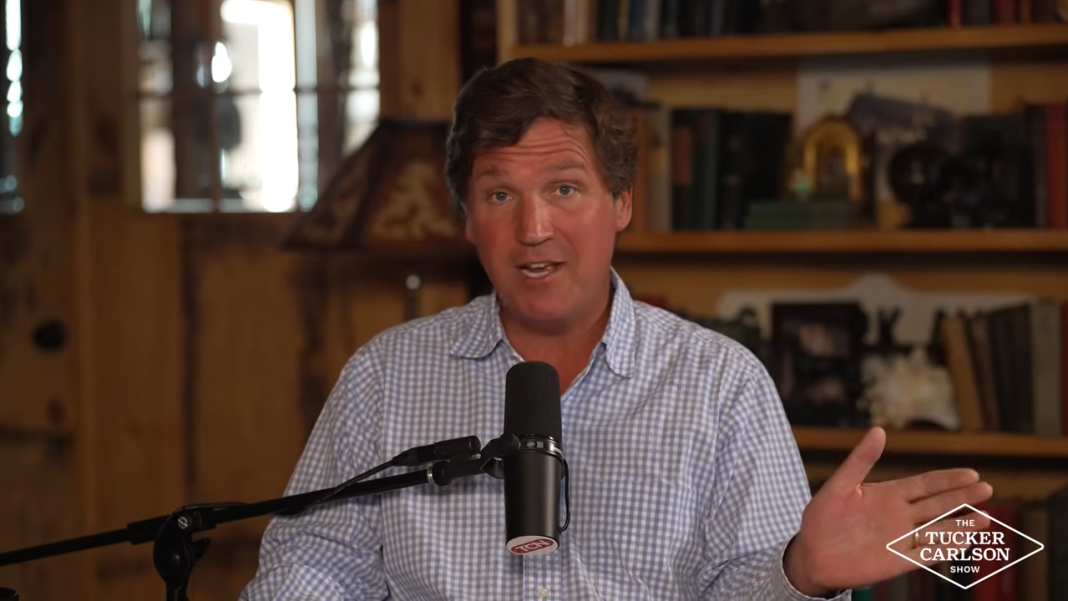
Following months of criticism over the Trump administration’s Iran policy, Carlson released an hour-long address arguing that America’s governing system has reached the end of its useful life. Rather than announcing a presidential campaign or launching a third party, he presented what he believes should be the principles of national renewal.
You can watch it here:
The timing is notable. Axios recently reported that Carlson has discussed a potential third-party movement with allies including Reps. Marjorie Taylor Greene and Thomas Massie. Whether or not that effort materializes, the speech reads less like a campaign launch than a constitutional preamble for a new political movement.
Carlson’s central argument is that America’s institutions no longer serve its citizens. Instead, he contends, both major parties have converged around foreign policy, fiscal policy, surveillance, and the interests of entrenched elites, leaving many Americans politically homeless. Rising debt, geopolitical instability, and artificial intelligence, he argues, expose a governing class unable to respond to historic challenges.
From that diagnosis emerges a vision that differs sharply from the traditional Republican platform.
Carlson’s Ten Principles
1. Equal Justice
No republic can endure if elites operate under different rules than everyone else. Carlson argues that equal justice—not equal outcomes—is the foundation of public trust.
2. Sovereignty
Sovereignty applies to both nations and individuals. America should be free from undue foreign or corporate influence, while citizens should not become dependent on debt or centralized control.
3. A Productive Economy
Carlson argues that national strength comes from producing tangible value—manufacturing, agriculture, engineering, and craftsmanship—not financial speculation or debt-fueled consumption.
4. Beauty
Clean cities, attractive architecture, and stewardship of America’s natural landscape are, in Carlson’s view, essential ingredients of civic confidence rather than aesthetic luxuries.
5. Health
Healthy food, physical fitness, sobriety, and mental clarity should once again become national priorities instead of dependence on unhealthy lifestyles or pharmaceuticals.
6. Truth
Political reform begins with honest speech. Carlson repeatedly argues that institutions cannot recover until uncomfortable realities can be openly acknowledged.
7. Strong Families
Economic and social policy should strengthen families, encourage children, and rebuild stable communities rather than simply maximize economic output.
8. Education
Schools should teach history, practical skills, independent thinking, and civic responsibility rather than ideological conformity.
9. Human Dignity
Government, technology, finance, and bureaucracy should exist to serve people—not the other way around.
10. National Renewal
Carlson concludes that America cannot be repaired through legislation alone. Durable political change follows cultural and moral renewal.
More Than a Platform
Whether one agrees with Carlson’s analysis or not, the speech represents an evolution in American populism.
Earlier populist movements focused on immigration, trade, and opposition to elites. Carlson instead attempts to articulate a governing philosophy built around fairness, sovereignty, productivity, beauty, health, truth, family, education, and civic responsibility.
Whether these principles become the basis of a third party, reshape the Republican coalition, or simply influence conservative thought remains uncertain.
What seems increasingly clear is that Carlson is positioning himself less as a television commentator than as an architect of a possible post-uniparty political movement.
AS OF 11 AM TODAY, SATURDAY, AUGUST 7, THE COMMENTS ARE RE-ACTIVATED
August 6, 2026, www.helleniscope.com
DISCLAIMER: The views and statements expressed in this article constitute constitutionally protected opinions of this author.