


EDITOR’S NOTE (Nick Stamatakis). For those of us who have known Astoria for decades, it is not difficult to understand how a neighborhood that once harbored the dreams of generations of Greek, Italian, Jewish and other immigrants could become, with the rise of Alexandria Ocasio-Cortez and Zohran Mamdani, an epicenter of the Democratic Socialists of America – as the Washington Post article (below) explains.
The explanation can be summarized provocatively: the erosion of the American Dream.
For generations, that dream was the glue of the American “melting pot.” Immigrants arrived with different languages, religions, and traditions but shared a common aspiration: work hard, raise a family, buy a home, educate your children, and leave them better off than you were.
That bargain is increasingly difficult for young Americans to believe in.
Capitalism has generated extraordinary prosperity, but its great danger has always been the concentration of wealth and economic power. When housing becomes increasingly an investment asset rather than a place where families build their lives, ordinary working people find themselves competing against those with vastly greater access to capital.
When banking conglomerates like BlackRock, State Street, and Vanguard, entities which “create money,” are allowed to compete with any of us, borrowers at 7% or so, in purchasing individual family homes, then the American Dream is dead. Congress failed to pass a law recently that would not allow such an atrocious act as the above…
And when homeownership moves beyond the reach of an entire generation, something much larger than a housing crisis begins.
Over the past two decades, Astoria has increasingly become a neighborhood of younger renters who see homeownership receding into the distance. Housing, education, health care and child care consume ever greater portions of their incomes, while traditional milestones—owning a home, raising children and accumulating wealth—seem increasingly reserved for those with high incomes or family money.
Under those circumstances, socialism does not arrive primarily through political theory. It arrives through disappointment.
That does not mean democratic socialism offers the right solutions. Many of its prescriptions risk weakening the economic dynamism necessary to restore opportunity. But simply dismissing its young supporters misses the more important question: Why has its message become so attractive?
Astoria offers an answer. The immigrants who built this neighborhood endured hardship because they believed there was a path upward. They worked long hours, opened small businesses, bought modest homes, raised families and expected their children to advance further still. Their faith was not necessarily in capitalism as an ideology. Their faith was in opportunity.
Once that faith disappears, the political consequences are inevitable.
If America wants younger generations to believe again in free enterprise and the American Dream, defending capitalism rhetorically is not enough. We must restore what made people believe in it: affordable housing, attainable homeownership, upward mobility, the ability to raise a family, and the expectation that hard work can still produce a better life.
The answer to the rise of socialism is not merely to condemn socialism. It is to make the American Dream believable again.
AS OF 11 AM SATURDAY, AUGUST 7, OUR COMMENTS ARE RE-ACTIVATED.
August 6, 2026, www.helleniscope.com
DISCLAIMER: The views and statements expressed in this article constitute constitutionally protected opinions of this author.
TO SUPPORT HELLENISCOPE OR BECOME A SUBSCRIBER, LINK HERE!!
=========================
Democratic socialists dominate this neighborhood. Not everyone is on board.
The divisions in Astoria, Queens, foreshadow the tensions that can emerge as more progressive candidates win elections across the country.

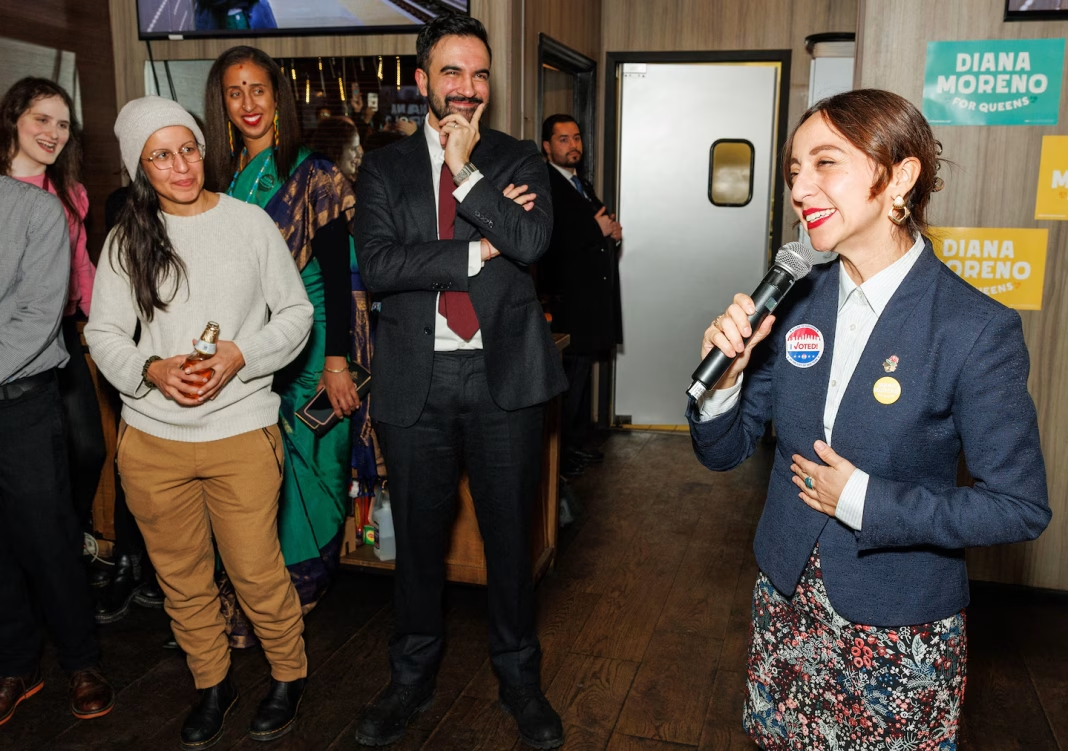
New York City Councilmember Tiffany Cabán and Mayor Zohran Mamdani listen as Democratic and Working Families Party candidate Diana Moreno speaks on election night in February. (Jason Alpert-Wisnia/AFP/Getty Images)
“Now, it feels fantastic to live here,” Barakos, 82, said in interview as she scanned the more than 100 stickers on the side of her house. “The democratic socialists are the best thing that can happen to this country. Republicans are a disaster.”

Tucked in northwestern Queens along the East River, Astoria is the most high-profile example of democratic socialist politicians amassing power and pushing a culture that could foreshadow Democrats’ future.
The nearly 200,000 people who live here are represented by democratic socialists in the city council, state assembly, state senate, mayor’s office and Congress. The neighborhood was home to Zohran Mamdani, one of the nation’s most prominent democratic socialist leaders, before his election as New York’s mayor.
Not everyone in Astoria shares the neighborhood’s increasingly liberal views though. A sizable bloc of residents are on guard as candidates aligned with the Democratic Socialists of America move into more positions of leadership.
The situation now provides a window into life in a neighborhood now commonly referred to as the “People’s Republic of Astoria.” It also previews the policies being prioritized — including refined approaches to affordability, homelessness and transportation — as more democratic socialists rack up victories across the country.
“Is there an Astoria everywhere? Not necessarily,” said Michael Lange, a New York political strategist who has closely tracked the rise of the democratic socialist movement. “But there are neighborhoods like Astoria in every large city in the country, and the future of the Democratic coalition is very urban.”

The changes have largely been driven by young, White liberals and new waves of immigrants who have turned the area into one of New York’s most diverse neighborhoods. The groups have united in their discontent over soaring housing, health care and child care costs as well as their shared opposition to immigration raids and concern for the plight of Palestinians in the Middle East. They now form a backbone of the local Democratic Party, elevating socialist candidates while sidelining the moderates who had held power here for generations.
Meanwhile, President Donald Trump won about quarter of the vote here in 2024 — a far more robust outcome for the GOP ticket than neighborhoods in many other blue cities.
The divisions here foreshadow the tensions that can emerge as more democratic socialists win elections by pledging to raise taxes on the rich to broaden social services for the poor. It’s a balance Democratic leaders will be watching closely as the DSA looks to play a role in the 2028 presidential contest.
“These voters are often highly organized, vocal transplants,” said John Ketcham, chairman of the Astoria Homeowners, Tenants and Business Civic Association. “They do not necessarily reflect most Astorians’ views, especially residents who have lived in the area for decades.”
‘Progressive politics will stay’
Astoria has been a haven for immigrants since it was incorporated in the 1830s, with large Dutch, Irish and Italian communities populating the area over several decades. A large number of Greek families followed in the 20th century.
The 1970s sitcom “All in the Family,” which explored the cultural gripes of older White Americans in the post-civil rights era, was set in Astoria. The area has rapidly diversified over the past two decades due to an influx of immigrants from the Middle East, Africa, South Asia, and South and Central America.
It’s now home to more than 100 ethnic groups and nearly 40 percent of residents are foreign born.
City council member Tiffany Cabán, a democratic socialist who was elected in 2021 to represent Astoria, described the neighborhood as a “beautiful, multicultural hyper locality.” She and other local political leaders said the neighborhood will remain a stronghold for progressive politics.
“We definitely see Astoria as a place where we can show that democratic socialists can govern to make people’s lives better,” said state Rep. Diana Moreno, a democratic socialist who represents parts of Astoria, adding: “This is a place where progressive politics will stay.”
Multiculturalism is reflected throughout the neighborhood, which spans about 200 blocks.
Mid-rise apartment buildings are wedged alongside three-story brick rowhouses on tree-lined streets packed with bakeries, coffee shops, and fruit and vegetable stands. Latin fusion restaurants that host drag shows stand alongside legacy Irish pubs. The neighborhood includes two of New York’s largest outdoor beer gardens but is also its also home to a large Muslim population that tends to avoid alcohol.

Richard Khuzami, the director of the Old Astoria Neighborhood Association and a member of the local community board, said the neighborhood began to change dramatically in the 2010s as younger White residents began moving in. The new residents, Khuzami said, began “voting in much higher” numbers and felt traditional Democratic leaders no longer represented their values.
The area’s first political surprise occurred in 2018 when Rep. Alexandria Ocasio-Cortez unseated a 10-term incumbent in that year’s Democratic primary.
Two years later, Mamdani, who was 29 at the time, defeated a five-term incumbent in the Democratic primary for state assembly. Mamdani in 2025 then pulled off a victory that made him New York’s first Muslim mayor.
Eric Thor, who lives in Astoria and once led the DSA’s New York chapter, said the movement has cultivated a stable network of residents who now consider themselves “DSA voters.” He said those voters are drawn to candidates with bold stances “who want to swing big” to address high child and health care costs.
During his first six months in office, Mamdani has delivered on campaign promises to freeze rent and make public transportation more affordable for low-income residents. He and the city council also recently agreed to set aside $750,000 in taxpayer funds to help low-income New Yorkers purchase pet food.
Mamdani is the only democratic socialist representing Astoria who holds executive office. The others are limited in what they can accomplish on their own. Still, Moreno and other Astoria politicians say their influence in the state capital and city hall continues to expand.
This summer, DSA candidates have unseated three congressional incumbents in races in New York, Colorado and Michigan. They also prevailed in the Democratic primary for mayor of Washington, D.C., and key New York state legislative races in other parts of Queens, Brooklyn, Syracuse and Buffalo.
Moreno said she and her DSA allies here remain committed to raising taxes on the rich and enacting affordable housing pilots where tenants control apartment buildings. Even if those proposals take time, Cabán said democratic socialist leaders are changing how Astoria is governed.
Bike lanes, for example, are being quickly built despite some neighborhood opposition. And when leaders faced intense public pressure to have police remove a disruptive homeless couple who had set up an encampment near a popular gym, Astoria’s leaders worked to find a shelter that could house them together, she said.
“It’s really easy to call the cops,” Cabán said, adding that instead, she and her colleagues “try to have conversations to see how we can get to the root of the problem.”
‘What are socialists?’
Not everyone here is convinced that the politicians representing Astoria are prioritizing problems that matter most to them.
At the Ravenswood public housing complex here, several residents said while they’re willing to give Mamdani and other democratic socialists a chance, they still don’t understand how they will benefit from their policies.
Debra Simmons, 68, noted she has water damage throughout her apartment and the city hasn’t fixed it.
“What are socialists?” asked Simmons, who is Black and described herself as a “Democrat to the heart.” She said she’s uncertain about the movement’s goals.
A few blocks away, an Italian musician was holding a free concert in Athens Square, a local park surrounded by ice cream and smoothie shops. As he swayed to the music and hugged passing police officers, Joseph DiPietro said he moved to Astoria 65 years ago and now has qualms about how it’s being governed.

DiPietro, the executive director the Federation of Italian American Organizations of Queens, said he used to feel that Democratic politicians represented everyone. Now, it sometimes feels like leaders want to govern little cliques” rather than their entire constituencies, he said.
“Some people want everything free,” DiPietro, a retired doorman, said of the democratic socialist philosophy. “Nothing is free. Tax the rich? Yes, tax the rich — but if the rich leave New York, where are you going to get the money? …. Don’t spit in the dish where you eat.”
Commercial vacancies on Steinway Street, once Queens’ premiere shopping destination, are also rattling business leaders. Several told The Washington Post that rising utility costs and high property taxes, which drive up rent, are forcing retailers out of business.
“Business owners feel squeezed,” said Ketcham, adding they “complain that public leaders have lost the pragmatic emphasis on public safety, competitive taxation, and quality of life that Astoria’s past representatives typified.”
Ketcham, a longtime Astoria resident, is also director of cities at the Manhattan Institute, a conservative think tank that has been critical of socialist policies.
Paul Halvatzis, who grew up in Astoria and owns Amorelli Realty, said the health of the neighborhood’s real estate market is now uneven.
Although single family homes in Astoria have doubled in value over the past 25 years to more than $1 million, Halvatzis said the owners of older apartment buildings are struggling amid Mamdani’s rent freeze. Six-unit buildings that previously sold for about $2 million are now being listed for $700,000 less, Halvatzis said.
“And frankly, there is not a lot of demand for them at that price,” he added.
Yet, other Astoria business owners brush aside concerns that democratic socialists are to blame for economic challenges.
On Astoria’s Broadway street, Fares “Freddy” Zeideia owns the King of Falafel and Shawarma, a well-known Palestinian restaurant located on a block that has a Colombian restaurant, an Irish bar, and a decades-old Italian bakery.

Upset about U.S. and Israeli policy in the Middle East, Zeideia has adorned his restaurant with signs decrying Trump and Israeli Prime Minister Benjamin Netanyahu. Zeideia has also created a “walk of shame” that forces customers to stand on photographs of conservative American and Israeli leaders as they order their gyros.
“The socialists are doing for Astoria what other politicians are not doing,” said Zeideia, who applauded the movement’s strong alignment with the Palestinian cause. “They are saying ‘enough is enough’ and thankfully this new generation is waking up.”
Zeideia said he was so thrilled by democratic socialists’ recent victories, he added red signs on his door labeling the restaurant “DSA headquarters.”
That’s the sort of symbol that invigorates Barakos, the homeowner with the bumper stickers stuck to her house.
Barakos, who is Puerto Rican and had been married to a Greek man, recalled times when her Black friends refused to visit Astoria because they feared racist harassment. “We are changing, changing for the better,” she said.
DiPietro just hopes Astoria’s socialist politicians don’t cause irreversible damage. “But no politician has ever done so much damage that it can’t be fixed,” he said.
“Maybe they are right,” he added of democratic socialists, “and some of us are wrong.”
















I shall always have fond memories of old Astoria circa 1975. I was there every week visiting my Greek in-laws and feasting on the best of the best real Greek food. Many good memories.
I’m in Michigan. I voted for Trump 3 times, and last week I voted for Abdul El-Sayed. This was not a Limbaugh-esque “operation chaos” move; I will vote for him in November as well.
I don’t particularly support Abdul’s program; this is a way that I can punish Trump for his adventures in Gaza and Iran, which are America Last policies. For those things, and the economy, he has lost me. As support for Israel becomes an important litmus test in our politics — God willing, in its final throes as Boomers and their Israel support slip the surly bonds of earth — it is important to vote accordingly.
I will be voting for Republicans on the state ballot because our Dem trifecta in Michigan is insane, but for Democrats on the federal ballot to send a message. Trump cannot count on my support. At least Abdul has populist policies he will probably try to follow up on; Trump has fooled me thrice, and shame on me.
What will you do if a third party is formed in the conservative/libertarian space by Tucker Carlson or anyone else?