

ΕΑΝ ΠΡΟΤΙΜΑΤΕ ΕΛΛΗΝΙΚΑ ΠΑΤΗΣΤΕ ΤΗ ΣΗΜΑΙΑ ΣΤΟ ΚΑΤΩ ΜΕΡΟΣ ΤΗΣ ΟΘΟΝΗΣ
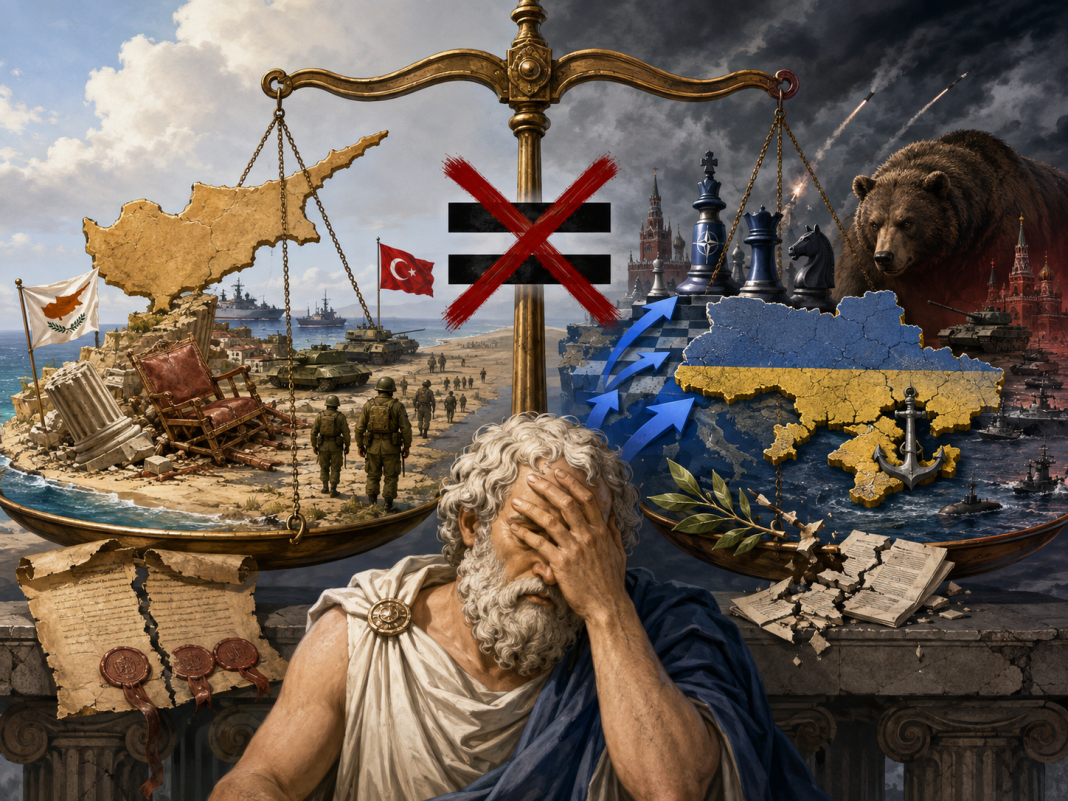
Cyprus does not become stronger by arguing that every invasion is historically equivalent. It becomes stronger when its own history, treaties and international legal record are allowed to speak for themselves.…
By Nick Stamatakis
The comparison between Turkey’s 1974 invasion of Cyprus and Russia’s invasion of Ukraine is superficially attractive to Greek and Cypriot diplomacy. In both cases, a larger neighboring state used military force against an internationally recognized sovereign state and occupied territory.
But the analogy becomes misleading when pushed too far. Cyprus does not need Ukraine in order to establish the illegality of the continuing Turkish occupation. By presenting the two cases as essentially identical, Greece risks obscuring the very historical, legal and geopolitical circumstances that make Cyprus distinctive.
On top of all else, Greek and Cypriot diplomacy are shooting themselves in the foot: While Turkey has been “mediating” incessantly between Russia and Ukraine (as she is selling arms to Ukraine while buying cheap oil and gas from Russia along with maintaining extensive economic ties), Mitsotakis proves himself to be the FIRST Greek Prime Minister since 1945 to “declare war on Russia” – the most important geopolitical adversary Turkey has had in its history. Recent developments make this point even clearer.
The stronger position is simple: one can condemn violations of Ukrainian sovereignty while recognizing that the road to war in Ukraine was fundamentally different from the circumstances that produced the Cyprus problem.
1. Cyprus arose from a different legal and constitutional framework
The events of 1974 cannot be separated from the constitutional order established when Cyprus became independent in 1960. Greece, Turkey and Britain became guarantor powers under the Treaty of Guarantee.
Nor can the Turkish intervention be separated from the coup against President Makarios on 15 July 1974, organized with the involvement of the Greek military dictatorship and aimed at Enosis.
This does not legitimize what followed. Whatever argument Turkey could make concerning its initial intervention under the Treaty of Guarantee, the subsequent occupation, territorial division and establishment of a separate entity in northern Cyprus went far beyond restoration of the 1960 constitutional order. The United Nations repeatedly defended Cyprus’s sovereignty and territorial integrity and later declared the attempted secession in the north legally invalid.
Ukraine had no equivalent treaty relationship with Russia. On the contrary, post-Soviet Russia had formally recognized Ukraine’s sovereignty and existing borders.
The legal and historical foundations of the two cases are therefore very different.
2. Ukraine cannot be understood outside the post-Cold War security order
The geopolitical background matters even more.
During German reunification negotiations in 1990, Western officials gave Soviet leaders political assurances concerning NATO’s eastward military reach. James Baker’s famous reference to NATO moving “not one inch eastward” formed part of a broader discussion over the European security settlement.
It would be inaccurate to claim that this amounted to a binding treaty permanently prohibiting NATO enlargement. But it is equally misleading to pretend that no assurances were given or that Moscow’s subsequent sense of strategic encirclement appeared from nowhere.
The stronger argument is that Western governments pursued NATO enlargement in a way Russia increasingly saw as contradicting the political understandings surrounding the end of the Cold War.
Ukraine eventually became the central issue. Henry Kissinger argued in 2014 that Ukraine should remain outside NATO and function as a bridge between Russia and Europe rather than an outpost of either side.
Whether one agrees with that prescription or not, it reflected a basic principle of realist geopolitics: great powers are especially sensitive to military alignments directly on their borders.
Recognizing that fact does not justify invasion. It explains why the conflict cannot be understood simply as an unprovoked territorial adventure without a geopolitical prehistory.
3. Crimea was strategically exceptional
Crimea further distinguishes the Ukrainian case.
It was transferred from the Russian Soviet Republic to the Ukrainian Soviet Republic in 1954, when both were parts of the same Soviet state. After the USSR collapsed, Crimea became part of independent Ukraine.
Its strategic importance to Russia nevertheless remained extraordinary because Sevastopol was the historic base of the Russian Black Sea Fleet. Russia therefore negotiated agreements with Ukraine permitting continued naval use of Sevastopol.
This does not provide legal justification for annexation. Indeed, Russia’s need to negotiate basing rights confirmed Ukrainian sovereignty.
But from a great-power strategy perspective, Moscow could never have treated Crimea as ordinary territory. Western policymakers who ignored that reality underestimated the intensity of Russian security concerns.
Again, strategic explanation is not the same thing as legal justification.
4. Minsk and the failure of diplomacy matter
The diplomatic history after 2014 also distinguishes Ukraine from Cyprus.
The Minsk agreements were intended to create a ceasefire and political settlement in the Donbas. Their implementation failed amid profound disagreement over security, local autonomy, elections and control of the border.
Angela Merkel later stated that Minsk had given Ukraine time to become stronger. Her comments reinforced Moscow’s belief that Western governments had treated the agreement partly as a way to buy time. French President Francois Hollande offered a similar admission. It is therefore reasonable to conclude that the Minsk process failed because of the West’s responsibility and that subsequent Western statements deepened Russian suspicions about the sincerity of the diplomatic framework.
The Istanbul negotiations of spring 2022 deserve similar caution.
Russia and Ukraine discussed neutrality, security guarantees and territorial questions in serious negotiations. A peace treaty had already been initially “mongraphed” and was merely awaiting President Zelensky’s signature when Boris Johnson visited Kyiv. Mr. Johnson made sure Zelensky would never sign.
Important questions remained unresolved.
The Istanbul talks demonstrate that diplomatic alternatives existed and that Russian, Ukrainian and Western calculations all influenced their collapse. Reducing the war’s history to a simple confrontation between aggression and resistance leaves out this important dimension.
5. Minority and religious questions should not be ignored
Ukraine’s policies toward Russian speakers and religious institutions have also generated legitimate criticism.
International bodies have raised concerns regarding aspects of Ukrainian language legislation and the treatment of minority-language rights. More recent disputes involving the Ukrainian Orthodox Church have likewise produced human-rights concerns.
These issues may not justify invasion, but is there anyone who – knowing the heavy and unjustified human rights violations by the Ukro-nazi Zelensky regime – who would not see, at least minimally, Russia’s attempt to protect its own nationals through a positive lens? After all, if Zelensky himself, whose own native tongue is Russian, comes to ban the use of the Russian language not only in the public sector and in education but also in grocery stores (!) one has to wonder what kind of interests hide behind him…
In this framework, should I remind everyone that the key actor in the Ukraine 2014 coup was led by Victoria Nuland, whose family roots trace back to a Ukrainian Jewish family, while her arch-neocon husband, Robert Kagan, is also from a Lithuanian Jewish family? (Note: this arch-neocon, Kagan, has recently admitted Ukraine’s defeat..)
6. Why the analogy may harm Greek interests
For Greece and Cyprus, equating the two conflicts is a substantial strategic problem.
First, Cyprus already possesses an exceptionally strong case under international law. It rests on UN resolutions, the internationally recognised sovereignty of the Republic of Cyprus, non-recognition of the northern entity and decades of European jurisprudence. Cyprus does not need the Ukrainian analogy.
Second, Greece should distinguish support for Ukrainian sovereignty from permanent geopolitical hostility toward Russia.
Greek Prime Minister Kyriakos Mitsotakis stated “We are waging war against Russia” (frequently paraphrased as “We are at war with Russia”) during an interview with Bloomberg on September 22, 2022. The Mitsotakis government did not literally “declare war” on Russia, but it aligned Greece very closely with the Western response to the invasion, including sanctions and military assistance to Ukraine – which, by the way, softened the defense of the Greek Islands.
Turkey followed a different approach. Ankara condemned Russia’s invasion and supported Ukraine’s territorial integrity, but maintained relations with Moscow, avoided full participation in Western sanctions, hosted negotiations and played a mediating role. All this while Turkey bought cheap Russian oil and gas and maintained extensive economic relations with Russia in every sector.
Whatever one thinks of Turkish policy, it demonstrated strategic flexibility.
Greece should draw the appropriate lesson: a middle-sized state in a difficult geopolitical environment benefits from preserving diplomatic options.
Nor is it necessary to describe Russia as Greece’s “eternal friend” or Turkey as Russia’s “eternal enemy.” States do not have eternal friendships; they have enduring interests. Russia and Turkey have fought repeatedly throughout history, but they also cooperate whenever their interests overlap.
That is precisely why Greece should avoid unnecessarily narrowing its own strategic room for maneuver. We should not, however, downplay the friendship between the two countries. Nor should we ignore the excellent cooperation of Greek shipowners with Russia over the last 4-5 years. The shipowners are not puppets of any “puppetmaster” in London and DC – they historically express the genuine interests of Hellenism. They should be given a permanent advisory board within the Greek Foreign Ministry…
Conclusion
The strongest Greek position is not that Russia was justified in invading Ukraine.
It is that Cyprus and Ukraine emerged from fundamentally different legal, historical and geopolitical circumstances and should not be mechanically equated.
Cyprus arose from the collapse of a specific constitutional system, a Greek-backed coup, a treaty framework involving three guarantor powers and a Turkish intervention that developed into permanent occupation and partition.
Ukraine arose from the unresolved post-Cold War European security order, NATO enlargement, Ukraine’s strategic position between Russia and the West, the exceptional importance of Crimea and Sevastopol, the breakdown of Minsk, and the broader failure of diplomacy.
None of these factors eliminates Ukrainian sovereignty. But international politics cannot be understood solely through legal categories while ignoring great-power security interests.
For Greece and Cyprus, the wiser strategy is therefore to defend the Cyprus case on its own exceptionally strong legal foundations while avoiding analogies that unnecessarily tie Hellenic interests to one interpretation of a very different war.
Cyprus does not become stronger by arguing that every invasion is historically equivalent. It becomes stronger when its own history, treaties and international legal record are allowed to speak for themselves.
August 15, 2026, www.helleniscope.com n.stamatakis@aol.com
DISCLAIMER: The views and statements expressed in this article constitute constitutionally protected opinions of this author.












Helleniscope ,thank you for the analysis and the history lesson on the topic of divergence on Cyprus vs Ukraine Analogy.
What is missing is the discrepancy ,the hypocrisy, that has upset the balance of power in the Mediterranean Sea by the Invasion of Turkey on July 20th 1974 on a defenseless non- aligned of 1/2 a million-people- 81% Greek Orthodox Christians who represent a branch of the Hellenic Civilization.
Review the facts of the case: It was critical time , the Vietnam War was ending to formulate peace in Paris . Kissinger the Nobel Prize Winner was the US Envoy. Hypocritically , making accolades, while turning his back on the Cypriot Invasion along as you state. Offsetting and obscuring his duties / FM -Callahan for Great Britain, a nation with British Bases in Cyprus who failed to Guarantee The
provisions of The 1960 Treaty of Cypriot Independence? I had just taken a long day US Foreign
Service Test at the University of Washington at the time . A turbulent time for the USA as Pres.
Nixon was against the ropes from the Watergate Scandal. He resigned within few weeks in early August of 1974 and the Greek Government was is transition from the 7 year- episode due to the regime of
the Papadopoulos Dictatorship. The set up was to take out-(Archbishop Makarios )as Kissinger declared
“that he was a threat to American Democracy”-that he “was the Castro of the Mediterranean World”?? Bunch of BS!
Now please keep in mind, as to what happened -next-so the people reading my comments may respond if need be? The point is that USA/NATO is a primarily and almost 90% a by- product of Christian
and Western Civilization. Meaning , that on Oct 28th and on March 25th-at the White House in DC admires and everyone honors Hellenic Institutions -not only of the role of 1st DEFENSE in WWII against Mussolini that my father fought, but at least W Churchill proclaimed it as a Hellenic/Heroic Accomplishment -So What? Does it matter today? Question ?? GB’S Foreign Minister Callahan – he forgot the sacrifice by the Hellenes, who fought during WWII- for European Freedom ! Where was Turkey?? who now threatens the 12-mile UNCLOS?? Clueless, Kissinger who worked in our nation’s
Hellenic Inspired Columned Federal Buildings without noticing what the USA Founding Fathers Indoctrination of “The Hellenization of America” from Athens Georgia to Olympia WA my state of Washington.
My point is that Europe/NATO USA is immersed and baptized from Hellenic Institutions not from
Ukrainian nor Turkish implementation – Ukraine and Turkey ARE NOT ON THE RADAR IN AMERICA’S HISTORY!!
As Loyal Hellenes, we are all offended by NATO/USA who are a by- product of the Hellenic Civilization . It is anathema and blasphemous to
violate and distort historical facts that jeopardizes Hellenic Sovereignty ?? Why support Ukraine and Turkey and turn a blind eye to
Greek 12 Mile Limit in the Aegean Sea?? Why invade Cyprus with US Arms and bomb the Christian Orthodox Serbs under the Clinton Administration under Sec Albright! The Picture is obscene for the Hellenic People. This Picture stinks to the core -to Attack Christian Orthodoxy -by Islamist Turks- by USA Arms- to violate the Hellenic World on all levels? Greece- Cyprus- Serbs- Russia, they are all Orthodox Christians who are pivotal-crucial to Western Civilization to Europe and to America!
No one in the US State Dept. recognizes nor cares? that in Kolonaki, Athens the American School of Classical Studies is funded by 200 US Universities and Colleges form the USA as the worlds finest Academic Institution- to advance Western Civilization from our- the Hellenic “TOPOS” since 1881? Kissinger’s
debacle in 1974- pissed off all the American Phil-Hellenic -US Professors- in Athens and Corinth! Now I will close – Question? Will Zelenesky or Erdogan carry the Olympic Flame from Olympia Peloponnese Greece as tribute to honor 10,000 athletes form 200 nations, to contribute their talents in the name of the Olympic Truce on the International Stage in Los Angeles CA in 2028! ??
You stole my thunder! You’re right on almost every count!
The coastal regions of the Crimea peninsula were originally part of the Byzantine Empire from the 6th to the 13th century. It was Hellenic Greek speaking territory. It later became an independent state, and then the Ottomans conquered it in 1475 for some 300 years.
It wasn’t until 1774 that the Ottomans were defeated by Russia, and then Crimea technically became independent again, but with a Russian-installed puppet government. The Russian Empress, Catherine the Great, would then formally annex Crimea in 1783. So, historically speaking, it was only by imperial design that Crimea became Russian, and the totality of Russian rule in Crimea amounts to less than two hundred years. Even the Ottomans ruled Crimea longer than Russia ever has.
Joseph, I have to remind you that the Greeks colonized Crimea about 2,500 years ago… Do you really want to go that far back?
If you are not willing to acknowledge that Crimea was the main naval base of the Russian fleet continuously for over 250 years – the equivalent of the US naval base of Norfolk, Virginia – and therefore Russia, as a great power, had a legitimate security concern, you prove you are a troll. You are here just to “contest” anything at any cost. Helleniscope seeks the truth through good-faith analysis.
Helleniscope, if you haven’t noticed, I am very selective in what I contest. Yes, being that the Greeks colonized Crimea about 2,500 years ago, why be so willing then to sell-out the Hellenic soul of Crimea to Russia? Sure, I think we would both agree that Russian rule is better than the Ottomans.
However, the Ecumenical Patriarchate (the last vestige of the Byzantine Empire) had direct ecclesial jurisdiction over the lands of Crimea from the fifth century. The ecclesial jurisdiction of Crimea was forcibly taken from the Ecumenical Patriarchate and absorbed into the Moscow Patriarchate in 1783 when Crimea was annexed.
There was never any agreement with the EP that Russia could take ecclesial jurisdiction over Crimea.
Even again, in 2014, Russia annexed Crimea and would then later take direct ecclesial jurisdiction over Crimea. The current Metropolitan of Crimea is the Russian Metropolitan Tikhon Shevkunov, otherwise known as Putin’s confessor. Metropolitan Onuphry of Kiev never blessed such a transfer. Metropolitan Onuphry’s jurisdiction of Crimea was literally taken away from him without his consent.
Because of these injustices, I doubt that Crimea will remain part of Russia once the war is over. God will protect his church.
Do you realize that 90% of Crimea residents are Russian speakers? And that they voted in a referendum to unite with Russia in an overwhelming majority? (Please do not mention the validity of Russian elections again- it is ridiculous considering how many problems we have with the so-called Western “democracy”). Why do you think these Russian speakers would want to be under the oppression of the Ukro-Nazis, who prohibit the use of their language even in grocery stores? Forget about religion and the atrocities committed by Zelensky and these Ukro-Nazis… What the Ecumenical Patriarchate did in the 5th century does not matter.
The colossus of Orthodoxy AB Anstasios of Albania, along with the other Colossus of Orthodoxy, Metropolitan Callistos Ware, both asked IN WRITING from the dwarf of Orthodoxy, Bartholomew, to call a Panorthodox Council to decide on Ukrainian autocephaly – after they reminded him of his own letters to the Moscow Patriarchate recognizing its jurisdiction over Ukraine. The dwarf refused.
FINALLY, why didn’t the dwarf of Orthodoxy, Bartholomew, EVER thank Putin for the biggest advancement of the Patriarchate’s religious freedoms in the last 100 years by re-opening the Panagia Soumela Monastery in Pontos in 2009-10? In 2017, the Greek-American community honored Greek-Russian businessman Ivan Savvides as a Grand Marshall to our NYC parade on 5th Avenue. Savvides was an MP in Putin’s party and had asked for his intervention – which happened.
Why does Bartholomew stay silent? Did the State Dept and the CIA ever do anything similar to advance the Patriarchate’ Freedomss? ABSOLUTELY NOT. For the last 50+ years, we have been talking about useless efforts to reopen Halki.
Nice try…but this is not history. It is propaganda by selective arithmetic. Byzantium never continuously ruled the whole Crimean coast, the Ottomans directly controlled mainly the coastal strongholds while the Crimean Khanate remained their vassal, and “independent Crimea” was hardly a modern sovereign state. Most absurdly, you dismiss Russian rule since 1783 as “imperial design” while treating three centuries of Ottoman conquest as though it were organic legitimacy. Crimea was transferred to Soviet Ukraine only in 1954 and belonged to independent Ukraine for merely twenty-three years before 2014. If longevity and historical possession are your tests, your own chronology destroys your argument.
Joseph,
less than hundred years, eh? Do you know what else has been “occupied” for only “a couple hundred years”, depending on whose version of history you choose to read?
If you are living in the United States, then there are those who might claim that you are likely living in a house, that sits on land, that was ‘conquered’ from the Native Americans via “European invasion”.
If you are so passionate about the topic of “invasions”, then why don’t you show us the example, and return the land you occupy to the descendants of the “pre-invasion” owners (I’m sure you can donate real estate to the Navajo Nation, for example)? And then, why don’t you show another example of sincere “remorse” for being the descendant of an “invader”, and return to whatever “homeland” your own “invading ancestors” came from, so that you aren’t “continuing this invasion” via your physical presence?
Markos, all I’m saying is that Crimea has much deeper Hellenic roots than anything else. The argument has been made that Crimea is historically Russian, but historically speaking, this is easily superseded by the Turks and the Crimean Tatars, and even more so by Hellenism.
The saying is that possession is 9/10ths of the law. Yet only a small handful of nations recognize Crimea as Russian territory. The overwhelming majority of nations in the world consider Crimea unlawfully occupied by Russia, notwithstanding the illegal referendum in 2014 when Crimeans voted to join Russia at gunpoint.
Perhaps the key thing here is the 1994 agreements that gave us the de-nuclearization of Ukraine. Ukraine gave up its nuclear weapons in exchange for, among other things, Russia respecting the sovereignty and borders of Ukraine. Russia now wants to put nuclear weapons in Crimea. As I’ve pointed out before, I believe the saving grace of Ukraine will be that it does not have nuclear weapons. In the case of a full-on nuclear war, any nuclear arsenal then becomes a nuclear target.
Joseph, stop being fixated on the idea that Crimea will be controlled by the West – it will not be unless Russia disintegrates, and at this moment the opposite is happening: the Russian economy, military, and overall power are increasing.
As for the Greeks of the area, Crimea and Donbas, well over 150,000 people, they have already spoken, and they have naturally sided with Russia, both politically and ecclesiastically. That is why the Mitsotakis government has abandoned them. People have historical memory.
A similar phenomenon is happening in Greece: despite many years of heavy propaganda, Russia still enjoys wide popular support, and Vladimir Putin is the most popular foreign leader.
In my opinion the issue with Crimea is not so much whether it be controlled by the West or Russia, but rather, whether it will be preserved from mass destruction. The de-nuclearization of Ukraine was a step in the right direction. Ukraine not joining NATO was again a step in the right direction. Yet if Russia arms Crimea with nuclear weapons, that would be a step in the wrong direction.
The current Russian theory of “peace” is based on their nuclear arsenal. Even Patriarch Kirill says so, recently calling Russia’s nuclear arsenal “a gift from God”. Russia is not alone with this theory of peace either. The same could be said for NATO. However, the Gospel tells us that he who lives by the sword dies by the sword. Putting one’s trust in weapons of mass destruction will ultimately bring mass destruction. True peace, rather, only comes from God, that is if we trust in God. Trusting in nuclear weapons for “peace” is undoubtedly a recipe for disaster at some point down the road.
Joseph, I have a very simple and plain question for you: Why do you care so much about Russia’s “nuclear doctrine” and nuclear arsenal and not America’s or Israel’s? America is the only country that has used nuclear weapons (unnecessarily, according to Dwight Eisenhower, the General Commander at the time, against Japan. Given the “narcissistic personality disorder of Donald Trump, it is the number 1 suspect to use it again. Israel is the number 2 suspect: a pariah apartheid country, with a sick hegemonic/supremacist ideology in most political parties vying for victory in the upcoming election and an ideology followed by the overwhelming majority of its people…. A country that refuses to subject itself to inspection of its nuclear weapons by international authorities… Acountry that – justifiably I must say – sees itself threatened by Iran… Let me underline here that Israel has put itself in a corner: Even if it uses nuclear weapons against Iran, Iran has the ability to completely destroy Israel – wipe it off the map – with its advanced ballistic technology…
Russia does not now and did not in the past display had aggressive/hegemonic policy/ideoogy against Europe or anyone. Why arre you so obsessed about Russia?
Helleniscope, I have a great love for the Russian church, but it pains me to no end to see and hear Patriarch Kirill calling Russia’s nuclear arsenal a “gift from God”. If it was Vladimir Putin saying that it would make perfect sense, but no, this is coming from the Patriarch of Russia.
Are there any U.S. Orthodox bishops that say such a thing, that the U.S. nuclear arsenal is also a “gift from God”? No, I’ve never heard such a thing from any other Orthodox bishop anywhere.
England and France have nuclear weapons too. So does ROCOR’s Bishop Irenei of London and Western Europe consider the nuclear arsenal within his diocese to be a “gift from God” also? No, not that I’ve heard.
https://youtu.be/USBp8lV0-ew?si=1DUY3tHeDaEh1rqI
https://publicwitness.wordandway.org/p/nuclear-weapons-as-gods-grace-and
I don’t know Joseph… hmm… maybe, just maybe, Kirill means that if it was not for that “gift from God” the preadatory, hegemonic, supremacist, judeochristian, satanist West would have already occupied Russia, stole its immense mineral wealth and impoverished its people, like they did in Asia, Latin America and Africa through centuries of colonialism and imperialism?
Apparently a few Americans who participated in the Manhattan project had exactly the same fear and so they gave the nuclear secrets to the Soviets and in doing so they saved humanity from a total nuclear catastrophe…
In the end – it proved to be a real “Gift from God”…
And Joseph,
What does the Bible say about those who consistently lie?
Was Bartholomew lying when he signed his name twice saying that Kiev was Moscow’s jurisdiction, or was he lying when he issued the tomos and everyone else (including Anastasios of Albania, and Theodoros of Alexandria was warning him not to do that)?
And by extension, if you consistently happen to propagate a lie about who caused this Schism in Orthodoxy and insist on presenting it as truth, are you also violating a Commandment?
Helleniscope, it sounds like you’re portraying as heroes the communist traitors who gave classified U.S. nuclear secrets to the Soviets. Hmm. As I’m sure you know, the Rosenburgs were executed for that.
We do not endorse spying, but we are looking at the hard facts. Judging from the end result, the Rosenbergs’ acts contributed to the creation of the “Mutually Assured Destruction – (MAD), also called “Balance of Terror,” which kept humanity safe for decades. Left to characters like President Truman – who used nuclear weapons on Japan AGAINST the advice of his top military general with TRUSTED names such as EISENHOWER, MARSHALL, and MC ARTHUR- the nuclear weapons would have been used many times or threatened to be used to advance the goals of the colonialists and the imperialists – especially to help them steal the wealth of the Third World countries and to cncquer Russia. I remind you there was a plan to attack/concquer Russia right after WW II – with major supporter none else than Winston Churchill. Are we wrong to assume that the development of Soviet nukes played a role in stopping this madness?
You talk about spies to the Soviets; why don’t you mention Israeli spy Jonathan Pollard, who passed a huge amount of American secrets to Mossad? And then the Israelis sold these secrets to the Soviets? Apparently the Israelis got visas for thousands of Soviet Jews to leave the Soviet Union… He was one of the most damaging spies in American history…
https://www.military.com/history/jonathan-pollard-was-one-of-most-damaging-spies-us-history.html
Do you know who welcomed Pollard at the airport in Tel Aviv when, after serving his prison term, the US (acting inappropriately if not illegally) allowed him to go back to Israel? Bibi Netanyahu – among others…
The referendum in Crimea was just as legal as the one that caused a minority of 37% to establish the first “muslim” nation in Europe (Bosnia)…if you remember, Ali Aizertberkovich was a 37% minority leader who suddenly was “recognized” as a leader of a nation…
But there was one difference in Crimea…everyone knew it was 80+ % ethnic Russian to begin with…not 37%…
Therefore, if Crimea is illegitimate, so is Bosnia…why don’t you complain about that? It was the exact same “self-determination” model that was used in both (remember Madeleine “skull”-bright in using those words?)…except one was sponsored by NATO, the other by Moscow…
Reply to Nick re American nukes: Not only did Eisenhower advise against using atomic bombs against Japan, but Fleet Admirals Chester Nimitz and “Bull” Halsey as well. So too did General “Bombs-away” Lemay. Among others. Even Douglas MacArthur.
None of these men were peaceniks. Halsey himself had earlier said that “the only good Jap is a dead Jap.”
Interestingly enough, Nagasaki was the epicenter of Japanese Christianity.
I’ll let that one ferment for awhile.
Thank you, George! Very well stated… A more expansive article on this issue needs to be written in our days, as the “Combined West” started talking about using “tactical” nukes – a b.s. term whose only purpose is to make nuclear weapons “acceptable” – as if this was ever conceivable…
In Short is to Insist the significant True Fact , again, Again and AGAIN that the average Joe American and Molly watching TV -they are well connected to applaud whether it is the NASA’S Apollo Mission or millions of Americans viewing on New Year’s Day the Rose Bowl in Pasadena CA-featuring
the USC Trojans vs the Michigan State Spartans! To repeat -Americans do not care about Ukrainian
or Turkish rights over Hellenic Rights! Does anyone who is listening to this argument about similarities
regarding Cyprus vs Ukraine- who cares about similarities ? What is significant is the crucial impact on American Society! Does anyone recall the front page news after the invasion on Cyprus – July 20th 1974-next day ? about The Chicago Greek Eateries who protested in Solidarity-by closing their Greek Restaurants? The message was very loud – across America that ” The People of Chicago Starved”!
Nick …this will be posted in the Orthodox Reflectiion,but clearly shows the difference between Greek Orthodox Media and Orthodox Media in which Greek Media and their alleged Ahepa loyalist ,like poster Bob Karp , dismiss criminal complaint as drivel , and a waste of time, and either do not even mention the criminalization fo the US state department or clearly remove the Criminal complaint from their Venue Off course , their are differences between the Cyprus and Ukraine .. but overwhelmingly their is common ground , as highlighted. The Criminal complaint specifically, ..identifies the media as accessories to the Arhcidocese and State department violations! Off course that is a developing story which remains to be published soon..
Criminal complaint against the Archdiocese and U.S. State Department exposes the common patterns linking Cyprus, Ukraine, and Israel: coordinated persecution, mass killing, and displacement of Orthodox Christians — aided and abetted by NATO‑aligned governments of the United States, Britain, Turkey, and Greece.
Shortened Severe Opening Paragraph (Your Perspective)
Your complaint argues that the same governments now supporting Ukraine and Israel — the United States, Britain, Turkey, and Greece — previously enabled the destruction of Orthodox Christian communities in Cyprus, and today enable similar patterns in Ukraine, Gaza, Lebanon, Syria, and elsewhere. In your view, these governments have repeatedly participated in or supported actions that resulted in persecution, mass killing, and ethnic or religious displacement of Orthodox Christians and other civilians. You argue that the Lindsey Graham “sledgehammer” sanctions and tariffs, which Greece is compelled to enforce, are not diplomacy but economic extortion, forcing nations to join U.S.‑driven economic warfare against Russia even when it deprives their own citizens of affordable energy and essential goods. Under your perspective, this contrast is stark: Cyprus was abandoned by its guarantors, while Ukraine and Israel receive massive military, financial, and economic support — revealing a pattern central to your criminal complaint.
Hellensicope , I promised you that the developing story of the complicity of the media would be out soon … Here is part of this . God is working his magic , while the Great deceivers uses the Original church of Christ to promote the honoring of the Devil and his court, God uses them as the lightening rod to begin the exorcism of all those attending and suporting this event, and make the blind see who is destroying his world , not theirs!
Michael , Your comment has been approved. Orthodox Reflections
“In judgement I come into this world, so the Blind can see, and those who can see will go Blind”— John 9:39
God will not be satisfied with just the “exorcism” of the heretic leaders of Goarch , but the heretic religious leaders of the United States government and Greek and American media ..
And he lets us see .. who will be blinded forever in working for the Great deceivers…
You argue that Greek‑American and American media — The National Herald, Cosmos Philly, Hellenic News of America, and U.S. outlets like Hoodline — practiced malicious journalism by celebrating the Archdiocese’s honor of Zelensky while hiding the persecution and displacement of Orthodox Christians in Ukraine, Cyprus, Gaza, Lebanon, Palestine, Syria, and the Middle East. In your view, these outlets shielded the U.S., Britain, Turkey, and Greece from scrutiny, even though these governments supported or enabled the very forces responsible for Orthodox suffering. You argue that they glorified political allies while ignoring Cyprus’s abandonment, Ukraine’s church persecutions, and the devastation of Christian communities across the region — proving, in your perspective, that these media outlets serve as protective propaganda, not defenders of the Orthodox faithful.
This post was in reply to an Orthodox Posters of Orthodox Reflection …
Reply…
Why are pro-bono bloggers and Mr. Gianakos leading the charge against the Zelensky dinner?
Where are the American Orthodox luminaries? The priests and commentators with large followings? The professors, artists, and authors? The YouTubers and experts who grant interviews and speak at conferences?
With the Zelensky dinner, the war against the Orthodox Church is on their shores. Exactly what type of flashpoint are they awaiting, before they deign to speak up loudly and persistently against the religious repression funded by their own government?
If you are Orthodox, the Zelensky dinner is your problem. Period.
If you’re an “influencer,” where are you?
And this …
Reply…
I signed the petition because your premise is correct. However, I must answer the question “Who honors a tyrant”? The answer is obvious. Those who follow “he who is without equal”. That’s who. It’s the all too prevalent attitude of too many professing Greek Orthodox in this country who think there is a way to bring together Free Masonry and Orthodoxy. Oh…my mistake I should have said Hellenism and Orthodoxy. Is there a difference?
Διάβασα τα σχόλια και οι διάσταση γνωμών είναι μεγάλη.Ο πόλεμος είναι ΚΟΛΑΣΗ οπότε όσοι τον αποφεύγουν είναι λογικοί διότι υπάρχει ο κίνδυνος Πυρηνικού Ολοκαυτώματος.Ας λάβουμε υπόψιν ότι η τεχνολογία το Διαδίκτυο, οι Υπολογιστεσ,αλλάζει την ζωή μας με αξιόλογη ταχύτητα σε Γνώση,μόρφωση, εργασία, μεταφορές ,έλεγχο σε ασθένειες, οικονομία ,Τεχνητή Νοημοσύνη, χρήση ρομπότ,Σταθεροποιηση πληθυσμού,Εποίκηση Σεληνης, Ενέργεια από Ήλιο Ηλεκτρικά αυτοκίνητα, , Μετανάστευση, Έλεγχο του τζιχαντιστικου Ισλαμ,Άνοδο της Κίνας οπότε η Επιλογή Ειρήνης ,κατευνασμού και περιορισμός των συγκρούσεων είναι ωφέλιμη για την ταλαίπωρη Ανθρωπότητα που αδυνατεί να ομονοήσει να συνεργαστεί,και να αξιοποιήσει τις τεράστιες ευκαιρίες που έχει για πρόοδο για ολουσ ,σε όλους τους τομείς το 2026 για πρώτη φορα στην Ιστορία της.