


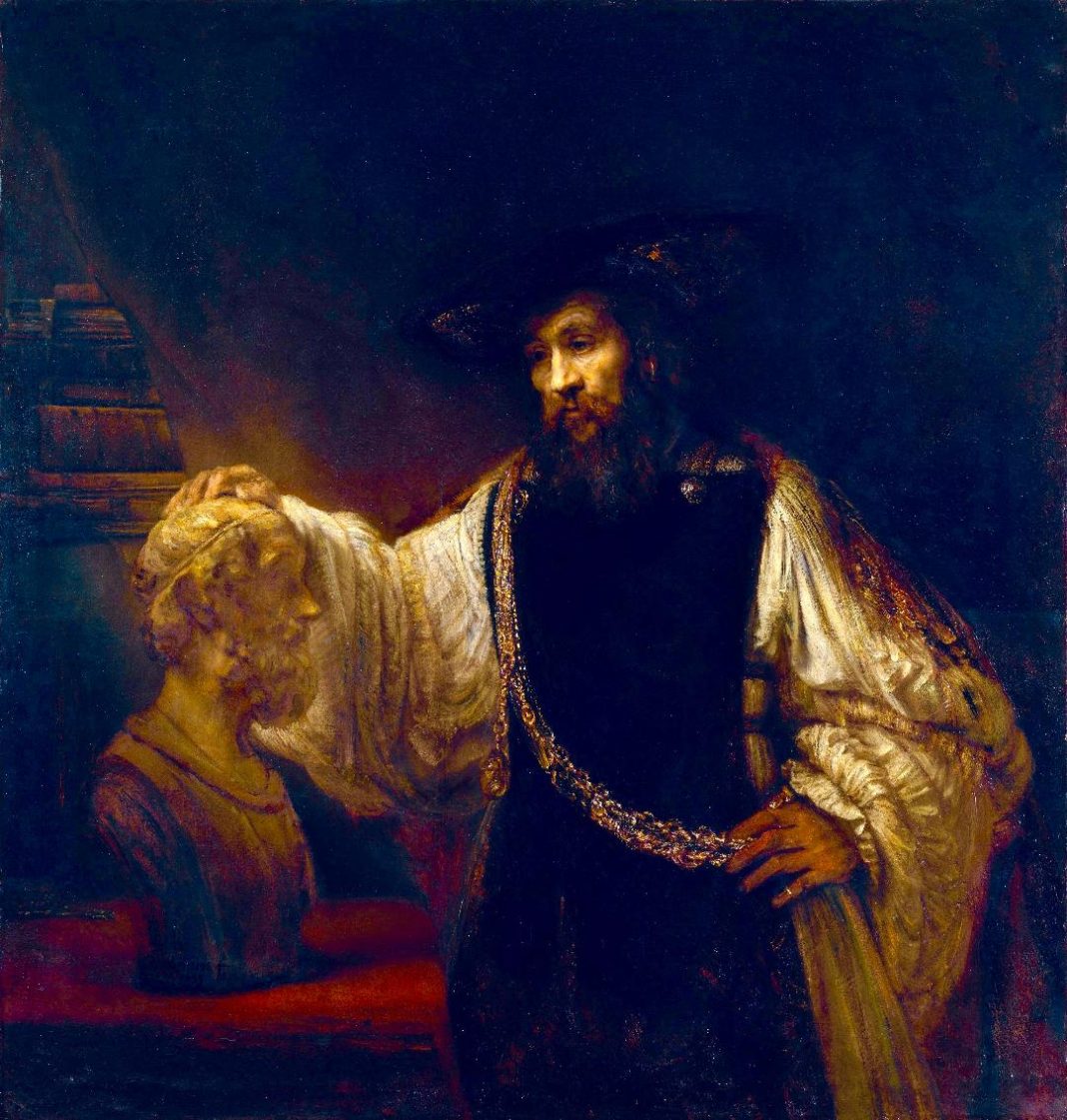
OUR MAIN IMAGE: Aristotle with a bust of Homer by Rembrandt, 1653. Metropolitan Museum of Art. Public Domain.
By Evaggelos Vallianatos
Prologue
I have a deep respect and affection for Homer. I do indeed think of him as the teacher of the Greeks. My understanding of Homer is no different than that of ancient Greeks.
Metaphorically, I am ancient Greek, too. In Greek, ancient is αρχαῖος / archaios, which means more than very old. Its core meaning is beginning and the rule of law.
Homer: sparked Greek civilization
The ancient Greeks started what we call civilization. Homer sparked that Promethean transformation of the Greeks. Plato would not disagree. He thought Homer was “the best poet and the most divine” (Ion 530c). He also reports that during the Panathenaea, Athens’ quadrennial religious and athletic festival honoring the birthdate of goddess Athena, bards would sing extensively from the poetry of Homer. Such public performances of the Homeric epics took place in the theater of Dionysos in front of about 20,000 Athenians who, along with the bards, wept while listening to the story-songs of Homer (Ion 530c; 535d-e).
Homer the Poet
Aristotle had no doubt that Homer was “the poet of poets” (Poetics 48b 30-35). He was the first scholar-philosopher to decode Homer’s wisdom. He realized that Homer’s epics revealed secret, lost knowledge of Bronze Age Mycenaean Greece. He understood its importance. No wonder Aristotle treated Homer as an equal. He often mentioned him in his philosophical, scientific, and political works.
Homer the polymath
Homer was a polymath. His poetry is full of gems of wisdom and insights about the Greeks, the Trojans, war, peace, agriculture, geography, traditions, science, technology (robots, very advanced technology), the natural world, the Cosmos, and the gods. Aristotle was also a polymath. Reading Homer’s epics was like going through an encyclopedia of tremendous wisdom and knowledge from great antiquity.
To Aristotle, Homer was like a fountain of knowledge and lighthouse of wisdom. His epics were like a time machine, allowing Aristotle to see the Cosmos and Greek society about 900 years before his age, the fourth century BCE. Homer gave Aristotle satisfaction, pleasure, and probable confirmation of his own knowledge, wisdom, and science.
Scientific insights from Homer
For example, Aristotle refers to Homer several times in his most important scientific treatise, History of Animals. In one instance (519a 10-20), he examined the potential influence of drinking water on the color of animals’ hair. Aristotle suspected that water quality might explain why sheep grazing the Chalcidica Peninsula in the coast of Thrace gave birth to lambs that were sometimes white and other times black.
Scamander River, surrounding Troy, made the hair of lambs yellow, which, Aristotle says, convinced Homer to name Scamander the Yellow River.
At another section of the History of Animals (575a), Aristotle discusses the age of Laconian / Spartan dogs. The males lived for about ten years. The females, however, lived for fourteen and sometimes twenty years.
This realization prompted Aristotle to bring up Homer and the account in the Odyssey (17.326) that Odysseus’s dog Argos died at the age of twenty.
Similarly, Aristotle cites Homer in his Politics, Poetics, Nicomachean Ethics, and other philosophical works. For example, in his Nicomachean Ethics (1141a 12-29). Aristotle turns to Homer to confirm his notion of wisdom: wisdom is a combination of “intuitive reason and scientific knowledge.”
Another example, when the Philosopher merged his observation of nature with Homer’s, comes from book XXIII of Problems (934a 13-24). Aristotle had observed that still water was more transparent than moving water, so the color of the sea changed from blue to almost black. Homer, Aristotle said, had reached a similar conclusion, saying the wind moved the water to a darker color, eventually capturing the metaphor in Homer’s work of the wine-dark sea (Odyssey 12.388).
Moreover, Aristotle had no doubt that Homer was the supreme poet of Hellas, with inestimable contributions to the development of poetry, tragedy, and theater.
Aristotle was by far the most profound of Greek thinkers. He had no doubt that Homer was the god-like author of the Iliad and the Odyssey. He also believed those epics were primarily the early history of the Greek people. Much more than any modern classical scholar, Aristotle had access to information and knowledge about Homer. Like the rest of the Greeks, the Philosopher judged Homer to be the teacher of the Greeks and a seminal pillar of Hellenic civilization.
Singing Homer
About 700 years after Aristotle, another Greek thinker spoke about Homer. This was Diogenes Laertios, a writer and philosopher. He flourished in the first half of the third century. He said that, from around 600 BCE, rhapsodes recited Homer’s poems throughout the Greek world. This was especially true on the islands of Chios, Cyprus, and Delos and the poleis / city-states of Syracuse in Magna Graecia, Sicyon in Peloponnesos, and Athens.
The recitation of the Homeric epics in Athens coincided with the celebration of Dionysos in both Athens and Brauron in the countryside of Attica. Solon, who was archon/leader of Athens in 594 BCE, required that rhapsodes, singers of poetry, sing substantive continuous sections of the poems of Homer, rather than disconnected passages (Diogenes Laertios, Lives of Eminent Philosophers 1.57).
History, sustained beauty and splendor in Homer
There’s some fiction in the epics of Homer, but not enough to dilute the historical integrity of the stories. Homer, inspired by the Muses/goddesses of learning, set down in alphabetic Greek writing the early history of the Greeks, a poetic account that records historical events dating from the early Bronze Age or more than 5,000 years ago.
The Roman teacher of rhetoric, Quintilian (Marcus Fabius Quintilianus, who flourished in the first century), captured the essence and appreciation of Homer in the Western tradition. “Homer,” he says, “is like his own conception of the Ocean, which he describes as the source of every stream and river; for he has given us a model and an inspiration for every department of eloquence…no one has ever surpassed him in the sublimity with which he invests great themes or the propriety with which he handles small themes. He is at once luxuriant and concise, sprightly, and serious, remarkable at once for his fullness and his brevity, and supreme not merely for poetic, but for oratorical power as well…. the Poet was the master of all” (Training in Oratory 10.1.46-51, tr. Moses Hades, Ancilla to Classical Reading, New York: Columbia University Press, 1954, 143-144).
Nineteen centuries after Quintilian, J. A. K. Thomson, a rare American Homeric scholar, connects Homer’s epics to the very foundations of the West. He mirrors Aristotle and Quintilian. “At the sources of Western civilization,” he says, “themselves its main source, stand two poems on the grand scale which for sustained beauty and splendor have found no superior, perhaps no equal, in all the poetry that has followed them. This is the most remarkable fact in the history of literature. If it seems to contradict what Aristotle regards as almost a law of nature – that the arts progress by degrees – we may discover the explanation in this, that the Iliad and the Odyssey are not the beginning but the consummation of an artistic process of which the earliest stages are no longer discernible. But, while this would explain the fact, it does not explain the miracle. The miracle is the quality of the poetry, and miracles cannot be explained” (“Homer and his Influence” in A Companion to Homer, eds., Alan J.B. Wace and Frank H. Stubbing, New York: The Macmillan Company, 1963, 1).
Epilogue
Aristotle, Quintilian and Thomson give us a balanced view of Homer, the great poet, teacher and historian of Bronze Age Hellenic civilization. This view rejects the mostly biased perspectives of classical scholars and movie producers like Christopher Nolan, who present Homer as a fiction writer.
















Η Πολιτισμένη Δύση επανέρχεται στις ρίζες της όταν μελετά τις εμπειριες που κατέγραψε ο Όμηρος πριν 29 αιώνες που είναι Πανανθρώπινες και Διαχρονικές!
What Else -to be said? What ? Why? and When? All of Western Civilization is born from Homer’s
Hellenic Universal Inspirational Western Educational -Paideia- its very source of our cultural identity!
I visited Askri , Beoetia Thivon last summer -Hesiod’s Town- we were impressed with the visiting history professors from the Univ. of Athens on ” Works and Days” -the “Theogony”. We thank the scholars and the staff for the tribute on Hesiod’s Contribution to our Hellenic Dynamic Culture that constitutes ( Homer’s
Epic Poetry as well) on behalf of our unique everlasting historical identity.
Thank You Again
BGT
I am glad that you have covered in a scientific way such difficult terminology in your posting cited with the right sources of reference proofing one more time that the helleniscope and its director Dr. Nickos Stamatakis has established an online newspaper beating the world and the many other newspapers around the world and the USA as well. I would like to add something that has given a pain on how to determine the best etymology of the word αρχαίος that was found first in “Herodotus 5,88 εσθής πάσα η αρχαίη των γυναικών with the right accents , that I eliminate here , and then in Sophocleus and Euripedus Aristophanes, and of course in Plato and Xenophon, and of course Aristotle but what has intrigued me is that while in the beginning the meaning of the word was ο από πολλών χρόνων υφιστάμενος, προ πολλού υπάρξας , there was not but one scholar philosopher Parakelsus who gave an etymology beyond the limits of any other literate person of his previous days who said talking about πυρήν αρχαία ζωτικη ουσία πρωτογενής( ενυπάρχουσα εν τω σώματι ζωικής τινός αυτοτελούς δυνάμεως, εξ ής καί δι’ ής επιτελούνται πάσαι αί φυσικαί και ψυχικαί λειτουργίαι.
It is also amazing that Socrates never mentioned Homer in his life but once releasing a dream he saw that Homer was involved . Of course we know that Socrates wanted to make people mainly the youth understand that they have to work on their own history and self knowledge without support for their entire Βίο from subordinates.
I would like to have a feed back on your opinion about Socrates and his standpoint view about Homer not from disrespect but from his differentiated approach about Homer who both are αρχαίοι for us.
Excellent analysis. For what it’s worth, what obtained before Homer (and following the Bronze Age Collapse) was known as the Greek Dark Ages. Homer, in valorizing Ilium, put the Hellenes back on the road to civilization.
Since the talk of the Town -despite its controversial performers- The Movie , Homer’s ODYSSEY is being viewed by millions Americans at center stage to digest nearly 3,000 years of Hellenic Paideia ,to proclaim the ” Wine Dark Sea”-The Aegean Sea. The Hellenic Hero from the Island of Ithaka to the Great Poet from Chios or Ionia , manifests the powerful historic message that should resonate world wide; not only to the USA, but to NATO and Ankara Turkey. Mr. Mitsotaki-please wake up! and get your marketing political agenda on track, to preserve Hellenic Sovereignty ,confirming UNCLOS- 12 Mile Limit in the Aegean Sea. Regrettably, in NY at St. Nicholas the ignorant folks generating the 1,500 dollar dinner to honor Zelensky, are definitely wasting time, their resources to undermine the Hellenic Sphere of influence
in the Mediterranean Sea. This summer, Homer’s Poetic Voice is alive and well by popular demand, by all honoring , respectively
the Dynamic Aegean Source of Western Civilization.