


ΕΑΝ ΠΡΟΤΙΜΑΤΕ ΕΛΛΗΝΙΚΑ ΠΑΤΗΣΤΕ ΤΗ ΣΗΜΑΙΑ ΣΤΟ ΚΑΤΩ ΜΕΡΟΣ ΤΗΣ ΟΘΟΝΗΣ
At 39, the Greek mathematician is internationally known for the “Aretakis instability,” a groundbreaking discovery concerning extremal black holes – a special class of black holes existing at an extreme relationship between parameters such as mass, charge, or rotation.
By Helleniscope’s Editorial Team
Born in Athens in January 1987 to Cretan and Zakynthian parents, Stefanos Aretakis grew up in Greece before embarking on an academic career that took him to Cambridge, Princeton, the Institute for Advanced Study, and the University of Toronto—and placed his name permanently in the international language of mathematical physics.
Aretakis’ path to Princeton carries an unusual irony. As a young student, he applied to universities in the United States, including Princeton, but they rejected his applications. He instead enrolled at the University of Patras, where he completed his undergraduate degree in less than two years with a perfect grade of 10. Years later, Princeton—the same university that had turned him down as an undergraduate applicant—welcomed him back at age 24 as a Veblen Research Instructor, and in 2016 he returned again as an Assistant Professor. Aretakis has not portrayed those early rejections as defining setbacks; he has said they simply helped him “reconsider some paths,” emphasizing instead the countless hours of work behind his success and the importance of continuing to pursue what one genuinely loves.
Aretakis’ greatest achievement came through his study of extremal black holes, special mathematical solutions of Einstein’s equations representing black holes at an extreme limit of charge or rotation.
In a series of pioneering papers, he proved that certain disturbances along the event horizon of an extremal black hole behave in a completely unexpected way. While some quantities decay, higher derivatives can grow without bound along the horizon.
The discovery became known internationally as the “Aretakis instability.” Related conservation laws discovered in his work are also known as Aretakis conserved quantities or Aretakis charges. His results opened a new field of investigation into the stability and dynamics of extremal black holes and have since been extended by researchers studying scalar, electromagnetic and gravitational perturbations.
Aretakis later worked with mathematicians Yannis Angelopoulos and Dejan Gajic to show that the distinctive mathematical “hair” associated with an extremal black hole’s horizon can, in principle, leave a signature detectable by observers far from the black hole. The result raised the possibility that a phenomenon first discovered through pure mathematics could ultimately have implications for observing black holes.
His research has also extended beyond black-hole instability. With Stefan Czimek and Igor Rodnianski, Aretakis developed important work on the characteristic gluing problem for Einstein’s vacuum equations, identifying conservation laws as the fundamental obstructions to joining certain solutions of Einstein’s equations.

A REMARKABLE MATHEMATICAL CAREER
Aretakis studied mathematics at the University of Patras, graduating with a perfect 100/100, before continuing at the University of Cambridge, where he completed his Ph.D. in mathematics in 2012 under renowned Greek mathematician Mihalis Dafermos. His doctoral research already centered on the stability and instability of equations arising in general relativity.
He was then appointed a prestigious Veblen Research Instructor at Princeton University and the Institute for Advanced Study from 2012 to 2015, followed by an Assistant Professorship at Princeton. Today he is an Associate Professor of Mathematics at the University of Toronto, where his research focuses on differential geometry, partial differential equations, general relativity, black-hole stability and the Einstein equations.
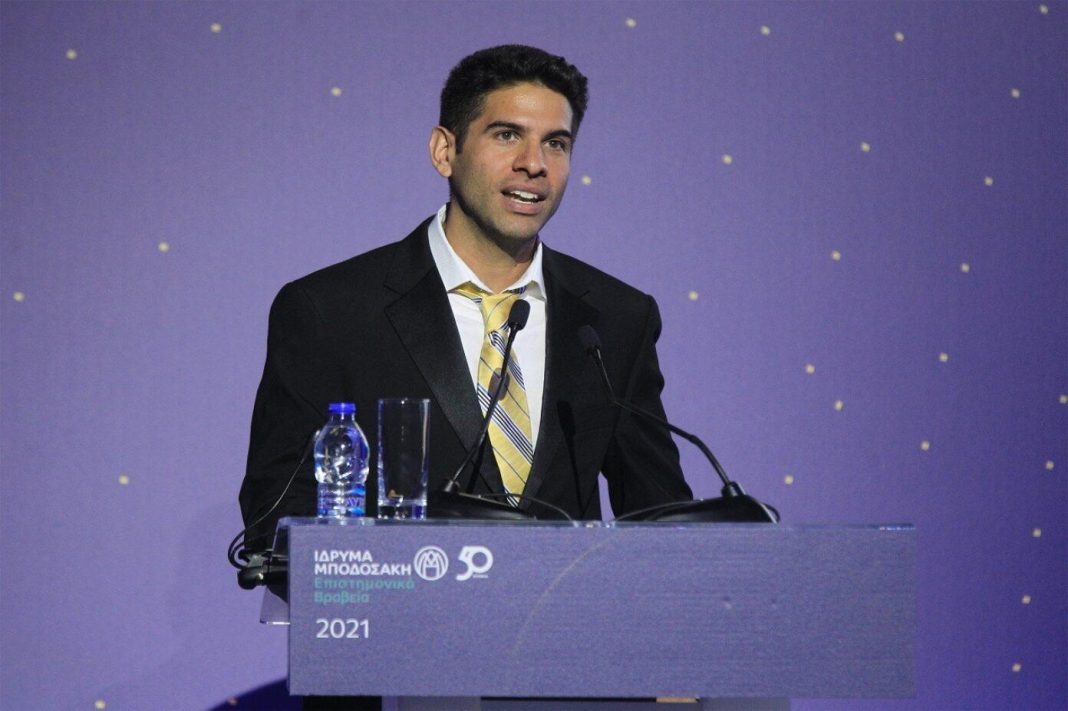
His work has earned major international recognition. In 2021, the International Union of Pure and Applied Physics awarded him its Young Scientist Prize in Mathematical Physics, specifically recognizing his influential contributions to black-hole dynamics, instability mechanisms and conservation laws in general relativity. That same year he received the Bodossaki Distinguished Young Scientist Award in Mathematics.
He has also received an Alfred P. Sloan Research Fellowship, the Papastratos Award in Geometry from the Academy of Athens, and other research distinctions. In 2024, he was named a member of the Royal Society of Canada’s College of New Scholars, Artists and Scientists, recognizing the impact of his work in mathematical physics and black-hole stability.

For most mathematicians, having a theorem or phenomenon associated permanently with their name is a rare distinction.
For Stefanos Aretakis, it happened while he was still a young researcher.
Today, physicists and mathematicians around the world studying the extreme limits of Einstein’s theory routinely encounter the same name:
The Aretakis instability.
It is an extraordinary scientific legacy established by a Greek mathematician who, at only 39, remains well in the middle of his career.
August 30, 2026, www.helleniscope.com, n.stamatakis@aol.com
DISCLAIMER: The views and statements expressed in this article constitute constitutionally protected opinions of this author.
















Congratulations, to the academic accomplishments of Mr. Aretakis and Helleniscope’s Journalism ,well documented for Hellenic Pride and Development.
AXIOS!!
Thank You
This is amazing to learn; what prowess and perseverance in Prof Aretakis’ education, work and research. Also, let us not forget that Einstein had a greek professor who taught him most of what he knew as he said so himself.
Another well done achievement by an Hellene.
As I grow older I am certain that about 70% of who we are and what we achieve has to do with our DNA. Hellenic DNA has fertilized the whole planet, as our ancestors were travelling incessantly for the past 5,000 years…
It was the mathematical excellence of Professor Karatheodori that allowed Einstein to achieve and prove his theory of relativity.
Indeed…..under every rock across the globe, Greek DNA will be found lol….
Professor Karatheodori showed Einstein the math and then took a back seat as Einstein advanced in his theorems? I wonder if that was purposeful as Karatheodori concentrated on advancing his research rather than fame? Einstein had different kind of assistance by his people. Greeks are not known for their cohesiveness.