

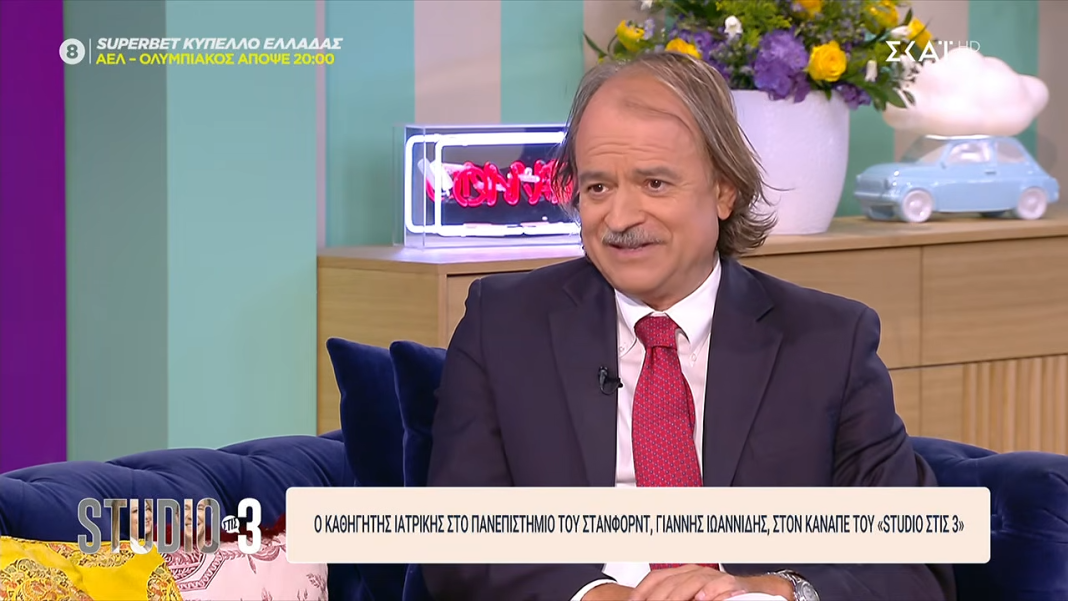
EDITOR’S NOTE (Nick Stamatakis). This is another superb interview with Professor Ioannidis (after his “αχρηστοκρατία” interview with Mr. Sahinis in “Antitheseis”).
Professor John Ioannidis’s central message is that science is valuable precisely because it is fallible. He rejects the idea that science delivers final truths or prophecies; if a claim cannot in principle be overturned, he says, it has ceased to be science and has become something closer to dogma, politics, or religion. For him, the scientific process should be able to “self-cancel,” correct itself, and improve. He even describes discovering one of his own errors as a cause for celebration, because a visible error can be fixed; the more dangerous errors are those that sit in scientists’ blind spots and persist unchallenged. That outlook also explains his skepticism toward scientific celebrity: credentials and prestige do not protect anyone—including Stanford or Harvard professors—from being badly wrong.
His sharpest criticism targets overconfidence within the scientific establishment. Ioannidis argues that scientists can easily start believing they possess special authority simply because they have expertise or prestigious titles. During major crises, he says, supposedly “uneducated” ordinary people have sometimes had more scientifically sensible views than governments, official institutions, or self-proclaimed experts. When an expert responds to criticism with “I’m the Stanford professor; who are you?”, the consequences of being wrong become especially damaging: it can make science itself look ridiculous. In his words, recent years have seen a kind of “self-ridiculing of science” when institutional authority collided with ordinary reasoning and refused to admit uncertainty.
At the same time, he is not anti-science; he is arguing for more rigorous, skeptical science. He urges people to “keep a small basket”—to be cautious about grand claims of miraculous drugs, exponential progress, extreme longevity, or transformative technologies, because scientific progress is usually slow, uneven, and full of reversals. What society lacks, he says, is “organized skepticism”: the habit of examining evidence, asking where information comes from, what interests may be behind it, inviting counterarguments, and trying to understand the opposing case before dismissing it. For Ioannidis, critical thinking is not cynicism or automatic rejection; it is the discipline of remaining open to being wrong.














Thank You For Helleniscope’s notation of scientific works by Greek Born Citizens,
that advance studies on Science/Humanity -worldwide, on all levels of academia . Regrettably , USA neglect’s Hellenic Impregnation ?? meaning “The
Hellenization of America” from Athens Georgia to Olympia WA to
Ithaca NY to Eureka CA to Marathon TX to Homer Alaska- The Baptism of American Culture needs to comprehend once and for all their “TAFTOTITA”, that they are and should BE PHIL-HELLENES! Case Closed!
Almost all the governmental buildings and academic institutions are poor Copies of Classical Architectural Symbols from the Hellenic Civilization-Nothing new that is very well known-but No one declares the insult ,the
duplicity, the hypocrisy for Not to RESPECT The Holy Sacred Historical (Topos)
that the Western Civilization is a product of its own lame Identity !USA/ NATO!!
The Hellenic Brain drain to Foreign Lands is in process and these talented Hellenes will embrace to advance their Hellenic Culture as other compassionate visionaries. Namely, Hellenes of the Diaspora who contributed to
Modern Greek Identity, the likes of Korais, Cavafys, Solomos, Gennadios,
many others. At least, Helleniscope sets the table to argue, debate , to
converse to sharpen the pen to advance Hellenic Power to establish its security in turbulent controversial times!