

ΕΑΝ ΠΡΟΤΙΜΑΤΕ ΕΛΛΗΝΙΚΑ ΠΑΤΗΣΤΕ ΤΗ ΣΗΜΑΙΑ ΣΤΟ ΚΑΤΩ ΜΕΡΟΣ ΤΗΣ ΟΘΟΝΗΣ
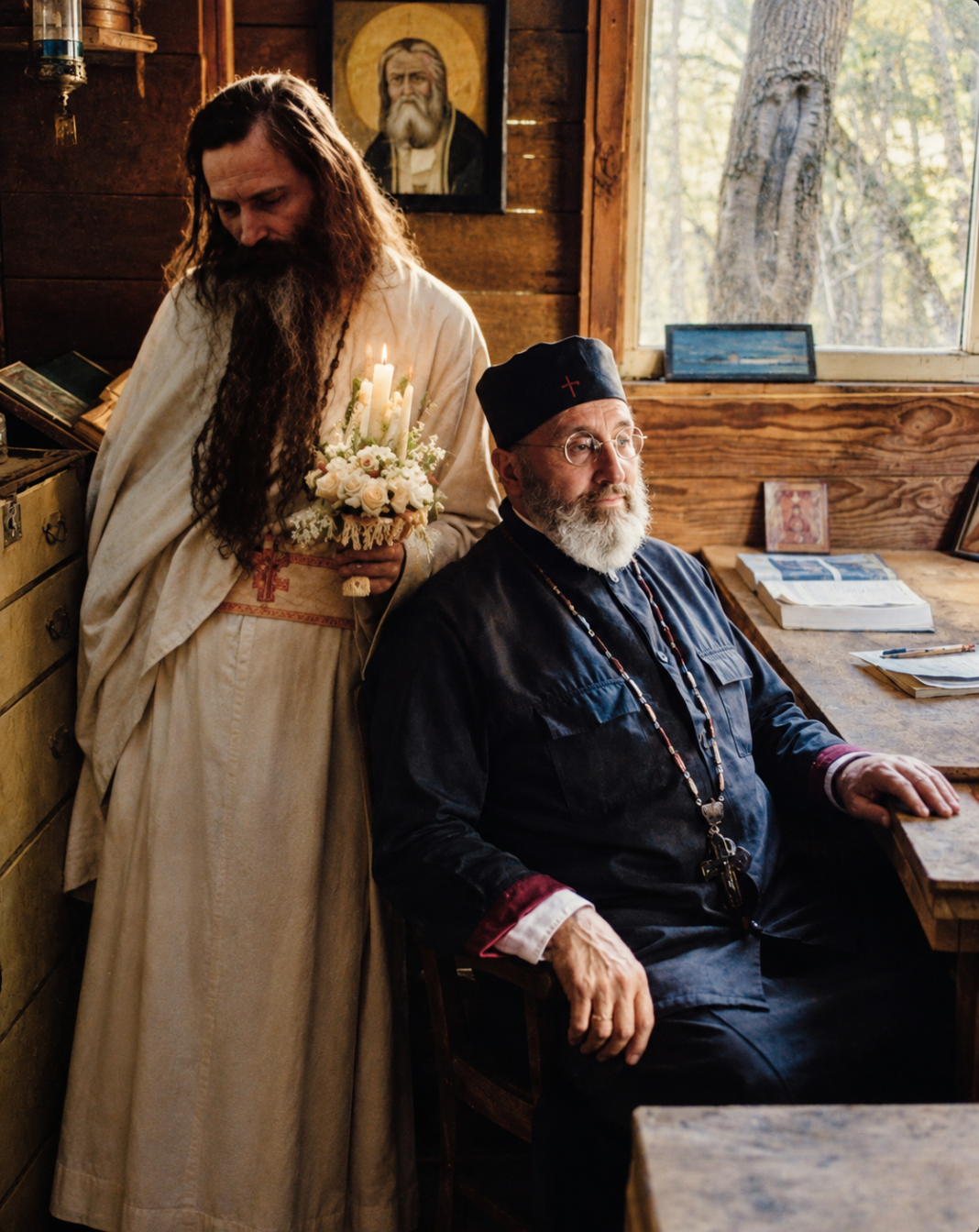
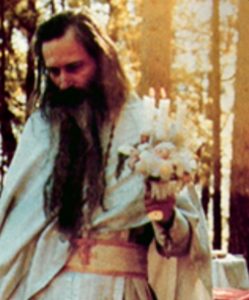
PHOTO: Artistic rendering of Fr. Seraphim Rose and Fr. Paul Baba
by +Chrissie Apollonia Nicolles
We all heard the big news in the Orthodox world last May 2026 about the legendary American monk and theology writer of myriad books, and foremost an Eastern Orthodox canonical priest: Father Seraphim Rose… soon to be canonized a Saint by the ROCOR Synod. However, in the country of Georgia, Met. Nikolozi has “venerated” him in 2023, declaring “his writings had a massive, transformative spiritual impact during Georgia’s communist suppression.” Also, newsflash: a film about the life of Fr. Seraphim Rose called “Voice in the Wilderness” is coming soon.
After learning about a certain Orthodox priest, Fr. Paul Haji Baba, a spiritual child of the renowned Fr. Seraphim Rose of California who met him before age 19 + broke bread with him… I was really eager to interview him! I reached out to my astute priest friend Fr. Hovik in the Northwest for his number (as he perennially sent me Fr. Rose quotes). Since then, I’m grateful for the welcoming voice of Fr. Baba’s spiritual sharing with me the
plenitude of his spiritual father and hearing his many otherworldly experiences (after death) of “seeing” his elder Fr. Seraphim Rose appear behind the luminous “wonder worker”, the well-known Saint John Maximovitch of Shanghai, enveloped in a pale pink
light and giving him words of encouragement!
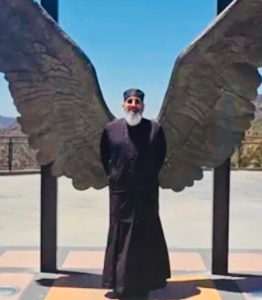
I’m certain the young Fr. Paul never imagined, in his wildest dreams, that a radical shift was about to befall him! He was invested in a music career at first, meeting with “the holy hermit” at his rustic, forest cell in Platina, CA, and also meeting holy fathers of St. Herman of Alaska who he described as extremely warm and loving to pilgrims, no matter what sinful baggage they had; this deeply moved him. But he had no plans for the priesthood; he was living a full life in classical music lessons (clarinet, flute, bassoon, piano, saxophone) and pursuing a career in jazz. Then, like a bolt of lightning, it all dropped off one night—he quit music. He wasn’t just changed – he was frightened too! As he described it, he was losing his mind at 19 years old + began repeating the Jesus Prayer to clear the demons …pondering how to explain the hole he dug himself into to his worried parents who didn’t understand his fascination with the teachings of the monk at the monastery … it was an awakening he couldn’t fight! The jazz music world didn’t work for Paul Baba anymore. He had, in effect, rejected the world. Thinking to himself:
“Oh Lord, something has happened!! I love Beethoven and Amadeus, but it can’t match Jesus… the devil tricks many a musician standing on quicksand—my musician friends are sinking because they made plans without Jesus Christ! I must pray and fast like I need water… If this brilliant monk living in a tiny cell with no electricity can radiate such joy and wisdom, it doesn’t help me… I’m in big trouble! Monk Seraphim is now telling me, ‘Also come walk this path?’ I have to go back… Frankly, I believed I was in Heaven… through the elder I began to love and accept the beauty of Christianity — I captured what he was trying to say to me as he did the Jesus Prayer.”
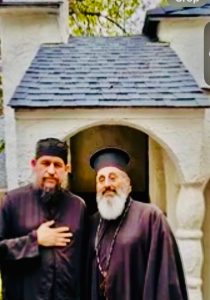
Father Paul’s “Tower Moment” upon meeting his holy elder is something we all understand who’ve bonded straightaway in a divine love with our Geronda or Gerondisa. You don’t need years to know them — it’s just instantaneous! The poet Kahlil Gibran
captures the sentiment:
“It is wrong to think that love comes from
long companionship, or long history together.
Love is the offspring of Spiritual Affinity and
unless that affinity is created in a moment, it
will not be created for years or an epoch.”
Later, with the blessing of Fr. Seraphim and his mother’s help, the young Paul opened a bookstore, naming it Byzantium Gallery in San Francisco – nearby was a Russian Orthodox cathedral once shepherded by Vladika (St. John Maximovitch). For 9 years, he sold painted Icons, incense, prayer ropes + Orthodox liturgical chants. But he operated it more as a “hospitality/theology center,” welcoming visitors with refreshments and open dialogue on God. Later, after he married, he instilled in his son Nicholas a love for Byzantine chant; Nicholas eventually became a master Protopsaltis of his father’s Antiochian Orthodox church in West Sacramento, CA.
What I find curious, listening to the voice of Archpriest Baba, is that despite his “abandoning music,” I notice his way of talking retains a distinct musical rhythm… a cadence that reveals the soul of a musician that’s still playing through his ‘evangelical’ spoken word. Fr. Paul never truly left music behind; at home he plays piano (video
enclosed to hear a melodic flow of a “trained musician turned spiritual apostle.”)
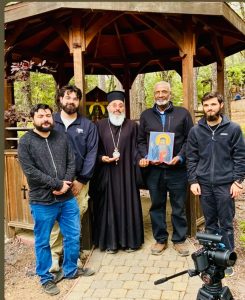
What exactly is edifying about our subject here, Archpriest Paul Haji Baba, really? It is that he’s a wonderful storyteller AND he’s a link between the American Hieromonk Seraphim Rose and all of us who’ve read his many writings yet never met him and now are struck by how beloved the name Father Seraphim Rose remains across the globe! Yet he was also a target of envy and criticism for his work. But it’s nothing compared to the Greek St. Paisios of Holy Mountain, who faced jealousy from some monks because of his immense popularity and spiritual gifts. Thousands would flock to Athos seeking Geronda’s counsel and miracle healings at his little cell, but the traffic of pilgrims and noise disrupted the monks’ hesychia. I’m disheartened to learn Fr. Rose never visited Athos and didn’t know Elder Paisios. Thus we await the formal sainthood of yet another ‘problematic’ priest… I wonder, with amusement, whether a canonized Father Seraphim in the West will end up weaponized by the ‘Orthobros?’ Just saying.
One of the many colorful stories of Fr. Seraphim’s first meeting with young college kid Paul is that he asked, “Do you have any problems, Brother Paul?” Fr. Baba replied, “Well, yes, I have some problems…,” then Fr. Rose halts and says ”Here, read this book tonight, and you’ll see that you don’t!” (The book was the life of a saint he can’t remember.) Fr. Seraphim was frank + direct; it was part of his love offered – and also temperate, which kept him from pride from the veneration surrounding him during his lifetime.
My late Russian Elder, Metr. Hilarion Kapral admired Seraphim Rose specifically because he always wished he could be a forest monk too; he gifted me many books, but I especially like “The Scent of Holiness” by Constantina Palmer, a devotee who knew blessed Seraphim well + wrote: “Fr. Rose used to say:
“Orthodoxy has such beautiful externals, but it’s easy to get distracted by these externals. It’s easy to think that because we are following all the fasting rules and because we know the Typikon, etc., we are actually living an Orthodox life, whereas we may not be at all!”
“If Christ is not there behind all that, then it’s a waste of time; it’s a beautiful waste of time, but it’s a waste of time nonetheless.”
Another favorite story is about Fr. Seraphim confessing to a friend of Archpriest Paul Baba’s who could not repeat his sins himself, so Fr. Rose told him all his sins from age 7 to 20 — all things no one knew except him!!
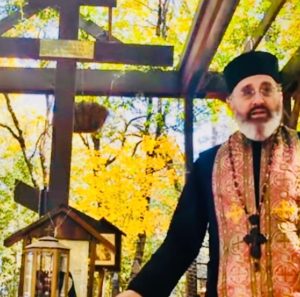
I view his collective writings as emphasizing that modernity offers very little true spiritual edification. Of course he took it to extremes, and many viewed him as crazy. But St. Paisios says, “One who doesn’t have a crazy streak cannot become a
saint or a hero.”
I rather liken Fr. Rose a bit to American poet/philosopher Henry David Thoreau, well known for his book ‘Walden’ + essay on ‘Civil Disobedience’. Like the Hieromonk Seraphim, Thoreau also studied Hindu literature and built a small cabin in the woods… however, Fr. Rose aspired to something far higher … it’s called Theosis. And he lived in the forest 13 years, in contrast to Henry David Thoreau’s 2 years “observing nature” — but not his Nous.
Fr. Rose’s 1st principle: “We are all pilgrims on this earth, and there’s nothing permanent for us here.” We must continuously remind ourselves we are just sojourners.
2nd principle: “Our Orthodox faith is not an “academic” thing — it is not a matter of the head — it’s of the heart.”
3rd principle: “IF you do not find Christ in this life, you will not find Him in the next.” And his quoting New Testament: “God is love; and he that dwells in love, dwells in God… Perfect love casts out all fear” (1 John 4:16). That is how we become less fearful of life and people or difficulties.”
What’s interesting, despite Fr. Seraphim’s deep reverence for Russian tradition, personified by his elder St. John of Shanghai, is that he did not want to join any existing monastery of ROCOR, and didn’t see himself following in the footsteps of St. John or any Russian hierarchs or theologians he admired…yes, he defended Orthodox tradition but at the same time was bringing forth something new, something entirely American. When he first bought Platina California land, Fr. Damascene ascribed to him: “It was the dream to bring Orthodoxy into the land of the cowboys!”
And despite being an ardent critic of ecumenism on a theological level, he was actually quite sympathetic toward well-intentioned people in mainstream ”ecumenist” jurisdictions. While Fr. Seraphim was an Archimandrite priest in ROCOR, which at the time was isolated from mainstream Orthodoxy — his personal approach sharply contrasted with the “super-correct” extremist factions of his day – his stance is understood by three
principles:
Opposing “Super-Correctness” — a faction in ROCOR championed as rigid, hyper-legalistic traditionalism, that patriarchates such as OCA, Greek Archdiocese, or Moscow
Patriarchate lacked divine grace because of their involvement in the New Calendar. Fr. Rose opposed this mentality, calling it a “loveless elitism”; he warned that focusing entirely on jurisdictional correctness masks a prideful, Pharisaic spirit that destroys Christian love. Even here, Fr. Paul Baba, spiritual child of Fr. Rose, tells me he learned not to judge the clergy. “So long as a priest gives valid confession, holy communion + standard services – do not judge a priest.”
Even while Fr. Seraphim was unyielding regarding doctrinal purity and “not bowing the knee to the spirit of apostasy,” and his disagreeing with the modernizing policies of their bishops — he believed in the “Orthodoxy of the Heart”… emphasizing that a simple, humble believer trying to love Christ was still closer to God than a toxic, prideful zealot who was lacking compassion. “God’s revelation is given to something called a loving heart…if others have not found the truth it would be madness for us to condemn them… because our own possession of truth depends upon our loving heart.”
A layman asked me, would Fr. Seraphim reject the likes of St. Joseph the Hesychast? Elder Ephraim of Arizona? St. Paisios of Athos? Justin Popovic, St. Cleopa of Romania, if they were ecumenists? I say no! I think this perspective is also shared by the GOC in America under Metr. Demetrius, who in a powerful act of spiritual bridge-building last June led pilgrims to venerate the early Western saints across England and Scotland — drawing on
Orthodox heritage of the first thousand years in the Christian West. Today, France, Ireland, Scotland, and England have Eastern Orthodox monasteries rooted in ascetic traditions from the Egyptian desert fathers and the Christian East. The best-known is a co-ed Monastery in Essex, England, with both monks and nuns under the Patriarchate, started by Archimandrite Sophrony, a disciple of St. Silouan of Athos.
I quote here a Russian priest: “While we have different playbooks, we play for the same team —we celebrate a feast on a different day, and so they call us heretics; this is a joke, of course; we’re on the same team as them!” Spiritual brotherhood is not political. In my experience, my priest friends + monastics are holier than any layperson espousing “us vs them” mentality in any jurisdiction. Fr. Hovik told me long ago:
“We should be ORTHODOX who happen
to attend a Russian, Greek, or Antiochian parish.
Christ is FIRST — not our ethnicity!”
(*And I say: Let’s pray and have mercy on the priests + monastics, for most only see Sunday mornings or brief visits to a monastery, but they face physical + spiritual warfare — standing long hours in liturgy despite leg ailments, judgment from the world, financial
pressures, counseling broken people, late-night hospital visits, even loneliness ).
Significant to note: Fr. Baba has praised Fr. Seraphim and Abbott Herman as two missionaries who made America Orthodox of their time. He declared, “Out of love for Jesus Christ, they extended as best they could, Orthodoxy to the suffering seeker.” That said, it’s vital to mention the controversial history of (Eugene Rose), now Blessed Seraphim, and his co-founder of St. Herman of Alaska Brotherhood: the defrocked Abbot Herman (Gleb
Podmoshensky), who are described as close friends and platonic monastic brothers…
In 1988, Abbot Herman was defrocked by the ROCOR Synod following numerous allegations of sexual misconduct and “homosexual abuse” with young men. Rather than accepting
defrocking, he took Platina monastery into schism, operating under various non-canonical “vagrant” bishops. Podmoshensky’s unrepentant behavior and the monastery’s eventual schism have unfairly complicated Fr. Rose’s canonization within ROCOR.
Naturally, I asked Archpriest Baba his thoughts on this troubling situation, and he was very specific in his response:
“Regarding Abbot Herman’s defrocking and
sinful misconduct, people should not judge but
let grudges go and leave it to God. We are
to pray for those who have fallen + help their
salvation. Our teaching is to have a forgiving heart.
We ask Christ to forgive us of our trespasses as
we forgive those who trespass against us.”
“And we pray for all those in the world who are victims
of hurtful activity. Fr. Seraphim’s life in the monastery
was very pure and taught the importance of looking
deeply into oneself, to recognize our weaknesses
before the Lord.”
This echoes St. Nektarios, who reminded us: “The saints did not become saints because they never sinned, but because they never stopped repenting.”
Father Seraphim Rose died in 1982, years before the full extent of Abbot Gleb Podmoshensky’s actions got publicized. Some accounts say Fr. Rose may have learned of his abusive misconduct on his deathbed when Gleb confessed his sins, and Fr. Rose reacted in outrage, shouting to him, “Damn you! I’m done with you!” But Fr. Paul Baba says it’s not true…
Accordingly, we see the stark contrast of these two men… The tragic fall of Abbot Herman, refusing to repent and cast into oblivion, and the valiant renunciation of Fr. Seraphim Rose
celebrated all over the Orthodox globe.
Furthermore, many West Coast jurisdictions held a prejudice against monastics and asceticism — but this delusion was healed by the efforts of
monastics like Hieromonk Rose and Elder Ephraim.
Do not forget: the diabolical American media also spreads rumors and lies about holy monks being cult leaders.
*May it be blessed! Many years, Archpriest Paul Haji Baba!









Saint Seraphim please intercede for us all.
I read his book The Soul After Death he offers interpretation of modern day near death experiences and orthodox patristic viewpoint.
Chrissie, this is a very thoughtful essay. One minor quibble: are you sure that all those saints you mentioned (Ss Paissius, Justin Popovic, Cleopa, Ephraim, et al) were ecumenists? Something tells me they were not.
Please clarify.
Georg my bad! My mistake ✅
I was quoting a layman who actually posed the question + I did not clarify it. NO WAY was Saint Paisios ecumenist + neither was Elder Cleopa!
Whew! Next thing somebody would say he was an Archon!
Α saint and ecumenist? This is an oxymoron ! Ecumenism (love without truth) is a panheresy according to Saint Justin Popovich of Serbia. St Paisios said in his epistle to ecumenist Athenagoras, “I never met an ecumenist with a stich of piety or “tsipa” venarable modesty. The layman asked a hypothetical question: If they were ecumenists Fr Seraphim would continue to pray for them and love them but he would avoid them and their teachings as we avoid vipers…
Very nice! And like the way you exposed dirty little secret of Abbot Herman out & cast him to oblivion is right .
Poor Father Rose to be tainted by a snake.
Beautiful. God’s grace knows no bounds. There is no flag above the Cross of the Truth of Orthodoxy.
The Orthobros just love this monk guy all over YouTube & his book Orthodoxy & Religion of the Future is my favorite. As expected Fr. Seraphim is another accused Anti-Semite.
So what? He loved Christ.
Chrissie good stuff.
Getting better with the writing and storytelling. I put my web browser to read it to me to gain time while doing choirs.
Remain focused and all will get better!
Wonderful writing Chrissy mou
you help the aletheia!
Congrats Apples!
Keep doing Jesus Christ’s Will
I think the big challenge today is that many people are more concerned about their ethnicity than their faith. Are you an
ORTHODOX Christian who happens to be Greek or Russian or Serbian or Antiochian or Arabic?
OR are you a GREEK, RUSSIAN,
SERBIAN, ARAB who happens to be Orthodox Christian?There’s a big difference in those two emphasis.
We hear constantly many Greek Orthodox in America are now leaving for ROCOR. It’s sickening what the Ecumenical Patriarch has done to Russia.
Think about that monk that was just murdered in Ukraine (by crazy Ukrainian zealots) and bishops and priests that have been beat up, churches that have been stolen? All of that is on the Ecumenical Patriarch’s head! When the history of the church is written, Bartholomew
will be a person of disgrace.
It’s really sad.
I serve liturgy on Friday with 4
ROCOR priests including their Bishop. It was fantastic and they welcomed me with open arms.
Even if Fr. Seraphim Rose is not canonized bc of his “tollhouse” controversy he’s still venerated all over the world. He was impressive & I now have icon of him.
Truth without love becomes spiritually destructive; but love does not eliminate truth. Orthodoxy needs both.
Fr. Seraphim Rose was strongly opposed to ecumenism as a theological program, while simultaneously warning Orthodox Christians against pride, hatred, factionalism, and judging people’s souls. In Orthodoxy and the Religion of the Future, he argued that ecumenism could become a spiritually dangerous distortion of Christianity,
Fr. Seraphim Rose was a large inspiration for lost souls who found the punk rock genre of the 70s and 80 and redirected them to our Lord. The “Death to the World” magazine was created to inspire people from these genres to find Christ.
I will say that no one, including
Saints are infallible in their beliefs or writings.When I inquired into Orthodoxy and visited my first monastery a monk had been guiding me around and explaining things to me and there was an icon of Fr. Seraphim Rose and the monk spent long time explaining his life. Since learning of blessed Seraphim I’ve great affinity towards him and wish for his canonization.
Apples,
Thank you for quoting poet Kahlil Gibran:
“It is wrong to think that love comes from
long companionship, or long history together.
Love is the offspring of Spiritual
Affinity and
unless that affinity is created in a moment, it
will not be created for years or an epoch. ”
I love this article and I love the name Seraphim Rose 🌹
Absolutely amazing!!!
What an incredibly well done essay. The author really knows her history. I have read other articles from her and I always learn something. My favorite part was learning about his love of music, especially Jazz. I used to be a drummer and loved playing Jazz.
Great article! I particularly liked that poem by Khalil.