


ΕΑΝ ΠΡΟΤΙΜΑΤΕ ΕΛΛΗΝΙΚΑ ΠΑΤΗΣΤΕ ΤΗ ΣΗΜΑΙΑ ΣΤΟ ΚΑΤΩ ΜΕΡΟΣ ΤΗΣ ΟΘΟΝΗΣ
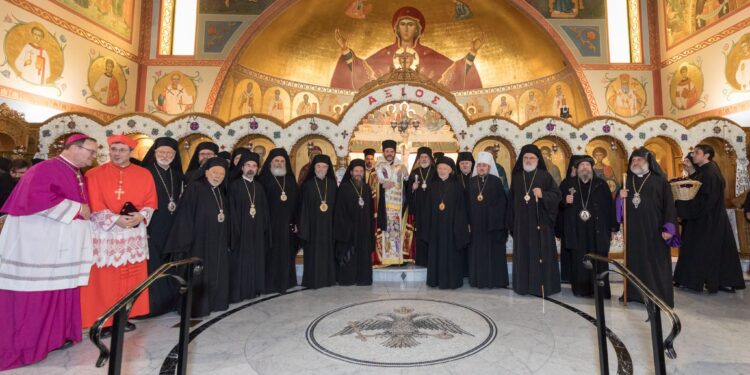
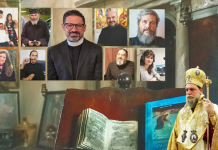
PHOTO: Catholic Bishops are seen on the left (Photo credit: Orthodox Times/Mike and Julie Agiannidis).
An RSVP-only enthronement, questions over access for ordinary faithful, non-Orthodox participation, and a carefully managed public image cast shadows over Archbishop Apostolos’s first days in Canada. As his tenure begins, questions of transparency, parish independence, and possible centralization may prove as consequential as the calls of “Axios.”
By Helleniscope’s Editorial Team
The enthronement of an Orthodox bishop is not a private reception, diplomatic gala or secular installation. It is an ecclesiastical act in which the Church—clergy and faithful alike —receives a bishop.
That is why several aspects of the September 19 enthronement of Archbishop Apostolos of Canada in Toronto deserve scrutiny.
The first troubling symbol was simple: RSVP.
The invitation asked those wishing to attend at St. Nicholas Greek Orthodox Cathedral to RSVP in advance, while subsequent reports described the cathedral as filled to capacity.
Limited space is an understandable practical problem. But it raises an obvious question: Why not use a larger venue?
It did not necessarily have to be another church. A sufficiently large hall or other suitable venue could have been appropriately arranged for the ceremony while preserving Orthodox liturgical requirements. The priority should have been allowing the widest possible participation of the flock rather than fitting an invitation-managed congregation into a small cathedral. (NOTE: Other UNWORTHY Bishops such as BP Diokleias Nektarios – the General Chancellor of GOARCH – followed the same troubling pattern of RSVP a few years ago. WHY? If you are afraid of the reactions of the faithful, do not ever become an Orthodox hierarch!!)
That concern becomes more pronounced when one considers the prominent political, diplomatic, and ecclesiastical dignitaries present.
There is nothing wrong with officials attending an enthronement. But when ordinary faithful are asked to RSVP for a capacity-limited ceremony while dignitaries occupy prominent places, one may reasonably ask: For whom is an Orthodox enthronement principally being held?
The question matters because the people are not merely spectators. Their ancient acclamation of “Axios!”—“Worthy!” has ecclesiastical significance.
Favorable reports describe an enthusiastic “Axios.” Yet they also illustrate why an RSVP enthronement was ill-advised. An “Axios” is most credible when the doors are unmistakably open to the whole flock. A larger venue could have eliminated the question entirely.
Ecumenism and unanswered questions
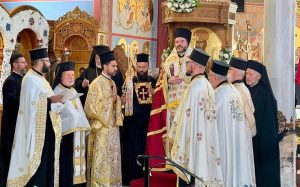
Another concern involves the presence of non-Orthodox religious representatives.
Published accounts document representatives of the Roman Catholic, Armenian Apostolic and Coptic Churches, among others. Their attendance does not, by itself, prove sacramental concelebration, and claiming otherwise would be inaccurate.
Indeed, subsequent reporting on the September 20 Divine Liturgy identifies the concelebrating hierarchs as Eastern Orthodox bishops. Nevertheless, traditional Orthodox objections concern not only Eucharistic concelebration but certain forms of common prayer with Christians outside Orthodox communion. Orthodoxy itself disputes the interpretation and contemporary application of the relevant canons, particularly in connection with ecumenical encounters.
The Archdiocese could therefore clarify an elementary question: Were the non-Orthodox clergy simply attending as honored observers, or did they participate in prayers or other religious acts?
Thank God, so far we have not heard of a Muslim religious leader present at the enthronement… Nor did we hear about any Turkish diplomats… Let’s see what happens in the next few weeks and months. I remind everyone that things started going south in GOARCH after the May 2018 enthronement of Nathanael as the new Metropolitan of Chicago – and his meeting a few days later with the Turkish Consul – something seen for the first time in GOARCH’s history… Later, we had plenty of similar episodes with Elpidophoros in New York…
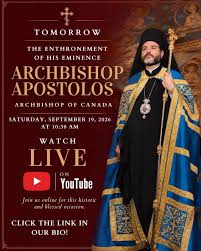
PHOTO: A livestream was announced but – from what our research showed – never materialized… Why? Were they afraid of the live commentary of the faithful?
A carefully managed image
The subsequent publicity also deserves perspective.
Favorable accounts have appeared across numerous Greek and Orthodox outlets, but they should not automatically be treated as numerous independent eyewitness reports. Some photographs were explicitly supplied by or credited to the Greek Orthodox Archdiocese of Canada. Other reports and photographs were republished from TNH, while additional institutional and community photo packages also circulated.
This demonstrates organized content distribution and syndication.
No reliable evidence presently establishes that favorable coverage was “purchased,” although such practices are quite common in the Church’s “tradition”. The simple presence at the enthronement of A. Diamataris, whose TNH has published numerous “question marks” about Apostolos (link here for many of those articles) in the past (but is now not simply silent, but joyous), reeks of “collusion”. TNH knows all the dirty secrets of Apostolos, esp. during his long duty in Astoria, where the paper is based. Bottom line: Syndicated reports, common institutional photographs, and repeated descriptions should not be mistaken for multiple independent confirmations of crowd sentiment.
That distinction matters most when assessing reports of an overwhelming “Axios” or an atmosphere of complete unanimity. Repetition across websites is not necessarily independent corroboration when several outlets are drawing upon the same reporting, photographs, or institutional sources.
Unity requires openness
Archbishop Apostolos placed unity at the center of his inaugural message. That is an admirable objective, but genuine Orthodox unity cannot mean managed unanimity.
It must include traditionalists, critics of ecumenism, dissatisfied parishioners, and faithful who question ecclesiastical decisions. A bishop becomes the spiritual father of those people too—not only those appearing in official photographs or on an RSVP list.
These concerns are not proof that Archbishop Apostolos’s ministry will fail. An enthronement is a beginning, not a verdict. But beginnings establish tone.
An RSVP-controlled ceremony in a capacity-limited cathedral; prominent dignitaries alongside questions about access for ordinary faithful; unresolved concerns about non-Orthodox participation; and a heavily managed institutional media presentation are, at minimum, bad omens that deserve attention.
The Parish Independence Question
A larger question will also test the meaning of the new Archbishop’s call for unity: the future independence and ownership status of Canada’s Greek Orthodox parishes and communities. Will Canada’s historically established communities retain meaningful control over their churches, property, and local administration as they have done since the beginning, or will the new era bring greater centralization under the Archdiocese – and the “Gang of Thieves” of the Phanar (who have already started selling properties in the U.S? Will parish assets and decision-making remain locally accountable, and will any proposed changes be presented openly to parishioners before they are implemented? These questions should not be treated as accusations or predictions. They are legitimate questions about governance, property, and accountability that the faithful have every right to ask—particularly at the beginning of a new archiepiscopal administration.
The remedy for these concerns is transparency: explain how attendance at the enthronement was determined, whether anyone without an RSVP was refused entry, identify the religious representatives present, clarify their precise liturgical role, and make the complete, unedited video readily accessible. The same principle should govern the future relationship between the Archdiocese and its parishes: no quiet centralization, no ambiguity over ownership, and no fundamental changes without full disclosure and meaningful participation by the affected communities.
And when the Church next gathers for such an important occasion, choose a venue large enough that no Orthodox Christian has to wonder whether he needed to be on a list to cry:
Axios—or Anaxios.
September 21, 2026, www.helleniscope.com, n.stamatakis@aol.com
DISCLAIMER: The views and statements expressed in this article constitute constitutionally protected opinions of this author.










Excellent commentary. Nick, you know Apostolos well. The question is, does he really care what you, I, or others think of him? His only concern is the same as Elpidoktonos’: power, money, and enjoying an illicit life. His statement to the priests made me wonder whether I should laugh or cry. I mean, “I don’t have two o faces, only one.” WOW. Let’s ask around. Start in Greece, travel across the Atlantic to Boston, Astoria, off to San Francisco, and then to us in New Jersey. I’d even recommend asking his archenemy (now) Elpidoktonos, Elpidofthoros, how many faces Apostolos has. Ask anyone, please. He is just as evil and probably worse. Canadians, watch your wallets. You’ll never realize that they’re gone.
Did the Cardinals also exclaim “Axios”?
That would be an interesting trend…exclude the Orthodox laity from the election of Orthodox bishops, but allow Cardinals to say “axios”…
A floral arch spelling out “Axios” no less! Po po, ti THRASOS!!!
When a bunch of gaidouria wearing rassa POSE FOR A PICTURE (!) in front of such arrogance, how can it not be deemed a mockery of what is Holy and a mockery of God himself.
I’d say don’t get me started, but it seems like it will not end until we put a foot down. The icons are WEEPING.
If Apostolos invited the heretics to his enthronement, what will stop him to invite them in a liturgy? I know of course that Apostolos is just a pawn. He does what he is told to do. I suspect the next thing we will see is concelebrations with the Catholics and we will start hearing more often the words “Orthodox Catholic Church”…
What can be done about all of this?
It’s time to get out the rotten tomatoes!
Even rotten tomatoes worth more than those rotten clergymen of the Phanar / AHEPA “holy” gang. I definitely wouldn’t waste my Greek yogurt for them…
Apostolos IS a pawn.
“Power, money & enjoying an illicit life.” You got his number!
https://spzh.eu/en/news/95869-elder-gabriel-us-pressured-patriarch-bartholomew-to-intervene-in-uoc-affairs
Everyone: Apostolos is an empty suit. No context, content or anything. His main and only objective is to overstuff his bank accounts and him mamas mattress. Let’s not forget his sisters (one of them is actually a brother) mattress here and in Rodos. His only other objective is to overthrow Elpidoktonos so he can move back to the U. S. He’ll be back before you know it. Trust me
There is not any feud between Apostolos and Elpidophoros. He installed Apostolos in the Metropolis of New Jersey. Apostolos is his protege. I agree that Apostolos won’t stay long in Canada. When Elpidophoros succeeds Bartholomew, the rumors say his health is declining, Apostolos will take Elpidophoros’ place! Rotation…
There was a serious fight between the two and we watched it closely… Territorial dispute mostly. I seriously doubt that Apostolos would come back to America as an Archbishop. He was sent to Canada to milk it for money and to slash the independence and power most parishes have.
Apostoli turned on his “friend” when he proved useless for him. Love turned to hate and hate to vengeance. The wonderful thing about it is that they both have a whole lot of dirt and filth on each other. Why? Because both being deviants, they fulfilled each other’s dreams and sexual appetites. Ask anyone in New York, New Jersey, San Francisco, Thessaloniki, Turkey etc. However, now that Apostoli is out of Elpidoktonos’ web, he’s liberated. Now, let’s see who destroys who and when. Black Bartholomew will eventually have to referee and pick and choose his favorite babe. And I’m sure, his other babes in Turkey and Australia who share him with Elpi will be pretty pissed.