


ΕΑΝ ΠΡΟΤΙΜΑΤΕ ΕΛΛΗΝΙΚΑ ΠΑΤΗΣΤΕ ΤΗ ΣΗΜΑΙΑ ΣΤΟ ΚΑΤΩ ΜΕΡΟΣ ΤΗΣ ΟΘΟΝΗΣ
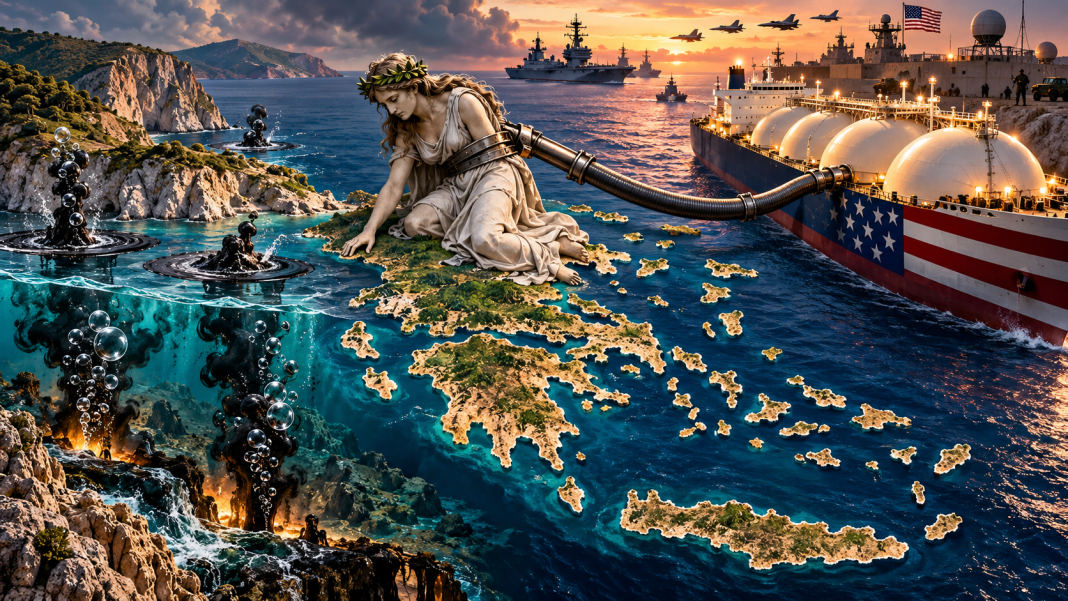
OUR MAIN IMAGE: An artistic rendition of the LNG situation in Greece.
Is Greece being turned into an American energy outpost – buying costly LNG while its own hydrocarbons remain largely unexplored for decades? And if Washington expects bases, weapons purchases, shipyards, ports, and energy dependence, what exactly is Greece getting in return?
By Nick Stamatakis
As Secretary of State Marco Rubio arrives in Athens for the U.S.-Greece Strategic Dialogue, one question should dominate:

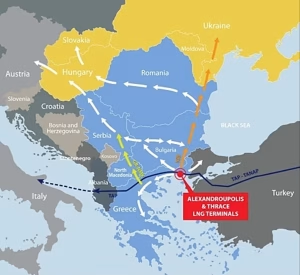
Who benefits from turning Greece and Southeastern Europe into captive markets for expensive American LNG?
Why should (relatively poor European countries) Greece, Bulgaria, Romania, Moldova and Ukraine pay for liquefaction, transatlantic shipping, regasification and new pipelines when cheaper regional alternatives may exist?
Does it make any business sense? Is this economics – or geopolitics dressed up as economics?
And why should Greece commit itself to decades of imported American LNG before it even knows what lies beneath its own seas?
Drill Greece First
Western Greece unquestionably has an active petroleum system.
Oil and asphalt have seeped naturally from Zakynthos since antiquity. Hydrocarbons have been discovered at West Katakolo. ExxonMobil, Energean and HELLENiQ are preparing to drill the potentially large Asopos prospect in the Ionian. Chevron has also entered Greek offshore exploration.
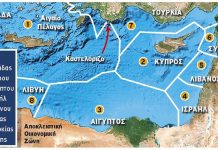
And Greece sits beside one of the world’s most important gas regions: Israel, Cyprus, Egypt and Libya.
So why the obsession with carrying American gas thousands of miles across the Atlantic?
Greeks can also reasonably ask whether foreign strategic interests have contributed to the extraordinary delays in exploring their own hydrocarbons. The decisive Prinos exploration campaign took place during the 1967–74 military dictatorship, and the discovery came in 1971. Whatever one’s judgment of that regime, it pursued drilling aggressively enough to prove that commercially exploitable Greek oil existed. Production began later, in 1981, and the Prinos complex produced substantial quantities for more than four decades.
Also, why has Albania produced plenty of oil for decades, while a few hundred meters south of the border in Greece – despite some efforts – nothing ever materialized? Did the geology suddenly change because of the border?
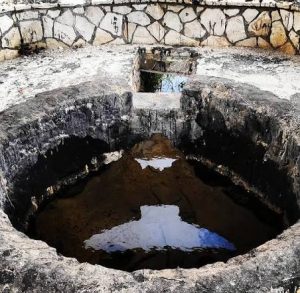
PHOTO: An open oil well in Keri Zakynthos.
Nearly a century ago, Greece had already demonstrated that Zakynthos petroleum was more than a geological curiosity. The Greek naval vessel Pergamos reportedly burned oil from Keri successfully—according to a parliamentary record, directly and without refining. Almost 100 years later, Greece is still being told to import LNG across the Atlantic before fully exploring its own hydrocarbons. (link here to records of the Greek Parliament). So the obvious question remains: if Greece proved a century ago that it had producible hydrocarbons, why has serious exploration advanced so slowly ever since?
No documentary proof shows an American master plan to keep Greek oil underground. However, evidence shows Washington intervened when exploration conflicted with its broader regional priorities. In 1976, Henry Kissinger explicitly discussed a moratorium on exploration in contested Aegean areas.
Is it unreasonable, then, for Greeks to suspect that their energy sovereignty has repeatedly been subordinated to Washington’s preferred regional balance?
If American LNG really is the superior commercial proposition, publish the numbers and prove it. Instead, Greece is being transformed into an LNG import and transit hub before its own hydrocarbon potential has even been properly tested.
That looks less like energy economics than geopolitics.
Washington’s recent energy strategy should inspire little confidence. Europe lost access to huge quantities of inexpensive Russian pipeline gas, Germany is being de-industrialized because of high energy costs, and Russia – far from being isolated – has moved dramatically closer to China while expanding its economic links with the BRICS and the Global South.
Was weakening Europe’s competitiveness while accelerating a Russia-China strategic alignment really the brilliant plan? Who are the MORONS in Washington who thought this through?
One UNCLOS for China, Another for Greece?
The contradiction becomes even harder to explain when maritime law enters the picture.
Greece ratified UNCLOS in 1995. The United States never did, yet Washington accepts much of it as customary international law and invokes its principles when American interests are involved. It also recognizes the basic principle important to Greece: islands generally generate territorial waters, EEZs and continental shelves.
Yet when Greek maritime rights collide with Turkish demands, Washington suddenly retreats behind phrases such as “dialogue,” “de-escalation” and “disputed waters.” And above all, we are tired of hearing theories of “equitable distribution” between Greece and Turkey from the State Department and other circles in DC.
Compare that with the South China Sea, where the United States vigorously condemns excessive Chinese claims, invokes international maritime law and supports Philippine rights against Beijing. Why does the principle become so much less clear when Turkey makes expansive claims, and Greece objects?
Where in the Law of the Sea (UNCLOS) did you see anything about “equitable distribution”? Is this what you applied between the US and the Bahamas or Cuba? Will you apply this in disputes between China and Taiwan or the Philippines? Please explain to us what your position truly is. Double standards, without a doubt…
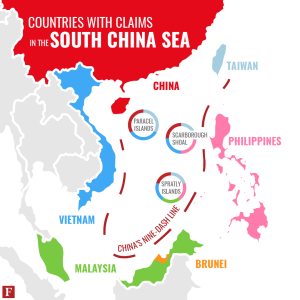
IMAGE: Map of the South China Sea, where China applies “equitable distribution” and uses giant machinery to form artificial islands so it can claim maritime zones… Did anyone see the recent Turkish ideas? They want to build such artificial islands in the Aegean!! (link here).
What Exactly Does Greece Get?
The United States enjoys extensive military access across Greece – so extensive that the country increasingly resembles an enormous American base. Greece buys American weapons, Rubio is reportedly expected to press for more, U.S. interests are expanding into Greek ports and shipyards, Washington wants Greek terminals and pipelines to carry American LNG, and ExxonMobil and Chevron are moving into Greek hydrocarbon exploration.
So what, exactly, does Greece receive from this celebrated “strategic alliance”?
Greece offers bases, purchases, infrastructure, and market access, while Washington becomes remarkably cautious whenever defending Greek interests might seriously inconvenience Ankara.

PHOTO: Costas Karamanlis defied George W. Bush (who demanded easy NATO expansion including Skopje) at the Bucharest Summit of 2008. He had to act evasively from his foreign minister, Dora Bakoyianni, a known promoter of US Deep State interests.
Who in Washington decided that treating Greece like a “colony” serves long-term American interests? Similar attitudes helped fuel the anti-American backlash that transformed Greek politics after the dictatorship and contributed to decades of radicalization – including terrorist organizations that killed Americans, among many others, and were only recently put out of business.
Is this what the American establishment plans? To repeat the same mistakes of the past 60-70 years? Are they so foolish as to ignore the basic elements of Greek character and identity?
The broader danger is the same across the West: political and economic elites concentrate wealth and power while showing growing contempt for the middle and working classes – and then seem surprised by the anger that follows. And the revolts that are certain to come: history offers plenty of warnings. But nobody in DC studies history.
Out of today’s political disorder, Greece may eventually produce a set of leaders very different from the globalist puppets of recent years. Given the country’s extraordinary geopolitical importance, continued strategic blindness in Washington could turn Greece from a dependable ally into a deeply alienated one. If that happens, the United States could ultimately lose much of its position in the Eastern Mediterranean, just as it has lost influence elsewhere in regions it once dominated. Is this really the strategic future Washington’s elites want to create?
PS. Please do not tell me that I should blame the Greek politicians more than the American Oligarchs. As you all know, I don’t miss an opportunity to blame the corrupt puppets who recently governed Greece. However, let’s not forget that when Greece had a leader who decided to act as a patriot – as in the case of PM Costas Karamanlis (2004-2009) – the CIA organized an assassination attempt against him. Please look it up or search Helleniscope for details if anyone doubts me. It’s also part of the Greek judicial record.
October 4, 2026, www.helleniscope.com, n.stamatakis@aol.com
DISCLAIMER: The views and statements expressed in this article constitute constitutionally protected opinions of this author.














This was a powerhouse of an article. Yes, Greece is caught in a trap.
Rubio set to invoke Western civilization in speech from Athens’ Pnyx 🇬🇷
ekathimerini (dot) com/politics/foreign-policy/1317435/rubio-to-invoke-western-civilization-in-speech-from-athens-pnyx/
What does “invoke” mean in simple words?
AI Overview
To invoke means to call upon, use, or bring into action a law, rule, or higher power.
Common Ways to Use “Invoke”
Using a rule or law: You invoke a law when you use it to protect yourself or take action.
(Example: A person in court might “invoke” their right to remain silent.)
🤔 Asking for help: You invoke a god or higher power when you pray 🙏 for help or protection.
Summoning by magic: In stories, characters invoke spirits or magic powers by calling them forward.
Invoke vs. Evoke
Invoke means to call upon or use something active like a rule.
Evoke means to bring to mind a feeling or memory. (Example: An old song can evoke happy memories.)