

ΕΑΝ ΠΡΟΤΙΜΑΤΕ ΕΛΛΗΝΙΚΑ ΠΑΤΗΣΤΕ ΤΗ ΣΗΜΑΙΑ ΣΤΟ ΚΑΤΩ ΜΕΡΟΣ ΤΗΣ ΟΘΟΝΗΣ
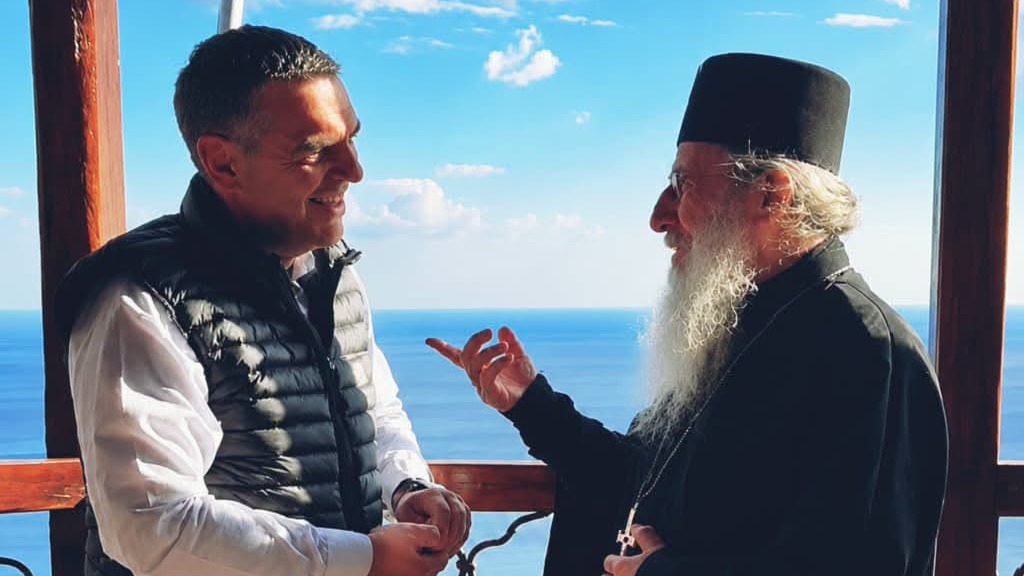
OUR MAIN PHOTO: Alexis Tsipras at Simonopetra Monastery with Abbot Elissaios.
Orthodoxy welcomes sincere repentance, and Mount Athos has never been a place reserved only for those whose faith is already settled. Yet Alexis Tsipras’s second highly symbolic visit to the Holy Mountain, like his first in August 2014, comes during an unmistakably pre-election political period, raising a legitimate question that photographs alone cannot answer.
By Nick Stamatakis
Orthodoxy welcomes repentance, sincere repentance, because metanoia is not merely a change of public language but a turning of the person toward truth; at the same time, the Church does not interrogate a visitor at the gate, so Alexis Tsipras’s return to Mount Athos should neither be mocked simply because he has publicly identified as an atheist nor automatically treated as proof that he has become a believer. During his October 1–2, 2026 visit he spoke of Athos as a journey into history, spiritual treasures and “the deeper meaning of human existence,” but he made no public profession of Christian faith.
This was Tsipras’s second confirmed visit to Athos; the first took place on August 7–9, 2014, when he was leader of the opposition, and SYRIZA was building momentum after finishing first in the May European elections. He went to Karyes and the Protaton, visited Simonopetra, Karakallou, Iviron, Stavronikita and Xenophontos, attended the morning service before leaving, ate with monks, and established relationships with Athonite figures that reportedly continued afterward. The chronology matters: the January 25, 2015 election came only 169 days later, and although it had not formally been called in August, Greece was already living through an extended pre-election period because the coming presidential vote could trigger parliamentary elections, and Tsipras was openly demanding an early national vote.
That makes the comparison with 2026 strong. Tsipras returned to Athos on October 1 while again leading an opposition force and campaigning for the next national contest; Prime Minister Kyriakos Mitsotakis has ruled out an autumn snap election and says voting will take place in spring 2027, but politically Greece is plainly in a pre-election phase. Contemporary reporting has interpreted the visit as part of Tsipras’s attempt to broaden his appeal toward centrist and culturally Orthodox voters, while Dnews explicitly noted the repetition of an Athos visit several months before another expected election.
Notably, in neither his 2014 nor his 2026 Athos visit is Tsipras documented publicly making the sign of the Cross; in 2014 the omission was explicitly remarked upon, even as questions persisted about the ten or fifteen minutes he spent alone before the “Axion Estin” icon.
The itinerary reinforced those political readings without proving them. Tsipras visited Iviron and stayed at Simonopetra, reportedly at the invitation of Abbot Elissaios, with whom he has maintained contact since 2014; he later visited the cell of Papa-Tychon, spiritual father of Saint Paisios, and Vatopedi, where Abbot Ephraim received him. Such images carry symbolic weight in Greece, particularly for a politician long associated with the secular Left, and Tsipras himself publicized what was described as a private visit.
The fairest critical conclusion is therefore not that an atheist has no place on Athos, because such an argument sits uneasily with Orthodoxy’s openness to repentance and spiritual searching, but that political calculation cannot reasonably be excluded. The timing in both 2014 and 2026, the public imagery and the effort to reach voters beyond the traditional Left make political repositioning a plausible part of the story, even though his long-standing relationships with particular monasteries show that the visit was not invented overnight for electoral purposes.
Whether Tsipras is still an atheist remains separate, because he has issued no verified statement during this visit announcing conversion or repentance; his children were not baptized, and his earlier statements described him as a nonbeliever who nevertheless respected Orthodoxy and the Church. Reports that his mother, Aristi, was deeply Orthodox and had belonged to the “Zoi” movement add a family dimension, although that claim rests on secondary reporting rather than a primary source I can independently verify. If sincere spiritual movement is occurring, Orthodoxy would welcome it; politically, however, the repetition is difficult to ignore, because on both occasions Tsipras went to Athos when Greece was already looking toward the ballot box.
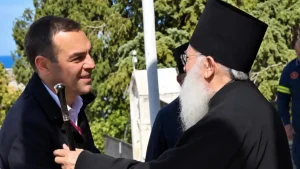
PHOTO: Tsipras with Abbot Ephraim of Vatopedi during his recent visit.
Political calculus was not confined to Tsipras, because Abbot Ephraim of Vatopedi has himself shown considerable skill in moving between rival centers of power: after his celebrated Russian contacts surrounding the Holy Belt in 2011, he returned to Moscow in October 2017 and met Vladimir Putin on October 26, presenting him with an Athonite icon, while the following year 2018, his visit to America included meetings with senior State Department officials and other influential figures in Washington and the Greek-American establishment – and notably ended in the Hamptons with a visit to Karloutsos. Thus, while Tsipras may understand the electoral symbolism of appearing on Mount Athos, Abbot Ephraim has demonstrated an equally sophisticated form of geopolitical positioning, maintaining access in both Moscow and Washington at a time when Russia and the United States were competing for influence in the Orthodox world. The encounter therefore reflects political calculus on both sides: Tsipras seeks the symbolic authority of Orthodoxy, while Vatopedi has repeatedly shown how spiritual authority can also generate access to secular power.
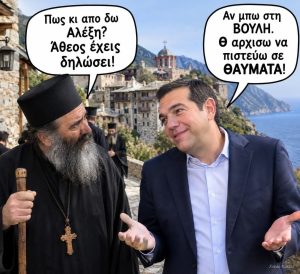
Please allow me to close this report and analysis with a funny cartoon:
- How come you are here, Alexis? Didn’t you say you were an atheist?
- If I manage to get my party in the Parliament, I will start believing in miracles!
October 5, 2026, www.helleniscope.com, n.stamatakis@aol.com
DISCLAIMER: The views and statements expressed in this article constitute constitutionally protected opinions of this author.










In cases like these, where someone has scandalized many people by openly and proudly proclaiming his sin (declaration of atheism on public television), the only sign of repentance that can be believed is if Tsipras, in the same manner, on public Television, proclaims the Orthodox Faith. Anything less is a delusion with strong undertones of “fakeness”, and serves as an insincere photo-op.
This method of public “Confession of Faith” has been utilized for many centuries by our Church Fathers.
P.S.
We will remind readers that Simonopetra happens to be on the list of Monasteries that appear to have voted in favor of sending a delegation to the “enthronment” of Epiphanios. We will also remind readers that Simonopetra is one of the “nearly impossible” monasteries to visit on Mt. Athos, unless you “know someone” or you are from a “wealthier nation than Greece”, or a dignitary / famous actor / etc… Vatopedi is also extremely difficult to secure hospitality with, and that monastery also voted in favor of sending a delegation to Kiev back in 2019….
In contrast, why didn’t Tsipras (the “executor” of the treasonous Prespes accord) dare visit Karakalou Monastery, to take a photo op next to the inscription by Strabo on its inner courtyard walls «Έστιν ουν Ελλάς και η Μακεδονία» (“therefore Macedonia is also Hellas”)? That would have been an opportunity to demonstrate a great “moment of repentance”, too, right?