
ΕΑΝ ΠΡΟΤΙΜΑΤΕ ΕΛΛΗΝΙΚΑ ΠΑΤΗΣΤΕ ΤΗ ΣΗΜΑΙΑ ΣΤΟ ΚΑΤΩ ΜΕΡΟΣ ΤΗΣ ΟΘΟΝΗΣ
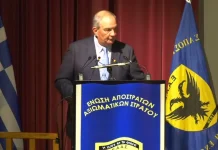
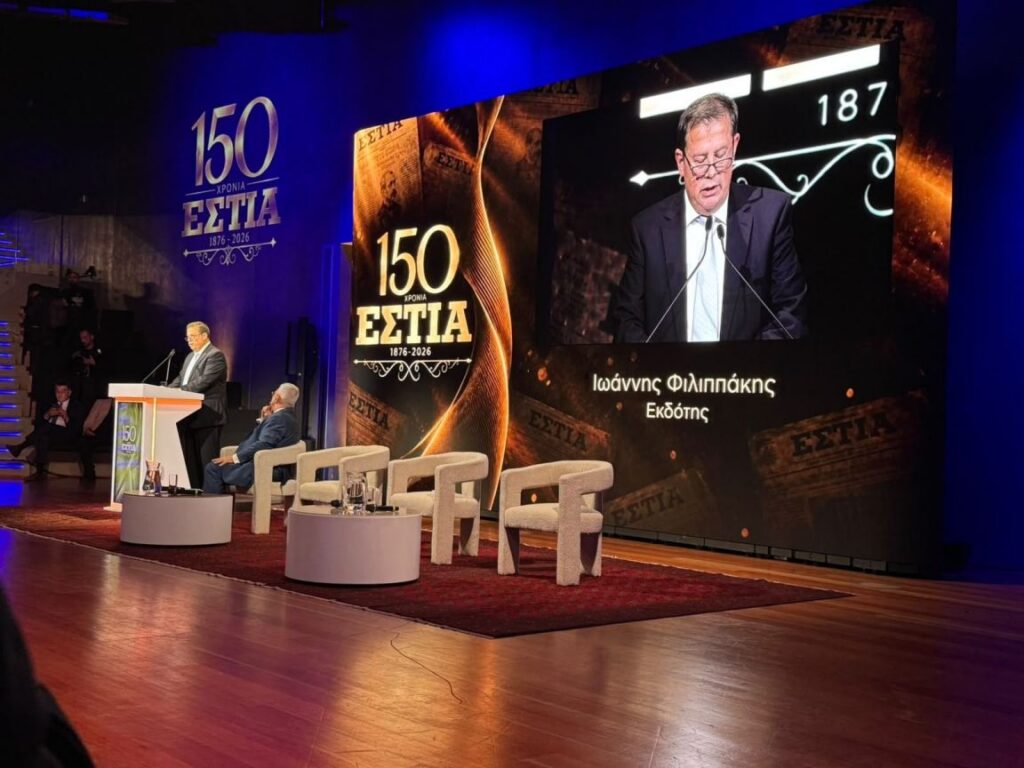
OUR MAIN PHOTO: Publisher Giannis Philippakis, at the podium of the Anniversary celebration.
For a century and a half, Estia has remained a distinctive voice in Greek journalism, closely intertwined with the country’s political, intellectual and cultural life. Its 150th-anniversary celebration highlighted not only the newspaper’s remarkable continuity, but also its determination to preserve its identity and values in a rapidly changing media landscape.
By Nick Stamatakis
Founded in Athens in 1876 by Pavlos Diomidis as a weekly literary periodical, Estia gradually developed from a forum for letters and intellectual life into one of the most enduring institutions of the Greek press, and in 1894, under the poet and journalist Georgios Drosinis, it was transformed into a daily newspaper covering politics, culture and public affairs. Over the decades, it became the oldest Greek daily newspaper still in circulation, preserving a distinctive editorial identity and even retaining the polytonic system of Greek accentuation, while its pages hosted major figures of modern Greek letters, including Kostis Palamas, Grigorios Xenopoulos and Drosinis himself. Its publication was interrupted only during the German occupation, from 1941 to 1944, after which it resumed and continued to record Greece’s political, social, and cultural evolution across three centuries.
That long continuity formed the backdrop to Estia’s 150th-anniversary celebration, held on 2 October 2026 at the Athens Conservatoire under the title “Estia – 150 Years of Excellence,” where representatives of political, academic, journalistic, economic and cultural life gathered to mark the newspaper’s historical contribution and to debate the meaning of excellence in contemporary Greece. Publisher Ioannis Filippakis presented the anniversary as both an honour and a responsibility, stressing that the newspaper’s century-and-a-half legacy belongs not only to the history of the press but also to the history of Greek democracy, while director Manolis Kottakis described Estia as a newspaper of opinion, reporting and intervention, committed to defending what it regards as the cultural and intellectual boundaries of Hellenism.
The evening’s speeches broadened the commemoration beyond institutional nostalgia, with Stanford professor John Ioannidis (you can watch above his excellent speech about “αχρηστία” instead of “αριστεία” – English subtitles) offering a sharply critical reflection on meritocracy and mediocrity, Metropolitan Gabriel of Nea Ionia linking excellence to cultivation, service and social responsibility, and scholar Meletis Meletopoulos emphasizing independent judgment, patriotism and the enduring value of human creativity in the age of artificial intelligence. The presence of senior political figures, including Parliament Speaker Nikitas Kaklamanis, Defence Minister Nikos Dendias, former President Prokopis Pavlopoulos and former prime minister Antonis Samaras, underlined the public significance of the anniversary, while the overall tone of the coverage presented the celebration not simply as a tribute to longevity, but as a statement that Estia intends to carry its historical identity into a rapidly changing media future.
Hands Off Greece and Hellenism, Mr. Mitsotakis!
October 5, 2026 | 22:09
Enough already with these… national-nihilist deals!
Manolis Kottakis
Two points formed the heart of my speech marking the 150th anniversary of Estia.
The first was the great struggle that lies ahead of us to ensure that the flame of Hellenism is not extinguished. I said this in 2024 at an event commemorating the Fall of Constantinople, at the dependency of Simonopetra, at the Monastery of Saint Nikodimos outside Goumenissa in Kilkis, and I have not stopped repeating it since. I am glad that Yannis Smaragdis also repeats it frequently.
The second point, which is an extension of the first, emerged from my thoughts following an excellent conversation we had with the distinguished Professor John Ioannidis, when Yannis Filippakis and I visited him at his country home in Derveni, Corinthia, to coordinate plans for the event.
We discussed the concern that, through the repetition and dissemination of inaccurate information about our identity, the fabric of Artificial Intelligence may in the future completely distort our national memory and vindicate the opponents of our country.
This is a colossal battle, one that we have failed to realize is already under way. And if we do not win it, Greece will in the future be described on the digital web exactly as its enemies describe it today when they speak about what happened in Tripolitsa, what happened in Asia Minor, what happened in Epirus, Thrace and Macedonia, and who Kapodistrias, Karaiskakis and Botsaris were.
The monstrous distortions now circulating will become official History. Digital History. The most dangerous kind of History!
I set out this framework at the beginning of today’s article in order to explain to some people who are bothered by criticism why it is a tremendous mistake to regard History as an obstacle to deals.
History has value as intangible capital, but even in purely monetary terms it is worth many billions more than short-lived deals—interstate or otherwise—being made in our region.
The prime minister cannot understand why we are making such a fuss over the sacred relics of the Eikosifoinissa Monastery, and he sees ghosts where there are none.
We are making a fuss, first of all, not merely because not everything is being returned, but because the memorandum to which he boldly affixed his signature did not include the word “stolen,” or at least the verb “removed.” Instead, the word “transferred” was chosen.
In other words, in the future, digital History will write, on the basis of this memorandum, that the Bulgarians did not steal sacred relics from our region in 1944, but simply “transferred” them to Sofia using the ACS courier service of the day!
But the issue is not only the relics.
The deeper strategic issue is that our neighbors in the Balkans, as well as our Turkish neighbors, are watching us and judging us by the way we handle a series of issues concerning our cultural heritage—from the name of Macedonia to the relics stolen by the Bulgarians, which they refuse to hand over, even though we effectively handed their government a gift ahead of the upcoming presidential elections.
And the conclusion they reach is that we are not prepared to fight for anything concerning our History or our own identity.
We care about pipelines, hubs, cables, deals, contracts and money—but not about defending who we really are.
And we are not prepared to fight even when we are paying them. That is the most astonishing thing of all.
The husband of the president of the European Commission received a huge contract from the Hellenic Republic for his company during the pandemic and the vaccine rollout.
And the lady’s way of saying thank you was to welcome the people from Skopje in Brussels the other day with phrases such as, “We welcome Macedonian culture and the Macedonian language.”
And we did not protest at all. Nor, of course, did we raise the possibility of a veto over their accession path because of all these irredentist issues.
Nor, naturally, did the prime minister take her by the hand—since we are paying her anyway—and take her to the Museum of Vergina so she could see what real Macedonian culture is.
Those Who Govern Us
With our rulers’ mentality, what will prevail in the future across the world of Artificial Intelligence will be the one and only Macedonia of Skopje, because we have absolutely no interest in fighting for our own, genuinely one and only Macedonia.
All of its ancient remains were found here!
Instead, we even conceal the statue of Alexander the Great on the Thessaloniki waterfront for the sake of a singer’s concert.
The fact that a treaty has been signed means nothing to the soul of the citizens—centuries of Greek History cannot be erased in a single minute, in a single moment, at Psarades on Lake Prespa!—but it also means nothing in the broader course of History.
We are very ready to disregard treaties when we are the ones who have to “give,” as happened with the Treaty of Neuilly, but not to defend treaties when we stand to receive something!
So how is a Turk, whose patriotic sentiment is highly developed, supposed to believe that we, as the Hellenic Republic, will fight for the Aegean and for our islands when he sees us so casually surrendering sacred relics, as well as the name of Macedonia, without the slightest protest?
All on the argument that a treaty binds us.
And if—as I hope is not the case—the relics that came from Bulgaria were returned to us through a deposit or custodial arrangement, in other words with Bulgaria effectively retaining ownership, then in the end we ought to be ashamed to show our faces in public.
The Mistake
A second example of how wrongly we think when we put deals first and leave History behind is the Sinirlioğlu affair.
We voted for the Turkish diplomat—an outstanding diplomat from the standpoint of his own people—to become Secretary General of the OSCE, even going against the wishes of our brothers in Cyprus, who naturally, given their neighboring invader, would never have voted for a Turk to hold a post in an international organization.
At the time, we celebrated our supposedly pioneering approach, when in reality we simply lent our own respectability and prestige to our opponent.
But now that Erdoğan has decided to propose the Turkish diplomat for the position of Secretary-General of the United Nations, and we understand what that would mean, should he be elected, for the Cyprus issue, Greek-Turkish relations and all our national issues, we are desperately campaigning behind the scenes to prevent him from announcing his candidacy and, by extension, to prevent his election.
In reality, we are engaged in a struggle that merely demonstrates to ourselves how foolish we are and how our neighbors exploit us in our naivety—at best, because I do not wish to consider anything more serious.
Had we thought of the obvious—that you never give your vote to a theorist of the “Blue Homeland” doctrine who challenges your History in the Aegean stretching back centuries—we would never have made this mistake.
With these two observations, therefore, I want to tell the prime minister that he should not be irritated by the voices being raised throughout the country against his decisions, whose national, religious and political consequences he completely underestimated because he has no feel for History.
I want to ask him to stop trying to obstruct the views of others through third-party proxies, little nobodies and clerical little nobodies.
We know everything.
If we are not speaking, we are doing so for the country’s good at this stage.
But at some point this bad joke must end: anyone who speaks out and states the obvious about our History is subjected to bullying behind the scenes—whether that person is a journalist, a Stanford academic or an academic at a Greek private university, a politician who has been expelled from his party, a metropolitan bishop, a local government official, or anyone else.
At some point, this has to stop.
History is an obstacle to deals because the peoples subjected to those deals still possess a strong historical memory, despite all the brainwashing, and they react.
And no political opponent of the prime minister in Athens is needed to ignite that reaction.
Peoples ignite all by themselves.