
By Dimitris Konstantakopoulos
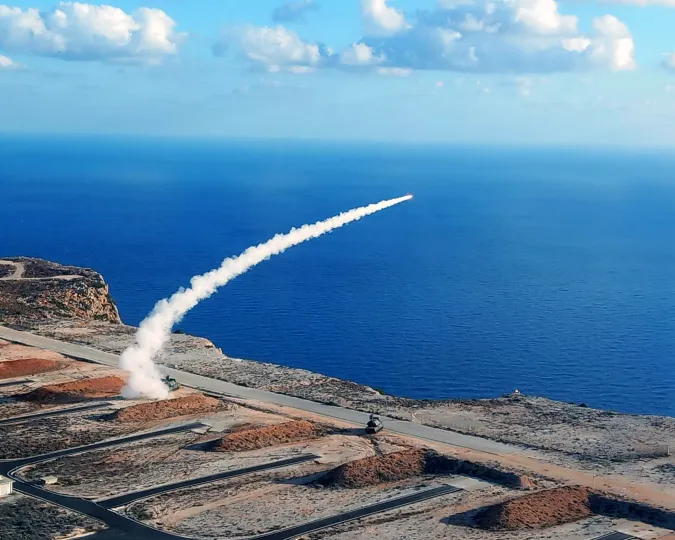
The government gleefully announced the signing of the contract with Israel for the “Achilles Shield,” claiming that it will make Greece virtually invulnerable within three years. In the article that follows, we will argue that the “Achilles Shield” not only fails to meet the needs of Greek national defense, but also poses a major strategic danger to Greece (and Cyprus).
I know that this position may strike you as extreme or even paradoxical, but I ask you to read the article to the end before forming your own opinion, whether you agree or disagree with mine.
I am very much afraid that I am not the one being extreme. What is extreme and paradoxical has been happening for a long time in our country and internationally, as even the most ordinary Greek citizen knows.
The announcement of the purchase of the Shield triggered, as one might expect, a barrage of propagandistic and promotional reports in the establishment media. But it also generated enormous enthusiasm among a large group of supposed geopolitical analysts, former diplomats, retired military officers of every kind, academics and journalists who have for some time been criticizing the government for submissiveness, urging it to go to war with Turkey tomorrow morning, liberate Cyprus and immediately proclaim 12 nautical miles in the Aegean, regardless of the consequences.
As soon as the Shield was announced, this entire group of “neo-nationalist friends of Israel” rushed to welcome its acquisition and, unable to contain their enthusiasm, called for us to go to war against Turkey right now and liberate the occupied territories, implementing the adventurist and incoherent doctrine of the “preemptive strike” or “preventive war.”
Indeed, their enthusiasm was so great that they forgot that we are supposed to become “invulnerable” in three years! They want us to do all this, if possible, within the current month or year. They are in a hurry to crush Turkey (just as Zelensky was in a hurry to crush Russia).
For now, we know little about the “Shield.” But even what we do know is enough to give us very serious cause for concern.
Let me say in advance that the choice of name also struck me, because we know that symbols play an important role in international politics. When the then Minister of Defense, Gerasimos Arsenis, visited Israel for the first time, our friends arranged for the visit to coincide with the celebration of Hanukkah, that is, the celebration—continuing after two thousand years—of the victory of the Maccabean rebels against the Greeks. Naturally, no one at the Pentagon thought to set another date. They did not even know the country they were dealing with. Even today, in his speeches to his people, Mr. Netanyahu frequently cites the Maccabees as an example, along with other passages from the Bible.
“Achilles Shield” is a fine, classically inspired name. It has only one little problem. Unfortunately, this formidable Shield did not protect Achilles, who was killed despite using it. So I, in turn, wonder—and I think not without reason—who on earth came up with the idea and who decided to give this system that name.
Let us now look at just some of the problems with this “Shield” before moving on to the most important one.
1. It will cost us an arm and a leg. They say €3.5 billion initially and €6 billion in total. We said we should defend our country, not destroy it economically and socially.
That money will be taken away from social and other income, from the National Health System, from our schools, and even from other urgent and current needs. Yes, we should defend Greece—but not a Greece without Greeks, which is what it will become as a result of the policies being pursued, compounded by colossal military expenditure.
After all, can a country that is disintegrating in every conceivable way win a war?
And if someone says, “But we are buying it to defend ourselves and deter war,” we reserve the right to explain in another article why this system risks bringing war closer rather than preventing it.
2. Judging by Israel’s own performance, even though it had the assistance of the Americans and NATO, the Israeli “Shield,” known as the “Iron Dome,” proved to be somewhat leaky. It was unable to prevent a large number of attacks against Israel by Iran, the Houthis, or even Hezbollah. Of course, Israeli propagandists maintain that it was relatively effective (what else would they say?), but reality contradicts them, despite the systematic efforts of the Israeli and Western media to conceal the significance of the strikes Israel sustained, and despite the fact that the Iranians, because of the graduated strategy they adopted, refrained from striking targets such as the Demona nuclear facility, perhaps in an effort to prevent Israel and/or the United States from using nuclear weapons.
Even the Israelis, however, have acknowledged that the system is economically inefficient, since each Tamir interceptor missile costs between $40,000 and $50,000, while their opponents’ rockets cost only a few hundred dollars. Its financing relies to a large extent on American funding. Although the system is sophisticated, very large simultaneous attacks (saturation) or prolonged wars have raised concerns about interceptor stockpiles.
3. This system makes all Greek forces indefinitely dependent on Israel, the most unpredictable country in the world, which has no problem changing alliances whenever it sees fit, failing to honor agreements, and, when necessary, even confronting its closest allies, such as the United States, whose destroyer Liberty it sank without consequences. Not only did they sink it, but they also bombed the ship’s lifeboats and antennas so that no SOS could be transmitted, all the sailors and officers would die, and the incident would remain unexplained—an incident that President Johnson ultimately covered up at the time. There are many related references online, including an interesting article by Greek-American Professor James Petras, an adviser to Andreas Papandreou and founder of the Center for Mediterranean Studies.
4. Throughout its history, dating back to ancient times, Israel has never distinguished itself by maintaining a friendly attitude toward Hellenism. For decades it was Turkey’s principal ally in the eastern Mediterranean, and it could become so again after Erdoğan, or if Erdoğan changes his policy. What would become of us then? A sandwich between Turkey and Israel, like Syria?
We referred to such a possibility as early as 2012, writing that “the Greeks risk being divided geoeconomically between Germany and the Markets, and geopolitically between Israel and Turkey.”*
5. It is not in the interests of Greece (and Cyprus) to identify itself with a state that is committing genocide and has provoked worldwide outrage, much less to appear as an instrument of Israel, as has already begun to happen internationally.
Mr. Netanyahu achieved the impossible at the latest General Assembly: leaders and representatives from almost half the world got up and walked out of the hall. Identification with this state and its leadership—and even more so, joint exercises and military cooperation with this country—strikes a critical blow against the moral and political-diplomatic standing of Greece and Cyprus, against their “soft power.”
Cyprus’s global standing helped secure favorable UN resolutions in 1964, 1974, and 1983, as well as the U.S. Congress’s decision to impose an arms embargo on Turkey.
6. The Greek people are deeply divided on this issue. In one poll, more than 60%, despite the relentless propaganda in favor of military cooperation with Israel, disapprove of it. In another, only 51% approve of acquiring the Achilles Shield, even though there has been no major public debate on the issue and, in all probability, most people are unaware of most of the facts mentioned above.
Yet in order to conduct an effective foreign policy—and even more so to defend the country and confront threats, and still more if, God forbid, you have to go to war—you need to have the great majority of the people united behind you like an iron fist, rather than acting against their beliefs and dividing them.
7. After the defeat of the Americans and Israelis in Iran, no one can say what the future of Israel and of the entire U.S.–Israel axis will be, an axis that claims to represent “Good” but behaves rather more like an “Axis of Evil.”
Does it make sense for a small country, in an explosive environment of geopolitical upheaval that does not allow us to predict even one month ahead, to place all its eggs fanatically and without the slightest reservation in a single basket, thereby objectively turning itself—through all these systems, bases, foreign troops and factories supplying Israel—into a potential target?
Or, to put it simply: do we have any interest, particularly given the condition we are in, in becoming increasingly entangled in the military confrontation now spreading across Western Asia? What other outcome but disaster can we expect from such involvement?
Military officers more qualified than we are have also analyzed other major technical problems, such as retired Air Vice Marshal Dimitris Pantelatos.
For all the reasons we have mentioned, we believe that the acquisition of the “Achilles Shield” is a grave strategic mistake by Athens. Unfortunately, however, there are much worse things concerning this system. Those will be the subject of our next article.
==============
* For the historical record, this article, which I translated into English and sent to various friends around Europe, attracted the attention of former German Chancellor Helmut Schmidt, who sent me a very encouraging message. Perhaps it was a coincidence—I cannot know—but two days later he went to the SPD congress and appeared on German television, where he launched a fierce attack on Chancellor Merkel over her policy toward the Greek issue.
It also attracted the attention of the European People’s Party think tank, which organized a seminar on the European crisis at the European Parliament building in Brussels and invited me to speak in February 2012. I went and spoke to them openly, placing particular emphasis on the role of Goldman Sachs and explaining what would happen throughout Europe if the memorandum-driven destruction of Greece continued.
I still remember what the Spanish MEP who chaired the meeting told me when he said goodbye: “You have a lot of courage, Mr. Konstantakopoulos.”
The Russians also translated the article into Russian and published it on the website of an institute under the Presidency. Only in Greece did it attract no interest—not even from SYRIZA’s supposedly anti-memorandum leadership at the time. The only person who was deeply shaken when I sent it to him was the late Petros Molyviatis.
“But if what you are saying is correct, we are heading for Armageddon,” he said.
It turned out that it is very difficult, if not impossible, to defend your country when its leadership does not want to.