

ΕΑΝ ΠΡΟΤΙΜΑΤΕ ΕΛΛΗΝΙΚΑ ΠΑΤΗΣΤΕ ΤΗ ΣΗΜΑΙΑ ΣΤΟ ΚΑΤΩ ΜΕΡΟΣ ΤΗΣ ΟΘΟΝΗΣ
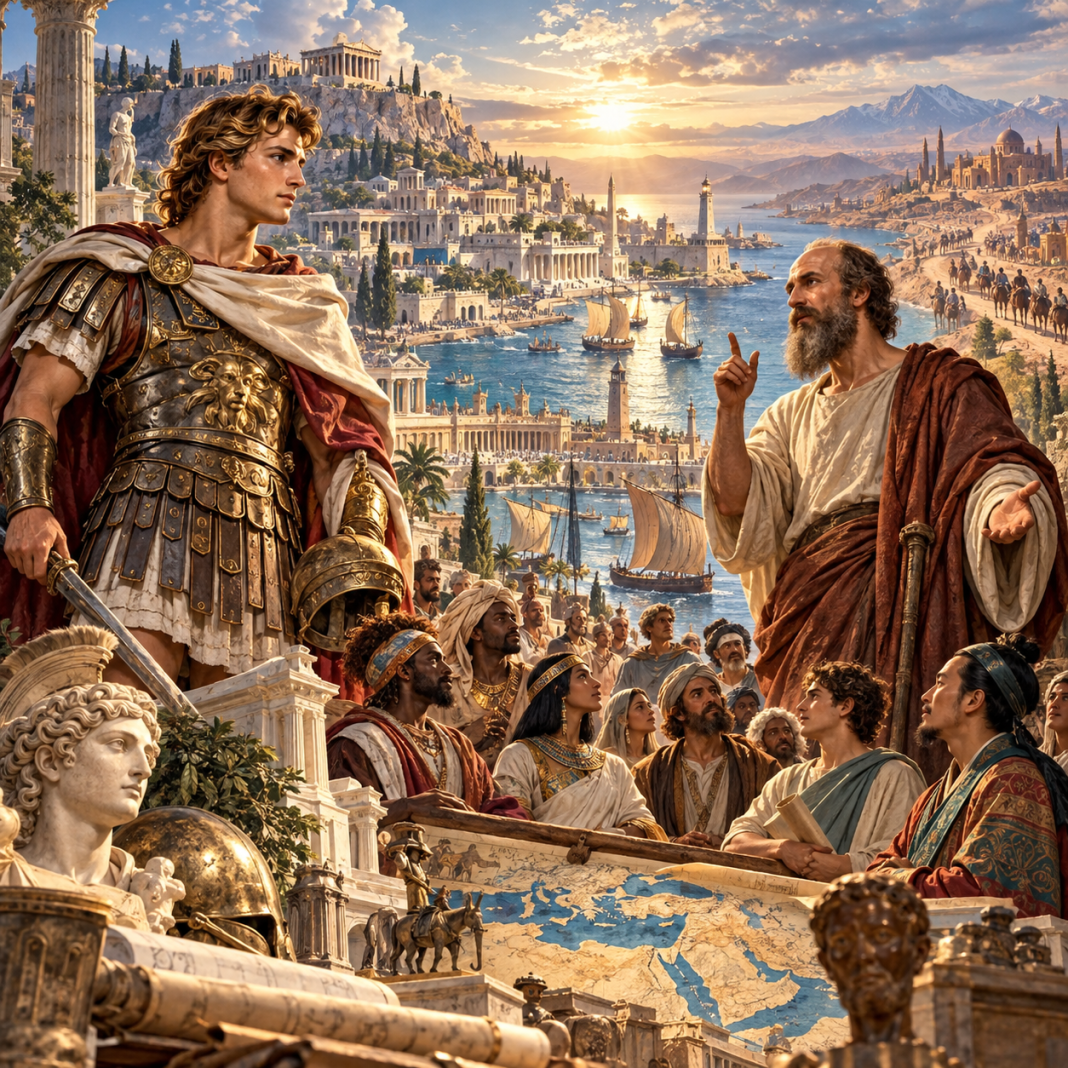
OUR MAIN IMAGE: An artistic rendition of Alexandrian Hellenistic Ecumenical Civilization. From Alexander to Apostle Paul through Classical and Stoic philosophy.
From Alexander’s Hellenistic Ecumene to Christianity’s Universalism: Will America and the West overcome the “Judeo-Christian” Colonialists to become a “Shining City on A Hill” that President Reagan promoted and – much earlier – President J.F. Kennedy had emphasized with its staunch anti-colonialist policies? Put simply: The Hellenic Cosmopolitanism that gave rise to Christianity would never approve of the Genocide Israel has committed. Rubio does. Until he changes course, he is disqualified from adopting Hellenic Civilizational Ideals.
By Nick Stamatakis
Marco Rubio’s speech in Athens deserves the applause it received from Helleniscope because he recognized a fundamental historical truth that too many Western leaders overlook: Ancient Greek civilization laid the philosophical, moral, and political foundations of the Western world, profoundly influenced the principles embodied in the American Constitution, and provided the intellectual environment in which Christianity would emerge and spread. In recent decades, the West has taken a declining course toward a woke globalist “ideal” and has lost its basic ideals.
(PARENTHESIS: I will bypass for now the very credible reports we have received from Athens that Rubio would NOT verify his visit in Athens unless the Greek Government – and its relevant committee would increase the US weapons purchase from $3B to $4B – a very hefty price to pay for some big words with NO – so far NONE – practical significance in terms of the threats Greece is faced with from Turkey. It was very expensive flattery, likely to have no real consequences, as you will see below.)
Yet Rubio left largely ignored an equally important dimension of the Hellenic legacy, one that distinguishes the universalist aspirations of the Hellenistic world from the racial hierarchies, economic exploitation, and imperial domination that characterized much of European colonialism over the past five centuries.
Alexander the Great, educated by Aristotle himself, conquered an enormous territory stretching from Greece and Egypt through Persia and Central Asia to the frontiers of India, but his achievement extended far beyond military victories, because the Hellenistic Ecumene that emerged from his conquests connected diverse peoples through Greek language, education, philosophy, commerce, and cultural exchange. Alexander founded cities across his empire, including Alexandria Eschate, or Alexandria the Farthest, in present-day Tajikistan near Uzbekistan, while encouraging marriages between his Macedonian generals and soldiers and local women, most famously at Susa, where Greek and Macedonian officers married Persian noblewomen.
Alexander was certainly no modern humanitarian when it came to warfare; he was all about victory, and his conquests involved violence and destruction, as wars naturally do. Notably, slavery had a totally different meaning in ancient Greece and had not much to do with the exploitative “Judeo-Christian” colonialist practices. But the civilization that developed after his death in 323 BC, his true legacy, produced an extraordinary synthesis of Greek, Egyptian, Persian, Central Asian, and Indian traditions, creating an interconnected cultural world whose influence survived for centuries.
Even today, Alexander lives in the historical and literary imagination of peoples stretching from Egypt and Iran to Afghanistan, Pakistan, and India, where he is widely known as Iskander or Sikandar, while communities such as the Kalash and certain populations of the Hindu Kush preserve traditions associating their ancestry with his soldiers, including evidence of direct descent even genetically. The enduring legacy is more securely demonstrated by the Greek cities, inscriptions, coins, kingdoms, philosophical traditions, and Greco-Buddhist artistic achievements that testify to the remarkable reach of Hellenistic civilization.
This historical experience invites an uncomfortable comparison with later European colonial empires – particularly those of Britain and France- which I would call “Judeo-Christian colonialists – whose domination of Africa, Asia, and other regions frequently involved systematic resource extraction, coercive labor, racial discrimination, and the subordination of local populations to metropolitan interests. The relationship between France and uranium-rich Niger, for example, became a symbol of continuing postcolonial economic dependence: the French paid a measly 5% for the uranium they stole from Niger to power their nuclear power plants, which provided 70% of France’s electricity.
Hellenistic civilization also generated philosophical and cultural traditions that transcended the ethnic boundaries of the ancient world, whereas later European empires often justified racial exclusion and domination even as they proclaimed the universal values of Christianity and the Enlightenment.
Above all, the Hellenistic centuries witnessed the rise and development of Stoicism, founded by Zeno of Citium in Athens around 300 BC, which emphasized reason, virtue, natural law, and humanity’s participation in a common moral order. Its cosmopolitan view of human nature helped shape an intellectual environment in which people could conceive of universal moral obligations beyond the divisions of city, ethnicity, and political allegiance, even though the historical relationship between Stoicism and Christianity was complex rather than a simple transmission of doctrine.
It was within this Greek-speaking Mediterranean civilization that Christianity developed and spread, with the Apostle Paul addressing Jews and Greeks across the eastern Roman world and proclaiming in Galatians 3:28 that “There is neither Jew nor Greek, there is neither bond nor free, there is neither male nor female: for ye are all one in Christ Jesus.” That declaration embodied a spiritual universalism that challenged inherited social divisions and would become central to Christian theology, developing in a world already transformed by centuries of Greek philosophical inquiry and Hellenistic cultural exchange.
And herein lies the central question that Rubio’s tribute to Greece should provoke: how can political movements claiming to defend Western civilization reconcile that universal moral inheritance with doctrines of ethnic superiority, religious exclusivism, or unequal human worth, whether those doctrines emerge from Western nationalism, religious fundamentalism, or supremacist interpretations of Zionism? Criticism of such ideologies must distinguish them from Judaism, Christianity, and the people who belong to those religious traditions, just as the universalist ideal itself demands.
Put simply: The Hellenic Cosmopolitanism that gave rise to Christianity would never approve of the GENOCIDE Israel has committed. Rubio does. Until he changes course, he is disqualified from adopting Hellenic Civilizational Ideals.
The same question extends to American foreign policy and the political and financial interests that influence it, including powerful donors whose priorities may not always align with the universal moral principles celebrated in speeches about Western civilization. If America truly wants to reclaim its Hellenic and Christian inheritance, it must show that its commitment to freedom, justice, and human dignity extends beyond its borders and doesn’t depend on the strategic or economic advantages offered by weaker nations.
John F. Kennedy understood this fundamental contradiction between America’s founding ideals and Western colonialism long before he became president. In his historic July 2, 1957 Senate speech, Kennedy openly challenged French colonial domination of Algeria, criticized Washington’s reluctance to confront its European allies, and argued that America’s moral authority depended upon supporting the independence and self-determination of peoples struggling against imperial rule. Kennedy understood that the United States could not credibly proclaim itself the champion of liberty while tolerating colonial oppression merely to preserve its alliances, and he envisioned a relationship with the emerging nations of Africa and Asia based upon sovereign equality rather than exploitation. His subsequent presidency did not always live up to those aspirations, particularly amid Cold War rivalries, but his anti-colonial convictions recognized that America’s greatest strength should come from the universal appeal of its principles rather than subordinating other nations to its power.
Will Marco Rubio help return America to the ideal of the “shining city upon a hill” that Ronald Reagan repeatedly invoked, while embracing the anti-colonial principles that John F. Kennedy so eloquently defended? And while establishing peace with the Soviet Union?

PHOTO: Norman Braman, Rubio’s openly pro-Israel, “America-second” supporter since his early days in politics.
We have to doubt. Why? Norman Braman, the Miami billionaire, former president of the Greater Miami Jewish Federation, prominent supporter of Israel, and longtime financial patron of Marco Rubio, has played an important role in Rubio’s political rise. Rubio is tied at the hip with the Judeo-Christian Zionists – period.
Reagan envisioned a country whose greatness was measured not simply by its economic and military strength but by its commitment to freedom, opportunity, openness, and the power of its example, an American ideal that resonates with the universalist philosophical inheritance of Ancient Greece and with the Christian understanding of the dignity of every human being. Rubio has recognized the foundations of Western civilization in the very land where they first took shape, but, as far as we can tell, he will never recognize that “supremacy” is not part of this Hellenic civilization, he actually said something like that in his speech. And he will never condemn Israel’s barbaric behavior in Gaza and the West Bank.
Unntil then, he must stop claiming the legacy of the most glorious civilization mankind ever created.
October 8, 2026, www.helleniscope.com, n.stamatakis@aol.com
DISCLAIMER: The views and statements expressed in this article constitute constitutionally protected opinions of this author.