

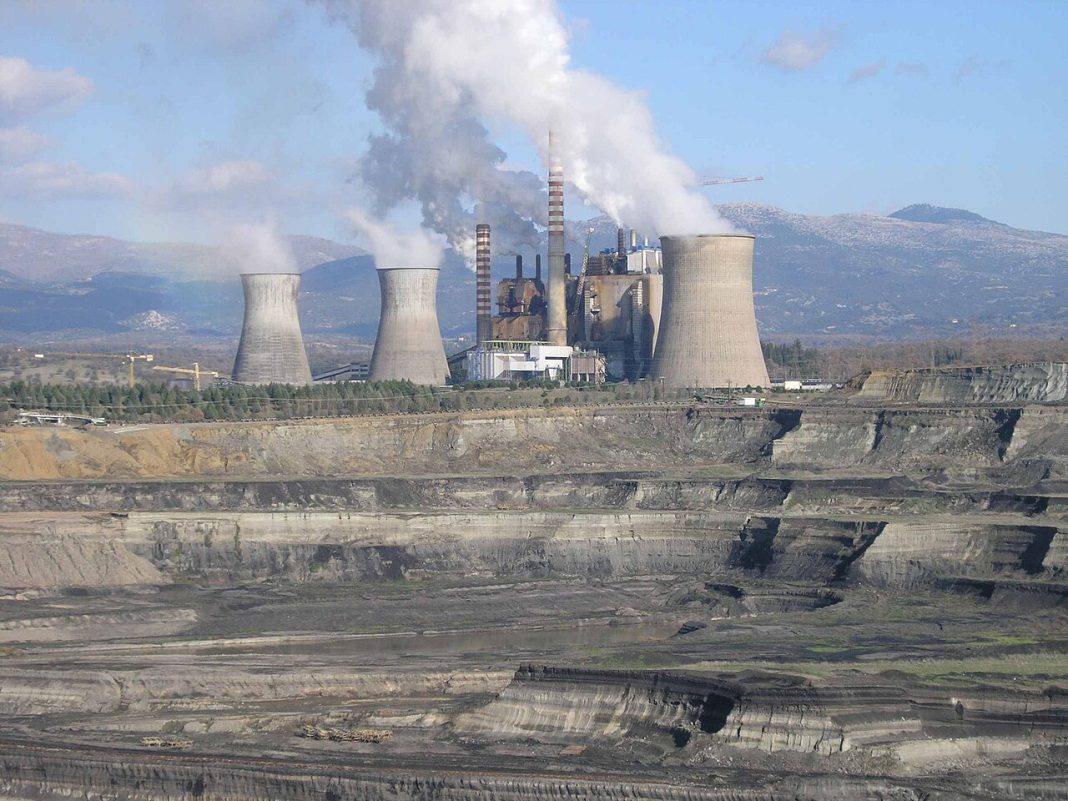
EDITOR’S NOTE (Nick Stamatakis). Despite the Mitsotakis government’s recent MINOR reversals of this STUPID and CORRUPT policy, Greece’s lignite electricity production has been severely weakened, with equipment sold or destroyed, specialized employees fired/emigrated and huge lignite power stations converted to gas. IT’S A HUGE SCANDAL BEYOND CONCEPTION!! Greece abandoned its only domestic source of energy, lignite, WITHOUT DEVELOPING ITS OWN EXISTING NATURAL GAS DEPOSITS IN THE SHALLOW WATERS OF THE IONIAN SEA, in favor of importing Texas LNG!! Why wouldn’t the Attorney General start an immediate investigation in the corrupt Mitsotakis family and its associates? Among them. Mr. Exarchou of AKTOR, the protagonist of American LNG imports in the Balkans and Eastern Europe, tries to convince us that his deal doesn’t involve Greece (link here to his interview today with protothem.gr). The Mitsoakis government is truly the most corrupt Greek government of the last 50 years!!
As even Germany is going back to coal, Greece’s only avenue is to reverse this process as much as possible.
================
source – dimokratia.gr (link here for the original Greek text)
How Mitsotakis Destroyed Greece’s Energy Sector for the Sake of U.S. LNG
In an unprecedented move anywhere in the world, he is destroying the country’s lignite-based energy infrastructure for no reason at all, while the much-publicized “transition” is taking us not toward renewable energy sources, but toward natural gas.
By Giorgos Chatzidimitriou
It is said—and was reported in the historic newspaper To Pontiki in the early 1990s, without ever being denied—that businessman Konstantinos Kyratsakis, to whom the father of the current prime minister had decided to sell off the Public Power Corporation (PPC), fainted at one point during the negotiations because of the extreme tension.
According to certain eyewitnesses who recounted the incident, the last thing he managed to say was: “Come on, Kostas, even you can’t be that greedy!”
This may be nothing more than an urban legend, since no official minutes exist. Nevertheless, that doesn’t change the fact that the PPC had long been in the Mitsotakis family’s sights.
After Kyriakos Mitsotakis’s near-total submission to American energy planning effectively stripped the PPC of its public character, the prime minister seized the opportunity to turn it into a vehicle to enrich its shareholders.
His government is the only one in Europe to eliminate lignite—Greece’s only domestic fuel resource—to promote imported, extremely expensive, more polluting, and increasingly scarce American shale-derived liquefied natural gas (LNG).
Meanwhile, as the warring parties in Ukraine and Iran destroy one another’s energy infrastructure, Mitsotakis, in an unprecedented move on a global scale, is voluntarily destroying Greece’s lignite-based energy infrastructure for no reason whatsoever.
In Washington, under press pressure, Trump was forced to dismiss the hyperactive former American ambassador, Kimberly Guilfoyle, who had been traveling around the Balkans on aircraft belonging to “friends” and acting as a sales representative for private interests.
She even provoked the public displeasure of her predecessor, Geoffrey Pyatt, who, after helping set Ukraine ablaze alongside the “hawk,” Assistant Secretary of State Victoria Nuland, was subsequently appointed to our part of the world to bind Greece to America’s energy agenda.
The plan called for the destruction of Greece’s lignite infrastructure—and this was to be accomplished through the method of “sudden death.”
1. Kardia Power Station
The Kardia Steam-Electric Power Station, which closed in 2021, is being converted into a high-efficiency combined heat and power (CHP) facility, with the simultaneous construction of a natural-gas-fired electricity generation unit with a capacity of approximately 100 megawatts.
2. Amyntaio Power Station
The Amyntaio Steam-Electric Power Station closed in 2021, and all of its electromechanical equipment was stripped out through scandalous methods amounting to outright “looting.”
At the same time, plans were announced to convert the facility into a hydrogen storage installation.
3. Meliti Power Station, Florina
The Meliti Steam-Electric Power Station, a modern facility equipped with pollution-control technology and constructed in 2003, was permanently closed in 2025.
The government announced its conversion into an energy storage facility, while modifications are being planned that would render it incapable of operating.
In July 2022, Environment and Energy Minister Kostas Skrekas reissued the operating license for the Achlada lignite mine to Lignitorycheia Achladas S.A.
He had revoked that license six months earlier because the company had fallen short of its agreed lignite supply quantities for the Meliti power station by 40% to 80% and had failed to pay its lease obligations to the Greek state from 2017 onward.
The justification for reissuing the license was that:
“There are compelling reasons of public interest requiring the immediate operation of the lignite mine in order to ensure the country’s energy adequacy.”
In short, the license was restored for reasons of “public interest” because lignite was supposedly needed to supply the Meliti power station.
Yet the operators export the lignite to Monastir (Bitola, North Macedonia) and import electricity instead.
And to complete this peculiar interpretation of the “public interest,” the government is permanently shutting down the Meliti power station.
4. Agios Dimitrios Power Station
The Agios Dimitrios Steam-Electric Power Station, the largest lignite-fired power station in the Balkans—which once supplied 20% of Greece’s total electricity—was permanently shut down by government order at the end of May 2026.
Immediately afterward, the PPC submitted a written request to the Kozani Urban Planning Department for permission to demolish the plant’s five cooling towers and other facilities using explosives.
Even Unit 5 of the Agios Dimitrios station, built in 1997, underwent an environmental upgrade that installed a flue-gas desulfurization system at the end of 2022.
That upgrade cost approximately €100 million—and the lives of two workers!
The justification that the site is needed to construct a massive 300 MW data center sounds ridiculous, since the PPC, the country’s largest landowner, controls some 250,000 square meters of land (approximately 25,000 hectares or 61,800 acres), effectively “borrowed” from the region’s farmers and natural environment.
5. Ptolemaida 5 Power Station
The Ptolemaida 5 Steam-Electric Power Station ceased operating toward the end of 2026.
This unit is Europe’s most modern low-emissions lignite-fired power station, with a high level of thermal efficiency.
It entered commercial operation only in 2024 and cost the Greek people more than €1.5 billion.
To eliminate any possibility of its restarting—and to prevent it from remaining available as a reserve generating unit—construction has already begun, on its doorstep, of a natural-gas-fired plant with a planned final capacity of approximately 450 megawatts.
At the same time, the same site will also host a waste-to-energy electricity generation facility that would burn municipal waste.
6. Solar Installations Around the Lignite Mines
To prevent the lignite mines from ever reopening, the PPC and Germany’s RWE have constructed photovoltaic installations totaling 2,200 megawatts around the Kardia, Amyntaio, and South Field mining areas!
What Will Electricity Generation in Greece Depend on From Now On?
“Renewable energy sources,” answer those who know nothing about the subject and those who have vested interests.
However, engineers and energy experts categorically state that, even if energy storage installations are expanded to the greatest possible extent, fossil fuels will remain essential for electricity generation until at least 2050!
This is also demonstrated by all the data provided to us by energy expert Stefanos Prassos:
a) Between 2019 and the end of 2025, renewable energy installations increased tenfold relative to consumption, and the electricity injected into the grid from renewable sources exceeded 50%.
At the same time, however, natural gas use for electricity generation increased by 56.3%!
b) In 2025, when an additional 2,500 megawatts of renewable energy capacity were connected to the grid, the use of natural gas for electricity generation increased by 18%.
c) Total natural gas imports into Greece during the first half of 2026 reached 43.07 terawatt-hours (TWh), an increase of 14.76% compared with the corresponding period in 2025.
d) Since 2019, when the phase-out of lignite was announced, new natural-gas-fired power stations with a combined capacity of approximately 4,000 megawatts have either entered operation or are under construction.
This is in addition to the 5,000 megawatts of natural gas generating capacity that already existed.
Therefore, the much-publicized “transition” did not take place from lignite to renewable energy sources, but from lignite to natural gas.
Growing Anxiety Over Energy Supply Security
Will we have sufficient natural gas this winter?
Greece imports natural gas equivalent to 101% of its consumption.
Today, the country receives natural gas from Russia and Azerbaijan via pipelines, while liquefied natural gas (LNG) comes mainly from the United States and, to a lesser extent, from Algeria, Qatar, and Nigeria.
Greece stores this LNG at the Revithoussa and Alexandroupolis facilities.
Because Greece is “complying” with American instructions to reduce imports of Russian natural gas, and the Trans Adriatic Pipeline (TAP) operates primarily as a transit pipeline, Greece now relies increasingly on imported liquefied natural gas, mainly from the United States, placing additional financial burdens on Greek citizens.
Because of the enormous gas shortages in Europe and Asia, it is by no means certain that Greece will be able to secure the LNG quantities needed to guarantee its energy supply and security during the coming winter.
An additional threat to the country’s security must also be considered: the recent unofficial warning by Iran’s Islamic Revolutionary Guard Corps that it would blow up the LNG infrastructure at Revithoussa and Alexandroupolis because of Greece’s involvement in the war against Iran, and because these facilities are regarded—and indeed function—as American bases.