
By George C. Michalopulos
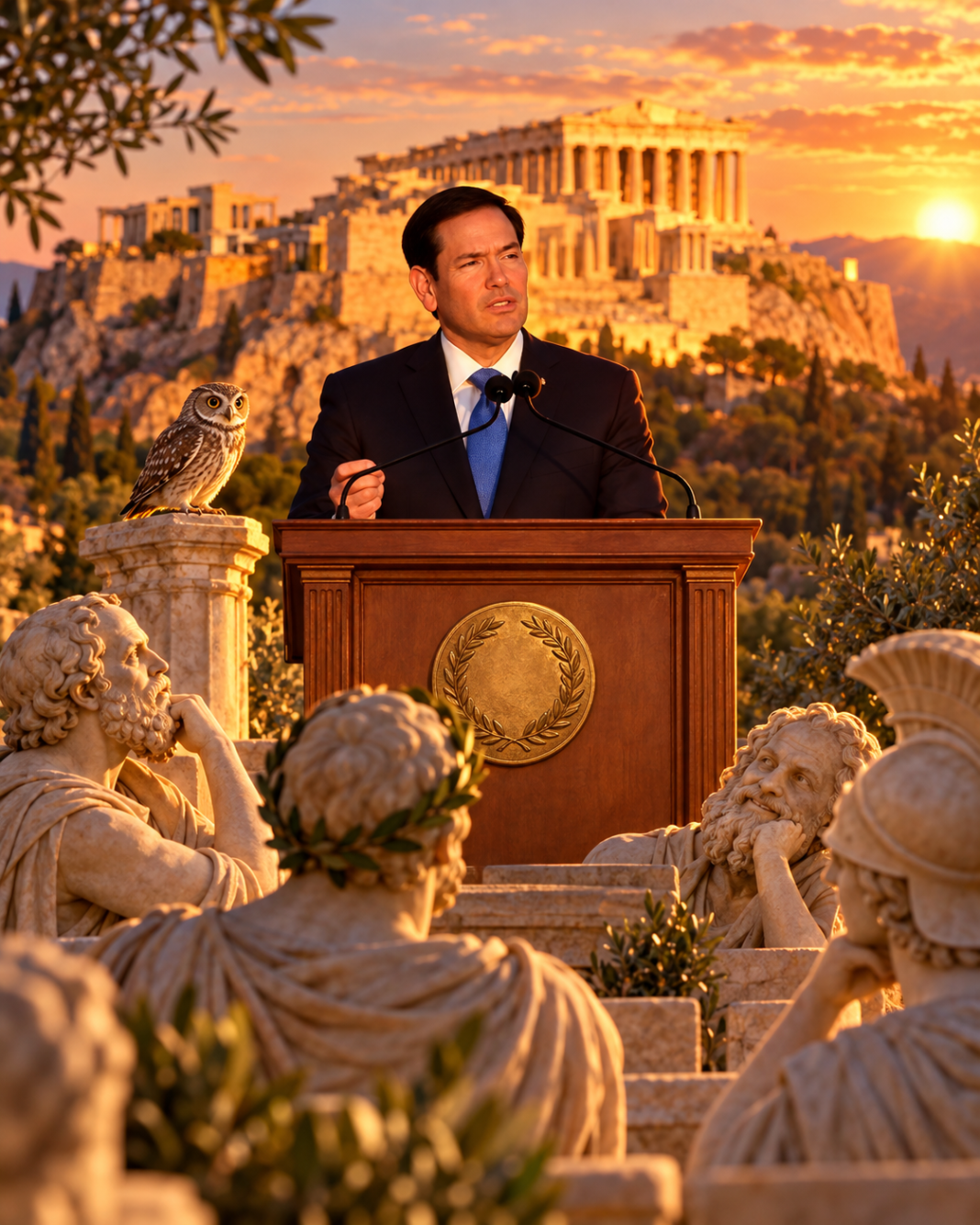
It has been little more than a week now since Marco Rubio gave his speech in front of the Acropolis in Athens. In the opinion of many (myself included), this was one of the most significant speeches ever spoken by an American Secretary of State. Indeed, he gave one of the greatest speeches by any American office-holder.
That’s a tall order, especially when you consider the men who have held that august office: Thomas Jefferson, James Madison, James Monroe, and Henry Clay, among the most prominent. To read these men is nothing less than an honor roll of historical figures, who made these United States the world-straddling empire it is today.
That day, with the Parthenon being the backdrop, Marco Rubio put himself firmly in the company of those men. Men who, we should remind ourselves, would have agreed with every word he spoke.
I don’t say this only because of my Hellenic heritage. Believe it or not, there is no bias here. Rubio laid out in glorious detail how the entire Western world, and by extension all of humanity, partakes of the fruits of Hellenism. In other words, thanks to what happened at Thermopylae, Salamis and Marathon, the entire world is a product of ancient Greek civilization.
But the honor roll does not stop there. This rocky, mountainous soil brought forth men such as Empedocles, Thales, and Pythagoras, men who looked at the cosmos and deduced that there was something, a reason, that could be known. That humanity was not subject to the capricious gods of the Bronze Age. These men and the countless other Greeks who chose to remain incurious took it upon themselves to explore the world. To do what God told Adam to do, to subdue the entire world (Gen 1:28).
Of course there were more: philosophers such as Socrates, whose devotion to truth caused him to sacrifice his life rather than give in to the caprices of the mob. His student Plato discerned the logos, or reason, that animates all creation and thereby set in motion the sciences. Aristotle, whose scientific and sociological observations make him the first and greatest political scientist. (Indeed, during the Islamic golden age, he was known simply as “the Philosopher,” without any qualification at all.) Zeno, on his porch (stoa) in Athens, preached a philosophy of self-restraint that influenced many great Roman statesmen who picked up Greece’s mantle.
But Rubio did not stop there. He painted a grand narrative, one which culminated in the Gospel of Jesus Christ and brought it to Christendom. It was a veritable paean to Western Civilization and the men who took that Gospel to all of Europe and even to the Americas. Cortez was mentioned without apology –as he should be.
I cannot recommend this speech enough; I believe it marks a turning point in history.
This is not a mere assertion. I firmly believe it. Why? Because Rubio’s speech laid down an unapologetic gauntlet, one which was thrown in the faces of those who have long hated our civilization and rubbed our faces in their diabolical nonsense. Rubio did not pander to the Greek diaspora; he esteemed all of the men who comprise the glorious enterprise of the Hellenes. Men and women of all races and ethnicities who stand on the shoulders of these ancient giants. People like you and I, whether we are ethnically Greek or not.
What is most encouraging is what did not happen. His speech was “fighting words,” a public rebuke to those who have worked overtime for the last half century to demolish the legacy of our civilization. And not just of Christendom but especially the Gospel. (We cannot forget that, for if we do, we do so at our peril.)
What else did not happen? No diatribes were hurled at his words by the Marxists, the totalitarians or the degenerates who despise our universal Hellenic inspired culture. To my mind, this proves what I have long suspected: that their entire anti-Christian belief system is built on a tissue of lies. And now we know it, but more importantly, that they know that we know it.
In other words, they are exposed for all the world to see.
Of course, this doesn’t mean the war is won. Far from it. These elites are not “going to go quietly into that good night” as Yeats wrote about another war a century ago. But now, they know that they face a formidable enemy. Even worse for them, the veil that let them command the heights of our societies has been dropped, not only from our eyes but from everyone’s.
The spell has been broken. That, I believe, will be the legacy of the speech.