
By Nick Stamatakis
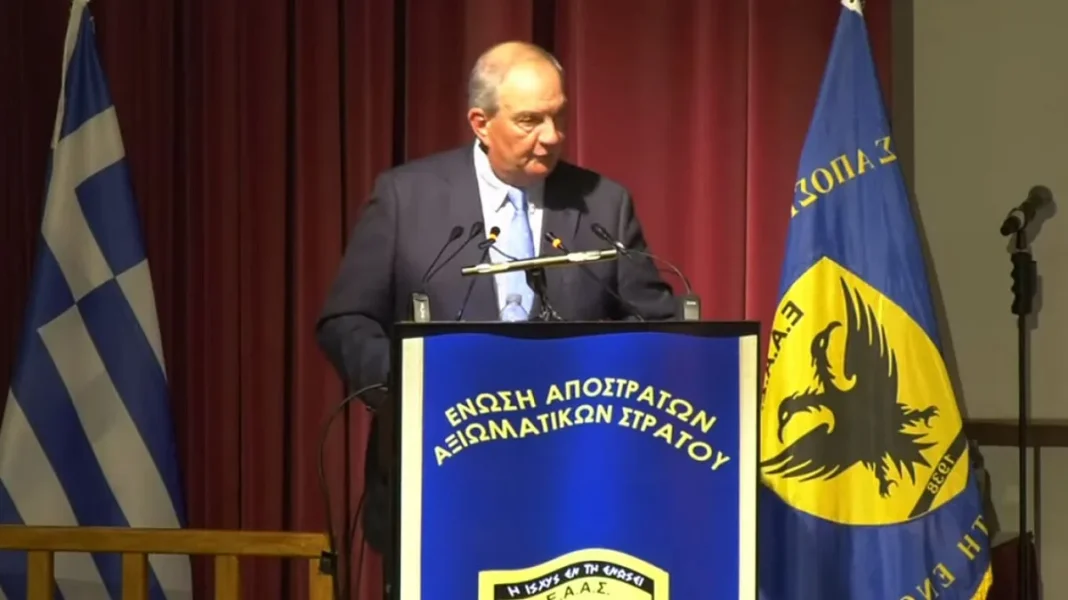
In a forceful address delivered today, October 25, 2026, at the War Museum in Athens, former Greek Prime Minister Costas Karamanlis sent a pointed message to Greece’s Western allies and partners: alliances carry responsibilities, and solidarity cannot be a one-way street. Speaking at an event organized by the Association of Retired Army Officers to commemorate Greece’s historic rejection of Italy’s ultimatum on October 28, 1940, Karamanlis drew parallels between the nation’s then-determination to defend its sovereignty and the challenges it faces today.
Focusing on Turkey’s ambitions in the Aegean and Eastern Mediterranean, the controversial Turkey–Libya maritime agreement, and the strategic importance of the Greece–Cyprus electricity interconnection, Karamanlis warned against underestimating Ankara’s intentions. He also questioned whether Western partners were willing to defend Greek and Cypriot interests while strengthening their own strategic and defense ties with Turkey. His central argument was unmistakable: Greece must remain committed to its alliances, but it must never compromise its sovereignty or national interests in the name of allied solidarity. The speech, presented in the video below, offers a significant intervention in the ongoing debate over Greece’s foreign policy, national security, and place in an increasingly uncertain international order.
YOU CAN READ THE WHOLE SPEECH IN GREEK BY CLICKING HERE – WE TRANSLATED THE MOST IMPORTANT PART – DEALING WITH THE MEANING OF ALLIANCES – BELOW
======================
===================
BELOW IS THE ENGLISH TRANSLATION OF THE SECOND PART OF THE SPEECH
Ladies and Gentlemen,
Let there be no misunderstanding. We belong to the Western Alliance and the European Union, and rightly so, because despite all their shortcomings—which, unfortunately, have been increasing dramatically of late—they remain the preferable, perhaps even the only, alternative available to us.
However, the time has come to tell them that good accounts make good friends. That demands must be accompanied by something in return. That you cannot continually ask for something without giving anything in return. That all members of an alliance or union are entitled to the same respect, comparable support, and mutual solidarity. This is especially true when what is actually being sought is not the satisfaction of arbitrary demands, but the acceptance and application of the rules of international law.
Once again, we will hear the familiar counterargument. Are we perhaps becoming tiresome, repetitive, and irritating with our constant protests and objections? Should we refrain from burdening others with our own concerns, especially when our allies and partners are preoccupied with supposedly more important matters? Will we be labeled chronic complainers for repeatedly raising issues concerning the Aegean, the Exclusive Economic Zone (EEZ) and continental shelf, Cyprus, and the stance of Skopje?
Such an approach is the very epitome of subservience.
No one respects those who fail to defend their rights, their principles, and their homeland. And no one takes seriously those who cannot find the courage to stand tall when their interests are threatened.
Ladies and Gentlemen,
The West—to which we rightly belong, and which many of us have defended for more than half a century—has entered a period of prolonged and worsening crisis.
I am not referring solely to the international arena, where wars break out with alarming ease and no end in sight. Conflicts are multiplying, while uncertainty and instability are becoming permanent features of the global landscape. The major powers, despite their overwhelming military superiority, find themselves unable to impose their will, while smaller actors, including non-state entities, are becoming increasingly emboldened and attempting to reshape circumstances to their advantage.
My primary concern, however, is the growing social discontent and the resulting political turmoil that we see intensifying across most European countries.
The ever-widening gap in social inequality, the dramatic decline of the once-thriving middle class, severe cuts to the welfare state resulting from rigid fiscal austerity, and the absence of hopeful prospects for the majority—particularly the less privileged and younger generations—are creating an explosive combination that threatens the future of our continent.
A vast majority of people feel marginalized, treated unjustly, and, above all, uncertain about their future.
They find themselves excluded from the banking system, pursued by faceless investment funds, and confronted with increasingly limited opportunities for employment, housing, quality healthcare, and education.
They have lost confidence in the justice system.
The prevailing social and political model is being challenged, and its legitimacy is eroding.
The simplistic and thoughtless condemnations issued by prosperous elites and mainstream media—warning of a far-right surge and dismissing disaffected citizens as conspiracy theorists or people misled by empty populist promises—not only fail to provide an adequate response but actually make the situation worse.
When traditional voters in Germany, France, and Britain abandon en masse the political parties that have long been their natural political homes, something very serious is happening.
I say this, and I repeat it, because I am profoundly concerned about the future of Europe and its member states.
The legitimacy of the postwar social and political order is rapidly unraveling, and the responsibility lies with Europe’s ruling political and economic elites.
This accelerating erosion of legitimacy threatens stability, social cohesion, social peace, and the way of life we have known.
The rumblings of approaching events are becoming deafening.
Ladies and Gentlemen,
We must be prepared for this difficult world that is emerging, for the dark and ominous horizon ahead.
We must be prepared, first and foremost, psychologically, but also socially and politically—and, above all, as a nation.
The challenges of the future must find us united, serious, and determined.
For our homeland, for our people, and for our children.