ΕΑΝ ΠΡΟΤΙΜΑΤΕ ΕΛΛΗΝΙΚΑ ΠΑΤΗΣΤΕ ΤΗ ΣΗΜΑΙΑ ΣΤΟ ΚΑΤΩ ΜΕΡΟΣ ΤΗΣ ΟΘΟΝΗΣ
By Nick Stamatakis
The Hellenic American National Council (HANC) has issued a strongly worded letter to Secretary of State Marco Rubio and the U.S. Congress, protesting Washington’s ambiguous stance on Greece’s maritime rights and the Turkish–Libyan agreement.
However, the letter’s center of gravity lies in its concluding call for immediate, united Greek-American action. HANC President Bill Mataragas calls upon all Greek and Cypriot American federations, organizations, and advocacy groups to convene an urgent video conference, followed by an in-person meeting in Washington, D.C., to establish a common strategy and decide on coordinated action before the State Department and Congress.
The message is clear: The time for fragmented efforts is over. The time for united action is NOW.
YOU CAN READ THIS LETTER BY CLICKING THE LINK HERE: HANC LETTER STATE DEPT OCT 2026, OR SEE IT BELOW.
==============
October 25, 2026
The Honorable Marco Rubio, Secretary of State
United States Department of State
The Chair and Ranking Member, U.S. House Committee on Foreign Affairs
The Chair and Ranking Member, U.S. Senate Committee on Foreign Relations
SUBJECT: FORMAL PROTEST AGAINST U.S. DOUBLE STANDARDS AND DIPLOMATIC PASSIVITY IN THE EASTERN MEDITERRANEAN
Dear Secretary Rubio and Distinguished Members of Congress:
On behalf of the Hellenic American National Council (HANC), we express our profound disappointment and strong protest over the State Department’s response to the recent approval of the Turkish–Libyan maritime memorandum by Libya’s Parliament.
Washington’s refusal to address the legal substance of this agreement, limiting its response to appeals for “good-faith negotiations,” represents a troubling abdication of diplomatic responsibility.
The United States cannot adopt a Pontius Pilate stance, washing its hands of responsibility while the sovereign rights of Greece and Cyprus—and vital American strategic interests—are placed in jeopardy.
AN UNACCEPTABLE DOUBLE STANDARD
In the South China Sea, Washington firmly rejects China’s expansive maritime claims, invokes international law, and defends the maritime rights of the Philippines. Yet in the Eastern Mediterranean, when Turkey advances claims that disregard the maritime entitlements of Greek islands, Washington retreats into diplomatic ambiguity.
Does international law apply differently to China than to Turkey? Are the rights of Greece and Cyprus less deserving of American support than those of the Philippines?
The European Union has repeatedly rejected the Turkish–Libyan memorandum as incompatible with the law of the sea and incapable of producing legal consequences for third countries. Its approval by Libya’s Parliament does not extinguish Greece’s lawful maritime entitlements.
Indeed, in 2019 the State Department described the memorandum as “unhelpful and provocative” and affirmed that it
could not legally affect the rights or obligations of third states, including Greece, without their consent. Why has Washington retreated from this clear position?
AMERICAN ENERGY INVESTMENTS ARE ALREADY AT STAKE
Direct American commercial and strategic interests are now involved. In February 2026, Chevron, in partnership with HELLENiQ ENERGY, signed exploration agreements with Greece covering four offshore blocks, including South Crete 1 and South Crete 2. ExxonMobil also maintains an exploration interest southwest of Crete.
These are concrete American corporate commitments, not hypothetical future interests. How can Washington encourage investment while remaining ambiguous about maritime claims that threaten the legal certainty and security of these operations?
Protecting lawful maritime rights in this region also means protecting American investments, energy security, and strategic credibility.
CRETE, THE DODECANESE, AND CYPRUS: A CORRIDOR OF VITAL STRATEGIC IMPORTANCE
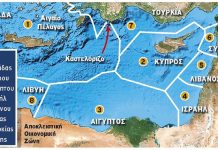
The maritime corridor from Crete through the Dodecanese to Cyprus connects the Aegean with the Levant, the Suez approaches, and the wider Middle East. Its security affects navigation, energy exploration, undersea infrastructure, NATO operations, and American strategic access.
Greece and Cyprus are dependable democratic partners in an area of growing geopolitical competition. Weakening their maritime position would ultimately weaken America’s own strategic presence. The security of this corridor is a fundamental American national interest.
THE TIME FOR A GREECE–CYPRUS EEZ AGREEMENT IS NOW
HANC strongly supports immediate negotiations between Greece and Cyprus toward delimitation of their Exclusive Economic Zones in accordance with international law. Such an agreement would strengthen regional stability, provide greater legal clarity for energy development, and reinforce cooperation with Israel, Europe, and the United States.
Neither Turkey nor any other third country should possess a veto over the lawful exercise of Greek and Cypriot sovereign rights, which are closely aligned with major American security, energy, and geopolitical interests.
OUR FORMAL REQUESTS
The Hellenic American National Council calls upon the State Department and Congress to:
- Reaffirm the State Department’s 2019 position that the Turkish–Libyan memorandum cannot legally prejudice the rights of third states, including Greece, without their consent.
- Apply consistent principles of international maritime law in the Eastern Mediterranean and the South China Sea, without geopolitical double standards.
- Explicitly support the right of Greece and Cyprus to conclude a lawful EEZ delimitation agreement without threats or intimidation.
- Recognize and safeguard American energy investments south of Crete and the strategic corridor extending through the Dodecanese to Cyprus.
- Initiate congressional oversight of U.S. policy toward Turkish maritime claims and request a formal explanation from the State Department.
- Unequivocally support Greece’s right to extend its territorial sea up to 12 nautical miles in the Aegean in accordance with international law, as is recognized for other coastal states, including the Philippines and Taiwan. Washington must firmly demand that Turkey withdraw its unacceptable 1995 casus belli—its threat of war should Greece exercise that right.
AMERICAN CREDIBILITY IS AT STAKE
The Hellenic American community has consistently championed strong American relations with Greece and Cyprus. Those partnerships are indispensable to U.S. national security and regional stability, but alliances must rest upon consistent principles and decisive diplomatic leadership.
We do not ask the United States to take sides blindly. We ask it to defend international law, protect its own strategic investments, and stand by its reliable democratic allies.
Washington cannot vigorously oppose expansive maritime claims in the Pacific while answering comparable challenges in the Mediterranean with silence and ambiguity. We urge Secretary Rubio and Congress to replace diplomatic passivity with principled leadership.
Greece and Cyprus deserve no less. American national interests demand no less.
A CALL FOR UNITED GREEK-AMERICAN ACTION
In light of the urgency of these developments, HANC will immediately convene a national conference in Washington, D.C., inviting all Greek-American organizations to discuss these issues, adopt a unified position, and coordinate joint action before the U.S. Department of State and Congress. The sovereign rights of Greece and Cyprus—and America’s vital strategic interests—demand a united and effective response from the Greek-American community.
Respectfully,
Bill Mataragas
President
HELLENIC AMERICAN NATIONAL COUNCIL (HANC)
On behalf of the Executive Board and Member Organizations
CC: The White House; Congressional Leadership; U.S. Embassies in Athens and Nicosia; Embassies of Greece and Cyprus in Washington, D.C.