
ΕΑΝ ΠΡΟΤΙΜΑΤΕ ΕΛΛΗΝΙΚΑ ΠΑΤΗΣΤΕ ΤΗ ΣΗΜΑΙΑ ΣΤΟ ΚΑΤΩ ΜΕΡΟΣ ΤΗΣ ΟΘΟΝΗΣ
THE ULTIMATUM: “Be careful not to allow Israel to draw you into participating in a strike against Turkey, whether from the Greek islands or from Cyprus, because if that happens, we will retaliate against you.”
source – estianews.gr – link here for the original Greek text
By Manolis Kottakis
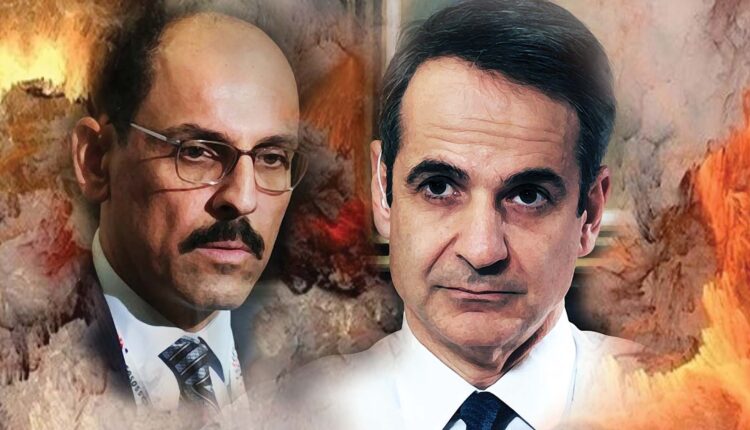
Estia tis Kyriakis reveals the behind-the-scenes details of the meeting between President Erdoğan’s envoy and Prime Minister Kyriakos Mitsotakis at the Maximos Mansion in early September, as well as the contents of the message he delivered.
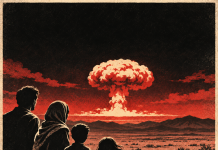
Threat of war and invasion if Turkey is struck by Israel from Greek or Cypriot territory.
In early September, İbrahim Kalın, the head of Turkey’s National Intelligence Organization (MIT) and a close confidant of President Erdoğan, secretly visited Athens.
He met with his Greek counterpart, Ambassador Themistoklis Demiris, head of Greece’s National Intelligence Service (EYP), and then, under conditions of extreme secrecy, went to the Maximos Mansion, where, at his own request, he met with Prime Minister Kyriakos Mitsotakis.
The meeting was leaked to the press. Initially, it seemed the leak originated in Turkey. However, subsequent investigation indicated that the source was more likely Greek—and apparently not acting in coordination with the Prime Minister’s Office, which was caught off guard by the revelation and never publicly confirmed that the meeting had taken place.
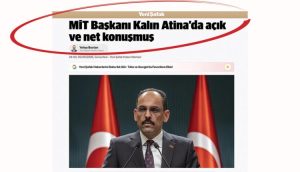
The Turks, by contrast, confirmed the meeting and leaked to the pro-government newspaper Yeni Şafak Kalın’s statement, “We will not accept faits accomplis in the Aegean,” as well as Erdoğan’s declaration, “We will not remain idle.”
The news, however, activated the government’s communications apparatus. Feeling under pressure, it said the Greek Prime Minister and the senior Turkish official had held “a discussion about Greek-Turkish relations without a pressing agenda or ultimatums,” to “reduce tensions.”
This was particularly striking because no one had yet alleged an ultimatum without knowing what had been discussed.
According to leaks from the Maximos Mansion to the press at the time, in response to Alexis Papachelas’s revelation:
“The Turkish official appeared reassuring, without conveying any message or ultimatum to the Greek side, since Ankara’s true intentions remain to be demonstrated in practice.”
According to government officials who spoke anonymously to the press at the time:
“The agenda included developments in the southeastern Mediterranean, the situation in Syria and Libya, and tensions between Turkey and Israel.”
In reality, as we shall see today, those denials concealed… confirmations.
An ultimatum was indeed delivered in the form of a threat. The reason for it—relations between Turkey and Israel and Greece’s involvement—was explained. The situation in Libya was raised. So was the electricity interconnection cable, under the broader heading of “Developments in the Southeastern Mediterranean.”
Caption: Article in Yeni Şafak titled “The Head of MIT Spoke Clearly and Categorically in Athens.”
The Ultimatum Was Delivered
Senior diplomatic and other sources today reveal to Estia tis Kyriakis what Mr. Mitsotakis and Mr. Kalın discussed behind closed doors, regardless of whether these revelations are once again denied after the fact.
(The first time, denials were issued preemptively, before anyone had even had the opportunity to ask.)
Moreover, subsequent events confirm the accuracy of these revelations.
President Erdoğan has declared twice this week—first at a gathering of his party and then in a televised statement delivered directly to camera, something he rarely does—that Turkey “will neutralize anyone who stands in its way in the Eastern Mediterranean” and is prepared “to pay the price for doing so.”
The ultimatum was delivered.
This is also confirmed by the Greek Prime Minister’s defiant statements after the October 28 military parade, when he declared that “Greece fears no one.”
Similarly, the Foreign Minister, speaking from New York with the bravado of Papaflessas [a Greek revolutionary hero], declared that “we are ready for a great ‘No.’”
And the President of the Republic, displaying excessive zeal, proclaimed that the “Armed Forces can crush the enemy.”
Whether bluff or reality, Athens and Ankara are exchanging threats—some genuine, others theatrical.
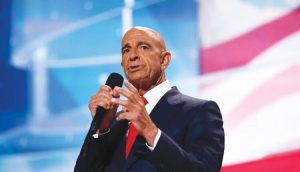
PHOTO: Tom Barack, the Ambassador to Turkey
The Most Important Contact
As reliable diplomatic and other sources explain to Estia tis Kyriakis, Kalın’s visit to Athens and his meeting with the Prime Minister constituted by far the most important contact between the two sides since Greece’s restoration of democracy in 1974.
There are two reasons for this:
First: Turkey had not dispatched a special envoy to Greece outside its Foreign Ministry’s normal hierarchy since 1974.
Second: Kalın carried a personal message from President Erdoğan to Prime Minister Kyriakos Mitsotakis.
Turkey may not have trusted the Fidan–Gerapetritis diplomatic channel and, more importantly, may have doubted whether a presidential message of such significance would be conveyed clearly enough to the Prime Minister.
According to our reliable sources, Erdoğan’s message to Mr. Mitsotakis was, in a free rendering rather than a verbatim quotation:
“Be careful not to allow Israel to draw you into participating in a strike against Turkey, whether from the Greek islands or from Cyprus, because if that happens, we will retaliate against you.”
He meant invasion and war.
An assault.
That is precisely why government sources rushed, the day after the meeting became public, to circulate the information that no threat or ultimatum had been issued.
Because one had been issued.
And if that had been confirmed, the Prime Minister’s Office would have been obliged to inform the media what response Mitsotakis had given.
The possibility that he responded as Ioannis Metaxas did to the Italian ambassador [in 1940] should probably be ruled out.
The government leak achieved its objective: it shut down all discussion.
But the truth eventually emerged.
The Mitsotakis–Kalın discussion focused on future political developments in Israel and the possibility that regional tensions would rise depending on the election results.
This connects with three developments that followed the Israeli elections:
First: Israel’s Prime Minister accused Turkey and Qatar of interfering in the elections and mobilizing Arab voters in order to produce a result that would create political paralysis—even temporarily—and delay Israel’s military plans against Iran and, potentially, Turkey.
Israel considers Turkey a “second Iran.”
Second: Despite the Arab parties doubling their electoral strength from 8% to 16%, and Likud losing a parliamentary majority—securing only 26 of the coalition’s 53 seats in the 120-seat Knesset—Netanyahu remained caretaker Prime Minister.
Following the US midterm elections, he could pursue one of two courses:
Call new elections in an effort to approach an outright majority and implement his plans for an Israeli attack against Iran and, later, Turkey.
Participate in a broad coalition government pursuing the same objective.
Third: The pro-Turkish US Ambassador to Ankara publicly reassured the Turks two days ago, at their own “Turkish House” in New York, where they were celebrating Turkish Republic Day, that “Trump will sign a peace agreement with Iran after the midterm elections.”
“The Turks Are Obsessed with Israel”
According to the same diplomatic and other sources:
“The Turks are obsessed with Israel and are haunted by the idea of encirclement. They include Greece in this perceived encirclement because of its gradual rapprochement with Jerusalem since 2010 and the deployment of missiles on the Greek islands.”
Turkey suspects that it could come under attack either from Cyprus, where military equipment has been transferred, or from Greece, where the islands are being equipped with Israeli Spike missiles.
For this reason, the Turkish leadership informed the Greek government at the highest level, through Kalın, that:
“Even if the strike against us comes from Cyprus, we will attack Greece.”
(Once again, we are conveying the meaning of the statement, not quoting it verbatim.)
Turkey also appears to believe that, regardless of the diplomatic discussions concerning written notification about the electricity interconnection cable, “France will not become involved if Greece and Turkey clash over the cable’s installation.”
Thus, Kalın delivered an ultimatum to the Greek Prime Minister, ostensibly in the interest of peace, concerning what would happen if Greece sided with Israel in a military confrontation with Turkey.
This ultimatum was delivered at a particularly critical moment, as preparations for seabed surveys related to the electricity interconnection cable are underway.
Turkey also views this issue within the broader context of its relations with Israel.
This is particularly significant because, according to reports on pro-government websites, the leadership of Israel’s intelligence services disagrees with the Turkish-Libyan memorandum.
They reportedly believe that the memorandum affects Israel’s vital defensive interests, rather than merely Greece’s naval presence in the Mediterranean.
Military sources tell Estia tis Kyriakis that this may explain why, following the Mitsotakis–Kalın meeting, an alternative route for the electricity cable was theoretically proposed.
Under this proposal, instead of beginning near Kasos, surveys would begin near Karpathos, as currently planned.
The cable would then follow a route through the delimited Greek-Egyptian Exclusive Economic Zone south of Crete before continuing toward Cyprus.
This would involve a substantial detour.
Is There a Metaxas Today?
The major issue currently confronting the Greek government, given the Turkish threats, is whether the cable’s route can provide a strategic advantage to the Greek fleet if it escorts the French vessel and establishes a protective barrier around it.
At a broader strategic level, the same sources say Greece must adopt Ioannis Metaxas’s strategy.
With the “Achilles Shield”—which also includes the underwater drones displayed during the military parade—and the transformation of the islands into small military bases exclusively for national defense, Greece will strengthen the protection of its sovereignty in the Aegean by air, land, and sea.
However, this creates a possibility:
At some point in the future, Turkey may decide to act preemptively against Greece, independently of developments involving Israel.
Perhaps through a military incident.
Turkey might also exploit the fact that the United States is withdrawing from the region and may have no inclination in the future to intervene to prevent a conflict.
If we accept this unavoidable reality as an “approaching event,” to use the expression of former Prime Minister Kostas Karamanlis, then we must choose the time and place to secure the strategic advantage.
Just as Metaxas chose the time and place, while secretly preparing.
But nothing more can be said on this subject.
Only one question can be asked:
Is there a Metaxas today?