



EDITOR’S NOTE (Markos): When a church building is dedicated to God, certain prayers are offered to Him, including the following: Κυριε, ηγαπησα την ευπρεπειαν του οικου Σου και τοπον σκηνωματος της δοξης σου…Psalm 25 (26): 8.
September 13, 2024, n.stamatakis@aol.com www.helleniscope.com
YOU CAN USE OUR GOOGLE TRANSLATE FUNCTION (CLICK ON THE FLAG)
DISCLAIMER: The views and statements expressed in this article constitute constitutionally protected opinions of this author.
============================
=====================
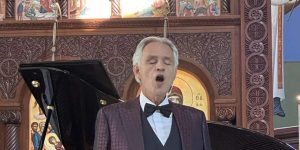
Tenor Andrea Bocelli was enchanted in his first appearance in a temple in the USA [images, video]
The tenor Andrea Bocelli in his first appearance in a temple in the USA / Photo: iefimerida.gr
ATHANASIA ANGELOPOULOU
13/09/2024 12:19
Celine Dion once said that if God had a voice, it would sound like Andrea Bocelli’s.
The blind tenor from Italy captivated the audience singing in front of the Sanctuary of the Greek Orthodox Church of the Dormition of the Virgin in the Hamptons, New York.
In the church with the unique icon painting and the rare acoustics, Andrea Bocelli unfolded his talent in a private charity concert with 340 spectators. The internationally renowned artist had been on vacation at the famous resort with his wife and was persuaded to appear at the temple of father Alex Karloutsou for a symbolic price so that the proceeds from the tickets would support the New York Cancer Foundation, whose soul is Tina Toulon who had dedicated her life to supporting cancer patients in New York and Long Island.
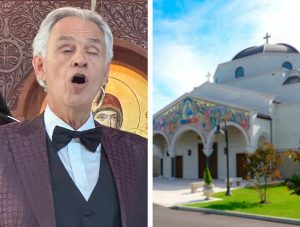
Photo: iefimerida.gr
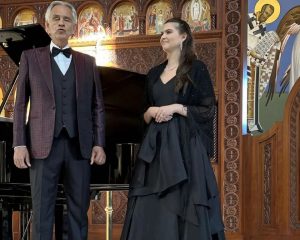
Soprano Theresa Carlomagno alongside Andrea Bocelli
He was joined by rising soprano Theresa Carlomagno and the timeless hits they chose to perform enchanted the audience in an absolutely immersive atmosphere. It was the first time that Andrea Bocelli sang in a church in the United States while among the audience were many members of the Greek-American community. Built in a green environment, in the neighborhood of the global jet set in Southampton, at a distance of about two hours from New York, the imposing temple impressed the famous artist, especially because his mosaics have traveled to the Hamptons from his native Italy.
The soprano Theresa Carlomagno next to Andrea Bocelli / Photo: iefimerida.gr
Andrea Bocelli grew up on a farm in the Italian village of La Sterza with parents who sold tools and wine. He was born with glaucoma but became completely blind after a football accident when he was 12. This, however, did not prevent him from developing into a global musical phenomenon with countless fans bowing to his every appearance.
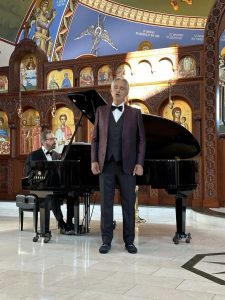
Images and videos from the presence of Andrea Bocelli
================
Μάγεψε ο τενόρος Αντρέα Μποτσέλι στην πρώτη του εμφάνιση σε ναό στις ΗΠΑ [εικόνες, βίντεο]
Ο τενόρος Αντρέα Μποτσέλι στην πρώτη του εμφάνιση σε ναό στις ΗΠΑ / Φωτογραφία: iefimerida.gr
ΑΘΑΝΑΣΙΑ ΑΓΓΕΛΟΠΟΥΛΟΥ
13/09/2024 12:19
Η Σελίν Ντιόν είχε πει πως αν ο Θεός είχε φωνή, αυτή θα ακουγόταν σαν του Αντρέα Μποτσέλι.
O τυφλός τενόρος από την Ιταλία καθήλωσε τους θεατές τραγουδώντας μπροστά στο Ιερό της Ελληνορθόδοξης εκκλησίας της Κοίμησης της Θεοτόκου στα Χάμπτονς της Νέας Υόρκης.
Στο ναό με τη μοναδική αγιογράφηση αλλά και την σπάνια ακουστική ο Αντρέα Μποτσέλι, ξετύλιξε το ταλέντο του σε μια ιδιωτική συναυλία φιλανθρωπικού χαρακτήρα με 340 θεατές. Ο διεθνούς φήμης καλλιτέχνης είχε βρεθεί για διακοπές στο διάσημο θέρετρο με την σύζυγό του και πείστηκε να εμφανιστεί με συμβολικό τίμημα στο ναό του father Alex Καρλούτσου ώστε με τα έσοδα από τα εισιτήρια να ενισχυθεί το Ίδρυμα New York Cancer Foundation , ψυχή του οποίου είναι η Τίνα Τουλόν η οποία είχε αφιερώσει τη ζωή της στη στήριξη των ασθενών με καρκίνο στη Νέα Υόρκη και το Long Island.
Στο πλευρό του βρέθηκε η ανερχόμενη σοπράνο Theresa Carlomagno και οι διαχρονικές επιτυχίες που επέλεξαν να ερμηνεύσουν μάγεψαν το κοινό σε μια απόλυτα κατανυκτική ατμόσφαιρα. Ήταν η πρώτη φορά που ο Αντρέα Μποτσέλι τραγούδησε σε εκκλησία στις Ηνωμένες Πολιτείες ενώ ανάμεσα στο κοινό βρίσκονταν πολλά μέλη της Ελληνοαμερικανικής κοινότητας . Χτισμένος σε ένα καταπράσινο περιβάλλον , στη γειτονιά του παγκόσμιου jet set στο Southampton , σε απόσταση περίπου δυο ωρών από τη Νέα Υόρκη, ο επιβλητικός ναός εντυπωσίασε τον διάσημο καλλιτέχνη , ειδικά γιατί τα ψηφιδωτά του έχουν ταξιδέψει στα Χάμπτονς από την πατρίδα του την Ιταλία.
Η σοπράνο Theresa Carlomagno στο πλευρό του Αντρέα Μποτσέλι / Φωτογραφία: iefimerida.gr
Ο Αντρέα Μποτσέλι μεγάλωσε σε μια φάρμα στο Ιταλικό χωριό La Sterza με τους γονείς τους που πωλούσαν εργαλεία και κρασί. Γεννήθηκε με γλαύκωμα αλλά τυφλώθηκε εντελώς μετά από ένα ατύχημα στο ποδόσφαιρο όταν ήταν 12 ετών. Αυτό ωστόσο δεν τον εμπόδισε να εξελιχθεί σε παγκόσμιο μουσικό φαινόμενο με αμέτρητους θαυμαστές που υποκλίνονται σε κάθε του εμφάνιση.
Εικόνες και βίντεο από την παρουσία του Αντρέα Μποτσέλι











Yikes! Well, the GOA FINALLY has gone the way of the Episcopalians!
I was raised not to clap one’s hands in church as it’s not appropriate. My how times have changed.
In one of his writings St John Chrysostom laments the fact that people don’t clap their hands in church anymore. That being said, this event should have been held in the church hall. Besides, the church should not be holding fundraising activities, festivals included.
Yes, but clap their hands for whom, exactly? Not for Bocelli.
In our hymnography, (standard Katabasies for the Theotokos that we hear a large part of the year during Orthros), we encounter the phrase:
“δεῦτε τὰς χεῖρας κροτήσωμεν, τὸν ἐξ αὐτῆς τεχθέντα Θεὸν δοξάζοντες.”
(Come let us clap our hands…glorifying God, the one who was born of her[the Theotokos])
That’s certainly what St. John Chrysostom was referring to…clapping of hands to glorify God, not Bocelli
In Jerusalem, during the service of the lighting of the Holy Light on Holy Saturday afternoon, there are plenty of youtube videos showing that a large number of the zealous Christians of the Middle East still “clap their hands” when they first enter the Church of the Holy Sepulcher, literally “in drumbeat and dance” (psalm 150:4), in anticipation of the joyous event. And even though it may seem “disruptive, disrespectful, and rude” on the surface (it’s definitely not “in order”, according to what is written in our Church Books today), their expression of joy is for the Holy Light – for the Resurrection -for God – and not for “Bocelli”. That’s why the seemingly loud, disruptive behavior is “tolerated”.
Clapping of hands is also observed and tolerated within several Orthodox communities in Africa too, during a variety of services, but also in these instances, they are not “clapping for Bocelli”. It is still within the expectation that this type of cultural expressiveness is a “form of praise” towards God.
That doesn’t mean that tomorrow we should go into Church and start clapping hands…the “cultural association” of exhibition of praise to God via “clapping” has been lost in Western society for centuries, so it would be unnatural and hypocritical to advocate for or “pretend with” something like that today. And imitating any well-known modern Protestant / Pentecostal hypocritical behaviors without purpose is not the way to go, either. We who were raised in Western society should continue focusing on “the quiet path” to spiritual advancement, limiting our “noise footprint” to participation in hymns, responses, and prayers that are prescribed for us during the service…and it goes without saying, that yelling hymns and prayers over the rest of the congregation’s “sound level” out of some “exhibition of piety” is not acceptable behavior either…we shouldn’t forcefully try and stand out, but rather “blend” with our participation.
But in some other geographical regions around the world, where culturally “clapping” during certain special liturgical occasions as a natural, honest, cultural form of praise to God has survived for many centuries (like Jerusalem / Africa), the Church’s tolerance of “clapping” will likely continue for a long time, and rightly shouldn’t be hindered by the bishops.
One can potentially argue that in some corners of Greek culture, the relatively modern (disruptive) phenomenon of repeated banging of the “stasidia” of the Church during the Vesperal liturgy on Holy Saturday at the point where the priest exits the altar with the antiphonal chanting of “Αναστα ο Θεος” is a Greek Orthodox attempt at “revival” of “clapping”, as well, although in this case, it started as a “fun event” for children in certain parts of Greece likely only 150 or so years ago, it spread, especially to communities in North America, but this modern practice has also turned so excessive and distracting from the Service, drowning the hymns and words that should be heard by the faithful, that it rightly should be curtailed and disallowed by the bishops.
Marcos, it really doesn’t matter if sounds drown out hymns being sung because hardly anyone can understand the hymns in Greek.
JK,
I suppose your generalization does not include the instances of this aforementioned calamity in Greece (that wouldn’t make much sense), but even in North America, evidence exists time and time again that many people (even educated ones) seem to have a hard time understanding things in plain English, too… :)
For example, why do we observe so many who are hasty to depart the Service after the first 3 “Christ is Risen” at the beginning of the Resurrection Service, at the same time that the first verse that is recited (even in English) is “Let God Arise, and his enemies be scattered”? It’s even written in their “little black Holy Week books”, so they can’t miss those verses…
The language excuse is not a valid excuse in a modern GOARCH community that is theoretically more educated than the immigrant ancestors who disembarked on Ellis island many years ago. Why do we spend years learning Spanish, or French or some other language just to earn a College degree, but we shy away from learning a few hundred Liturgical keywords in the original Greek? Isn’t it embarrassing for one to admit that they are college educated, have learned a “foreign language” at some point, but 5 or 6 decades into their life on this planet they refuse to open a book to learn a few keywords that have been handed down in Liturgical tradition for 2000 years? Isn’t that equivalent to “burying your talent”, if you showed how capable you were when you learned French or Spanish, but then refuse to learn a few Liturgical terms that are repetitive every Liturgy for your own spiritual benefit? IS IT REALLY A GOOD THING FOR AN EDUCATED PERSON TO RELY ON UNRELIABLE TRANSLATIONS for their entire life? Even the Hebrew tradition forces the children to learn how to read from their original sacred texts to prove “adulthood”…Why don’t they complain as much about having to read from the Torah? Why are they more zealous about maintaining their traditions? Why don’t we care as much?
It’s not an aptitude problem, at least for those with College degrees…it’s more of a willingness issue at the end of the day, if not an “identity crisis” of sorts…
I think Cyril and Methodios would disagree with you. Greek school is one thing and worship is another. St Paul, it is better to speak 5 words in a known language than 10,000 words in an unknown language. Do you really believe that learning some basic Greek would help one understand the hymnology of the church. Greek was my first language and I can not pray the Lord’s prayer in Greek.
If Greek was your first language and you can’t pray the Lord’s Prayer in Greek then you and we are dealing with a much bigger problem here…
Nick, I don’t know what you are inferring in your response to my statement about the Lord’s prayer but I assume you know the difference between saying the Lord’s prayer and praying the Lord’s prayer. Obviously, I can say the Lord’s prayer but can’t pray it because I don’t have contact and connection with the words.
JK,
I just wrote above that people can’t even understand hymnology in English in N. America either, so you are asking a rather pointless question. You can’t understand hymnology without proper catechesis, and you can’t have proper catechesis in any language unless the original words and Patristic interpretations are understood…yes…in their original language (Greek)…
By the way, a couple hundred years after Cyril and Methodios, the Russians had to return to Constantinople and study some original Greek Liturgical manuscripts (Diataxeis of Philotheos Kokkinos, etc), in order to do some Liturgical “course correction” after some Russian manuscript “divergence” occurred over the years… Were you aware of that “historical event”? Why did they have to go back to the original Greek texts?
In the meantime, you are totally avoiding the theory that you yourself may actually have been “burying your talent” / ancestral opportunity to learn the language of your ancestors for decades now… why couldn’t that Scriptural quote be viewed as most applicable in this specific case?…Using St. Paul’s words as an excuse (“Προφαση εν αμαρτιαις” Psalm 140(141):4, Brenton, or Douay-Rheims translation [ pretexts / excuses in sins]) is not very convincing, nor does it warrant reciprocal empathy in your situation, because God created you and placed you into a family that had a language that you apparently opted not to learn (aka you brought the tragic aforementioned conclusion upon yourself), despite obviously being very intelligent, and applying your aptitude to other books and other focus areas of learning…it’s not an aptitude problem. You are extremely intelligent and able. Hence, trying to spin things into “playing a victim” that doesn’t know Greek so that St. Paul’s words apply as a “first choice” in this situation is not going to fly with me, at least.
I’ll repeat what I saw at a US University many years ago…Non-Greek heritage Protestants were registering in droves to learn Ancient Greek, in order to be able to understand scripture in the original language. Perhaps at the age of 18-20 they were much wiser than all of us, aware of the weak position of relying on a massive assortment of translations that are not exactly identical with each other?
Στην Εκκλησία δοξολογείται ο Θεός και
ευλογείται ο άνθρωπος… τίτλος τον
οποίον λίγοι φέρουν.
Ο Άλεξ … από όλους τους τίτλους
επέλεξε τον SMART ALEX, είναι ικανός
να φορέσει οποιοδήποτε καπέλο…..
προκειμένου να πετύχει τον σκοπό του
η να ικανοποιήσει τον αμαρτωλό εαυτό
του παρασύροντας τα βόδια ….,με τα μεγάλα βυζιά. Κάποτε έρχεται ο κορεσμός για τα πάντα και τότε αν
δεν συνέλθουμε , ξεκινά ο εξευτελισμός του ανθρώπου , διότι και
αν η ψυχή ακόμη αντέχει το σώμα ήδη
την έχει εγκαταλείψει.
Και για όλους μας ισχύει η παροιμία:
“ Δείξε μου τους φίλους σου να σου πω ποιός είσαι “ την οποίαν εγώ προσωπικά έχω μετατρέψει ως ακολούθως: “ Δείξε μου την οικογένειά σου να σου πω ποιός είσαι”.
Τούτο το καπέλο με τον Μποτσέλι φωτογραφία που επέλεξε μου θυμίζει τον Μπάιντεν που κυκλοφορεί με το
καπέλο του Τράμ , διότι μετά το φιάσκο που του έκαναν τα τέρατα της
Αμερικής ένιωσε εντελώς κενός… το
ίδιο θα συμβεί και στον Αλέξανδρο πριν από το πλήρωμα του χρόνου, θα
νιώσει τόσο κενός που δεν αποκλείω να τον δούμε μα κυκλοφορεί με
Μουτσούνα Αρχιεπισκόπου Ισκώβου.
Σήμερα γιορτάζουμε την ύψωση του
Τιμίου Σταυρού ·
“ Σταυρός, φύλαξ πάσης της οικουμένης”
❤️
“This is another prime example of what St. Kosmas Aitolos once said…”there will be a day when the clergy will become laity, and the laity demons…” ”
I beg to differ, on this day at the least, the Clergy have become demons (heretics, hypocrites), the Laity have become phantoms–those with faith have vacated the churches. Anyone in that church may as well have been a stray cat or a goat, oblivious to what an Orthodox church is, and represents.
Times have not changed. Did all the Orthodox Christians that lovingly taught us all what we know LIE TO US??
NO! Be deliberate in what you do and what you don’t do. Always.
God gave us all Free Will to live as we please. But we will stand before Him in Judgement. He said so.
During Christ’s time, there were 12 disciples, one of whom was a thief…
Today, even if the percentage of “thieves” within the hierarchy has risen dramatically, we the faithful still have the spiritual obligation and free will to shop around to find the one who is NOT a thief. There are still a few solid bishops around, although you may have to get on an airplane for several hours to find one…
Stick to the Truth, and to those who proclaim and apply it in their lives…
Αίσχος…αλλά αυτά γίνονται όλο και περισσότερο στης εκκλησίες διότι οι περισσότερη δεν γνωρίζουν τι σημαίνει νά δοξάζουν τον Θεό.
Helleniscope does incredibly vital work and we are all grateful for your dedication to uncovering scandals and proclaiming the truth. On this one, must respectfully disagree. He didn’t invite some rap star or someone who sang something inappropriate. He invited one of the world’s most famous opera stars and the proceeds were earmarked to help people with cancer. That 340 people crowded under an Orthodox Dome of a magnificent church, most of whom were not Orthodox, is a wonderful thing indeed to spread our faith. No doubt, anyone who entered there was awed and perhaps some will ask questions, attend a service or one day even become Orthodox. I understand the sentiment of maintaining our traditions, but in this case I think it was acceptable and in fact a blessing. Thank you again for all of your tremendous work.
Bob, Karloutsos had many other options – among them to use the community center or to pick any other venue in the Hamptons. Literally next to his Church is SUNY Southampton college, that is now part of Stony Brook and Karloutsos IS a member of the Board at Stony Brook. He could have booked the Southampton College theater (look it up – there are beautiful photos online) in 30 seconds. But no, he thought it was wonderful to desecrate the Orthodox Church. He is very much in line with Protestantism. I remind you here that similar events regularly happen at St. John the Divine in NYC, an Episcopalian Cathedral. There, they even allow Halloween celebrations in the Church!! Is this the road we want to take? OF COURSE NOT!!
Hey Bobbi..for a guy who bashed Helleniscope for deleting and manipulating comments that had a “Negative Influence ” on Helleniscope narratives that all his discovered Scandals of Zionist Joe Biden and the ruling Democratic party , The leaders of the Catholic and Greek Orthodox Churches, CNN , Fbi and Justice department were indictable offenses and crimes against humanity and grounds for prosecution and removal from offices of power!
The only service Helleniscope has provided for his Neo Con Greek American Sons of liberty readers is to continue to fool them, that the Dominant White Supremacist Evangelical Protestant leaders of America’s government , Congress , Media , Churches, and the Dick Cheney, Donald Trump, George Bush, and Lindsey Graham Evangelical Protestant Republican Party have not been willing participants in their crimes against humanity and God! All Helleniscope does is accurately reveal all the scandals and evil of the now acknowledged Uni Parties, but merely as a political tool to funnel votes to his Poliotical Party of choice and benefit ..the Republican Party ! The Helniscope maligned Pope ..just had a negative influence on both ruling parties , and highlighted what Helleniscope really supports… Pope: Unfortunately , the American Elections only allow Americans the choice of electing “One of the lesser Evil” of America!
And thanks to Helleniscope and the other Greek Media outlets …those evil Evagnelical dominant parties ..the Republican and Democratic .Party have just without the permission of the American People openly “Declared War on Russia ,Europe and America , and possibly the world by ordering the Zelensky Government to use U.S and British long Range missiles to bomb Russia , despite the fact that they know that Putin would retaliate against America, and officially begin WW3!
Congratulations on in order for the Good work ..Helleniscope has done , and you can add this scandal of inciting WW3 to their resume! I am sure Helleniscope you will not share this post , which will have a Negative influence on you!
Bob,
Following the logic of your “respectful disagreement”, why did they even stop there? Why don’t they also go to the next step, and serve refreshments, heat up some water or coffee with the same utensils they use to heat up the “zeon” during Liturgy, and perhaps even use other holy vessels for “non-Liturgical purposes”, too, like they once did at a concert 20 years ago in North America, which was held in a Protestant Church, and where somehow (unknown which GOARCH priest allowed it) they managed to borrow an actual working Orthodox “katzio” (type of censer) from a Greek Church altar’s skevofylakio and gave it to a muslim guy who they dressed in a “raso” (also borrowed from a Greek Church), an Orthodox monastic cap, and a “mandyas” to increase the “theatrical effects” of their show? That video was circulating many years ago…it was quite disturbing.
Outrageous, impious, and desecratory, one might say? Why then would it be considered more sacrilegious to use dedicated Liturgical vessels for “private use” than to utilize an entire dedicated holy Church building for a similar non-Liturgical, theatrical, “secular purpose”?
That kind of thinking is illogical at best, and entirely foreign to our Tradition…Anything that is 100% dedicated to Liturgical worship of God (item or building) means it should not be used for “private / secular use”, plain and simple. There are some very old and still valid Canons about that, too. It’s really not negotiable, even under the argument that “it was for a good cause”. Bottom line for anyone wanting to imitate the happenings at the Hamptons in the future…Go next door to the hall and do whatever Bocelli fundraising concert you want. Keep that stuff out of God’s dedicated House of Worship.
Bocelli what a snowflake along with mercenary Karloutsos.
Like a soup and sandwich .
It depends! What did he sing? Can understand if he sang sacred tunes.
What was the program?? Alex always finds a way to outdo himself , doesn’t he?
Marcos, I know more Greek than 95% of my congregation. I have always believed that the church’s hymnology is a primary source of catechisis and I guarantee you that the hymns are more understandable in English. Your unwavering attachment to the Greek language seems misplaced to me. Jesus used his native language, Aramaic, to communicate with his followers and there many saints who knew no Greek. Understanding should always be the guiding principle of the church. If the people know Greek use Greek if they know Chinese use Chinese.
We are talking past each other…the fixation is not upon forcing “all faithful” to learn Greek, but at least within the “Greek” Orthodox archdiocese, to expect and strongly encourage those with Greek background combined with intellectual aptitude (like yourself) to learn the original texts, because North America is literally a “sea of Protestantism” due to largely incorrect interpretation / translation of Scripture. Someone has to “hold the line” at the end of the day…
I want to supply you with an example to illustrate the point about “Protestant influence” in English translations:
Let’s compare Luke 11:28 to Romans 10:18, and let’s compare KJV
But I say, Have they not heard? YES VERILY, their sound went into all the earth, and their words unto the ends of the world. (Rom 10:18) (Verily is also translated as “Indeed” in many other translations)
But he said, YEA RATHER, blessed are they that hear the word of God, and keep it. (Luk 11:28) (Rather is also translated as “on the contrary” in other translations)
So, JK…answer this…how is it possible for the same Greek word – μενουνγε – to be translated into 2 VERY DIFFERENT meanings in English (VERILY/INDEED vs. RATHER/ ON THE CONTRARY)? And by the way, which one is actually “correct”? :)
Is there perhaps a possibility that Protestant “interpretation”, or perhaps “rejection” of the Orthodox teaching about the Theotokos played a key role in [intentionally] distorting the translation here? Is it possible that KJV (original English translation) as well as subsequent Protestant versions couldn’t accept the use of the word “Indeed” in the instance of Luke 10:28, because it would be in line with Orthodox theology about the Theotokos’ example of doing perfect obedience to God’s will by responding to Gabriel with the words “ίδου η δούλη Κυρίου, γένοιτό μοι κατά το ρήμα σου” (Luke 1:38)? Then they’d have to accept other things that they reject today, wouldn’t they? Oops… :)
At least that’s one major theory as to “what may have transpired” here with the “variant English translation of the same Greek word”, but the scriptures are currently speckled with a bunch of these controversial “Protestant translations”.
So JK…How exactly do you reconcile or justify this situation, without going back to examine the original Greek? How can you reject the importance of the original Greek in these cases? Is the above really a “misplaced attachment to the Greek language”, or perhaps, is your attachment to (and unwavering faith in) faulty English translations misplaced instead?
and by the way, the “Aramaic” comment is something you keep bringing up, but Scripture consistently tells us clearly that only 3 languages were represented on the Cross above Jesus’ head…Greek / Latin / Hebrew…why wouldn’t they also put Aramaic on the cross if that was supposedly what Jesus spoke? You can claim that it was just a “spoken language”, but then your sources cite “aramaic texts” from the first couple of centuries, so clearly there was a “written language”, too…I think you are being influenced by sources that belong to a perennial propaganda engine desiring to delegitimize the original Evangelist’s authentic Greek writings, and unfortunately there have been many of those efforts out there for a long time.
Amen !!!!!
And thank you for taking the time to flesh out those thoughts with details. The Lord’s Prayer and the Liturgy itself are rife with mistranslated words that alter the message from the original .
Are you suggesting that Jesus spoke a language other than Aramaic? Do you believe that translations into Slavonic, Romanian and Arabic are faulty translations and thus distort the message of the Gospel? What about all the saints that didn’t know a word of Greek yet experienced salvation and new life through Jesus Christ?
You love going around in circles, and avoiding questions presumably in an attempt to divert/distract/delay?
By the way, why don’t you answer my direct questions about the inconsistent translation of μενουνγε Romans vs. Luke above, and about your continued steadfast faith in such faulty English translations?
We already answered all that you ask in previous questions in this forum… but maybe there is a short-term memory challenge at play here, so let’s play this annoying game of merry-go-round for your sake…
1) Sure, and why not?… the fact that the Gospel writers intentionally recorded the people’s confusion about the understanding of Jesus’ phrase Ελι Ελι, λαμα σαβαχθανι (and intentionally wrote it as a single, unique instance in “non-Greek”) , while the same bystanders were clearly not confused about the “other things Jesus preached” in the 3 years prior is a strong argument supporting this very view…The ball is in now fully in your court to explain why Aramaic was not included in the 3 “main” languages on the Cross, if it was “the predominant one” at the time and locale…
2) No translation is fully accurate, but some languages are “weaker” than others, when compared to Greek, and English happens to be one of the “weakest”…as a result, Slavonic translations (and Latin ones) are far more accurate than the English ones (remember this response from a while ago now)?
3) Nobody who was known to have ended their life believing/preaching heretical thought, confusion, and deception has been elevated a “saint” of the Church. Sainthood is largely about succeeding at “denial of one’s self”…you are conflating the concept of corrupted texts with the path(s) to sainthood, and that is not a valid logical construct. Many martyrs didn’t even read a word of Scripture, because they were illiterate. And until the printing presses were invented, only the “extremely wealthy” could afford a manuscript of Scripture in their homes…However, the first Apostles were documented as “preaching in languages/tongues”, as they went to “the reaches of the earth”…so yes, all these “people” heard the Gospel “in their own language”, which initially the Holy Spirit (through those original Apostles) via the “speaking in tongues” we can be assured was “the most accurate verbal translation and instruction” that could be provided, because the Holy Spirit wouldn’t provide anything less. That’s how saints were first produced in those “languages” and “cultures”…then they taught others, and others, etc….(similar case with Cyril & Methodios, in later years) What got recorded later on paper, and how things got “mis-translated” or “paraphrased” by error-prone humans is not a surprising outcome…just look at the mess that transpired with the Filioque starting in Toledo Spain, from supposedly “Latins” that had both a “good translation” and “good knowledge of Greek” to begin with…it doesn’t take much to stray…