


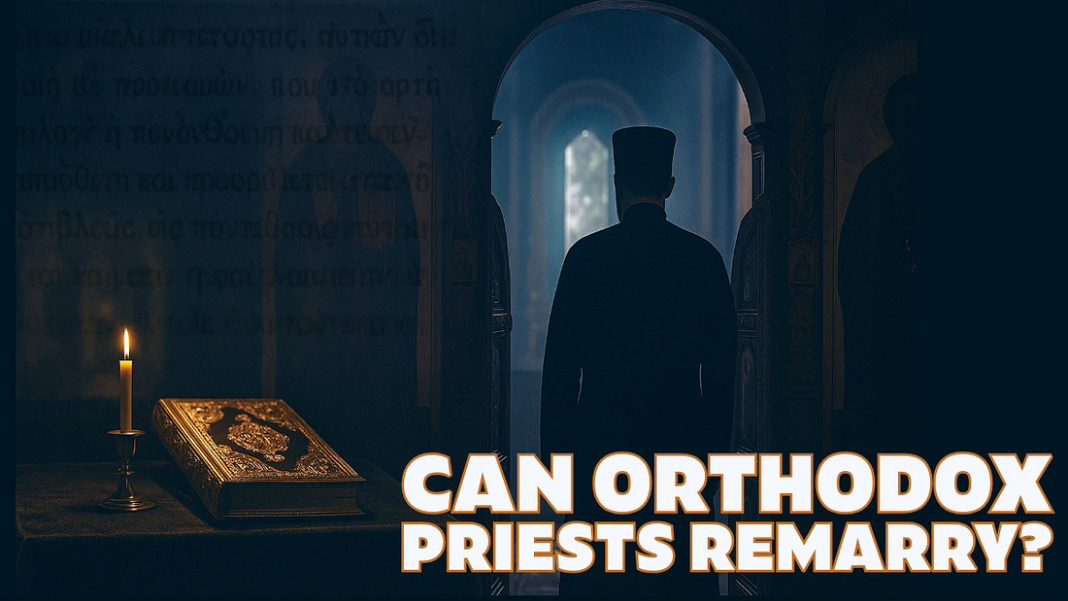
What a recent remarriage reveals about the Orthodox Church’s pastoral flexibility and its ancient boundaries
By Father Emmanuel Lemelson
We begin this reflection not with judgment, but with understanding, mindful that each bears his own cross in the mystery of salvation.
Celibacy: A Discipline or a Mystery?
In the Roman Catholic tradition, priestly celibacy is treated primarily as a discipline, a legal and institutional rule that can, in theory, be altered. This reduction of celibacy to a “rule” reflects the broader Latin tendency toward juridical thinking, often at the expense of theological mystery. As a result, we see hundreds of thousands of celibate priests living in the world apart from monastic community, a situation with little precedent in early Christianity.
In contrast, Orthodox tradition holds that celibacy is not a legal burden but a charismatic calling. The celibate does not merely refrain from marriage but enters into “theou erota” (θεού έρωτα), a divine love for God (cf. 1 Corinthians 7:32-35). It is a mystical orientation, not merely a lifestyle choice.
Christ’s first public miracle at Cana in Galilee (John 2:1-11) was at a wedding. The Orthodox understanding of holy matrimony is deeply sacramental—a manifestation of divine love between man and woman, reflective of the relationship between Christ and the Church (Ephesians 5:25-32). To speak of celibacy merely as “discipline” is to flatten the depth of both callings.
St. John Chrysostom, in his Homily 12 on 1 Timothy, emphasizes the honor of both celibacy and marriage, but always within the order and edification of the Church. Neither state is to be exalted over the other, but both are to be lived with sobriety and sacrifice.
The Rule: No Marriage After Ordination
Historically, the Orthodox Church has maintained a clear and consistent rule: marriage must precede ordination to the priesthood or diaconate. Once a man is ordained, he may not marry, even if widowed. This is affirmed by Canon 3 of the Quinisext (Trullo) Council (691-692 AD), which remains normative in the Orthodox Church.
A priest who is widowed is expected to remain celibate. The rationale is spiritual, not legalistic: having received the grace of ordination, the cleric is now fully devoted to Christ and His Bride, the Church (cf. 2 Timothy 2:4). Any further bond, however noble, could distract from that singular focus.
St. Gregory the Elder, father of St. Gregory the Theologian (Nazianzus), offers a notable early example. A married man who became a bishop, Gregory was ordained after his wife’s death. His life of pastoral service and eventual sainthood demonstrates that, while rare, bishops who were once married have existed in the Church’s history, provided they lived in celibacy following their wife’s repose.
Recent Developments and Economia
In 2018, the Ecumenical Patriarchate issued an economia (οἰκονομία), considered controversial by some, permitting the remarriage of priests in limited circumstances, namely, if they are widowed or abandoned. Each case is reviewed individually, and the remarriage rite is subdued, emphasizing humility. The justification is pastoral: some priests, particularly in isolated or demanding environments, may struggle to fulfill their duties without a spouse.
Yet this practice raises serious ecclesiological and theological questions. If the tradition stands firm in forbidding marriage after ordination, do exceptions risk eroding the foundation? Does compassion eclipse wisdom?
A Recent Case
A recent pastoral letter from a Protopresbyter in America, announcing his intention to marry, highlights these tensions. Having received formal approval from the Eparchial Synod and the Ecumenical Patriarchate, he writes tenderly of his new bride-to-be, her children, and their shared hopes. Yet one line stands out: “…I would not journey through life alone.”
This sentiment, while deeply human, invites pause. Can one who walks with God ever be truly alone? (cf. Psalm 139:7-10). Does the desire for companionship, however sincere, supersede the ontological change conferred by ordination?
Also notable in the letter—perhaps revealing something of the presbyter’s interior disposition—is the absence of more theologically precise terms such as “divorce” and “remarriage.”
Historical Witnesses in America: Widower Bishops
The Church has long honored widowed priests who, after losing their wives, chose celibacy and, in some cases, rose to the episcopacy. St. Innocent of Alaska is perhaps the most notable canonized example. Others include Metropolitan Ilia Katre (of blessed memory), Metropolitan Leonty Turkevich, Bishop Basil Rodzianko, and Bishop Mitrophan Znosko-Borovsky. These men did not seek marriage again; they embraced their cross.
St. Gregory the Elder is among the earliest known examples of a bishop who had been previously married, affirming that such paths, while exceptional, were handled with pastoral discernment and always within the bounds of celibate life post-marriage.
Another notable figure is St. John of Kronstadt. Though married, he and his wife reportedly lived in celibacy and mutual asceticism. He considered his priesthood a full and complete union with Christ, and his life testifies to the compatibility of marriage and sanctity when ordered to God.
 |
St. John of Kronstadt
Their lives remind us that grace is sufficient (2 Corinthians 12:9), and that loss, while painful, can lead to sanctity. They chose the harder path, and were transfigured by it.
The Risk of Ideals
Clergy, like all men, are prone to idealization. A married priest may romanticize monasticism; a celibate may idealize marriage. Without daily experience, each path can appear “other” than it truly is.
But to exalt one over the other is spiritually dangerous. To exalt celibacy alone echoes the heresy of Docetism, which denied Christ’s full humanity. To exalt marriage alone risks the opposite heresy, Arianism, which denied His divinity. Christ is both.
As St. Maximus the Confessor teaches, “The Word of God became man so that man might become god by grace.” Both callings, marriage and celibacy, when lived sacrificially, offer deification.
The Laicization Path
Traditionally, if a priest desires to marry after ordination, he is returned to the lay state, a difficult but honorable path. Such men deserve respect for their humility and fidelity to the Church’s order. Their decision proclaims the holiness of both the priesthood and marriage.
By contrast, permitting remarriage within the priesthood risks confusion: will clergy begin dating? Can parishioners bear the ambiguity and imbalance such situations create? Even well-intentioned economia must guard against scandal (cf. Romans 14:13).
Second Marriages: A Caution
The Church’s rite for a second marriage is markedly penitential. It reflects the reality that something has gone wrong. Second marriages, statistically, are far more prone to failure. When a priest remarries, the risks compound: public witness, sacramental example, and spiritual authority are all at stake.
Again, holy tradition here is not arbitrary. It is pastoral wisdom shaped over millennia.
St. Basil the Great, in his canonical letters, speaks firmly about the second marriage of clergy, recognizing it as an act of condescension (συγκατάβασις) rather than ideal. His canons still guide the Church’s discernment today.
No Limits to God’s Love, But Boundaries in Holy Tradition
Let us be clear: there are no limits to the mystery of God’s mercy and love. But the Church does not legislate based on sentiment alone. Her canons, forged through tears and martyrdom, are guardrails for salvation. As Christ said, “You do err, not knowing the Scriptures nor the power of God” (Matthew 22:29).
In conclusion, we pray for the priest and the new presbytera mentioned above and for the new family they will now form, which some might colloquially call a “blended” family. At the same time, we remember the former spouses of each for their healing from the scars of divorce. May their union be blessed with love, humility, and the wisdom to serve the Church with integrity. We also pray for discernment—that in showing compassion, we do not lose our anchor.
You’re currently a free subscriber to Fr. Emmanuel Lemelson: Against The World. For the full experience, upgrade your subscription.













An important clarification to the phrasing above. The practice of the Church has historically been such that an active priest would have to choose between “remarriage” and the “priesthood” (a.k.a. continuing to remain as a functioning priest). The Church Fathers spend quite a few pages explaining why, and it is not constructive to repost those words, out of sensitivity on this issue.
However, the most important point here is that any “Economia” on decisions of Ecumenical Councils should not be “codified” or “”normalized” by any Local Synod, such that the “Economia” becomes “New Tradition”, and the Legacy Tradition becomes “Economia”…that’s the biggest problem with what the Synod of Constantinople decreed on 2018. It introduced yet another Ecclesiastical Schism, one that had been settled by an Ecumenical Council years before. The Tychikos incident where Bishop A didn’t accept Bishop B’s “economia” is only the tip of the “schismatic iceberg”…we will likely see many such instances in the future, where one Orthodox jurisdiction will not accept a clergyman from another jurisdiction who is also a “digamist” (remarried).
And to avoid these kinds of schisms, the answer is in Tradition itself, where only another Ecumenical Council can authoritatively reverse a previous Ecumenical Council’s decrees…(and not a Local Council)…
Well, I guess the Patriarch doesn’t expect holiness from the priests anymore. Not expected to bear the cross of widowhood or a failed marriage, not to lead by example. To have a “relationships” until he meets “the one”. It feels wrong.
As Nick stated in a previous article about arrogance, it’s the hubris of wanting to remain a priest and shepherd to the lay folk,
Ignoring what is written in the New Testament and two millennia of tradition !
That’s the precise problem…a clergyman with a serious weakness can quickly become ineffective as a spiritual leader when the flock sees that weakness…and as a result, clergy have always been historically held to a higher standard by the Church Fathers, and in this case also codified in the Scriptural phrase in 1 Timothy 3:2 “a man of one wife”, (and for the “legalistic” skeptics out there, it doesn’t apply only for the “episkopo” (“bishop” based on one of the options in the English dictionary), but to the “episkopo” (overseer in a broader sense – aka the local parish “overseer” too).
And by the way Mario, you bring up a separate point that the article didn’t cover…
the modern “technicality” (hypocrisy) that we are seeing where the presbytera and the priest become “separated”, living separate lives, but have “technically never filed for divorce”, in order to avoid the other famous Canon about not being able to remain a priest if you get (officially) divorced…[so that the priest doesn’t lose his income and the presvytera can receive alimony, child support, etc without a legal judgement]… Although that’s another tragedy that occurs more than we would like, sometimes it’s because the young seminarians are pressured to get married when they are a bit too young and immature so they can be ordained quickly, and they literally pick the wrong life partner to be a presvytera (who may also in turn not know what she really wants in life yet)…
And at this point it’s worth recalling the other “charlatanism” (another flavor of hubris as you call it) that results in nasty scandals in the news from time to time (we all hope these unfortunate cases remain rare), where certain young men that are trying to hide a “spiritual struggle” from broader society decide to become “celibate clergy” (because that way nobody will ask them the “annoying question” of why they aren’t married), but still actively exercise those “struggles” in secret (until they are disgustingly exposed in the media from time to time)…This is charlatanism, because the individual is being deceptive, and even worse, sometimes the person sponsoring him (συμμαρτυρια) may also himself be hiding something that is an ineligibility (κωλυμα) for priesthood…Fortunately, the Church Fathers made sure that there are other Canons that govern those behaviors too…but unfortunately, corruption breeds more corruption.
Nevertheless, all these Canons are totally consistent with the concept of a community leader (the priest) being able to lead effectively from a position of spiritual strength, and not weakness… (although in certain cases of abandonment of marriage, if the priest truly remains celibate, most modern local societies will NOT see this situation as a position of “weakness”, but rather of “strength”, so that could be a solid argument for “economia” for the individual to remain a priest in such a situation)
And again, if controversial Economia is ever applied, it should be real “Economia”, by rare exception, low key, not advertised as something to imitate, in a situation ALSO deemed acceptable by the flock (if the details are ever exposed), and not a codified “Local Synodal decree” that transforms it into a “new teaching” (new Tradition) and causes schisms with other Orthodox Churches….
I am a widowed priest. I almost did leave the priesthood to remarry after my wife died. God saved me from my own stupidity. I continued to serve and over two years ago was tonsured a monk. It’s a hard cross, but my wife and I had thirty good years. Metropolitan Nicholas of ROCOR lost his wife while he was a young deacon.
Maybe no man should be admitted to a seminary until he is married for several years. The test of time….…