
EDITOR’S NOTE (Nick Stamatakis). Among the staggering data of incompetence and corruption in this damning article about Greek politics, one stands out: In the 80 years since 1945, Greece had as prime ministers three Papandreous, two Karamanlis and two Mitsotakis!! If you multiply this disgusting phenomenon by the hundreds or even thousands of ministers, mayors, other senior public officials and – notoriously!! – university professors (yes my friends, professoriships are somehow inherited in Greece!!) then you do not need much further explanation for the total disaster facing Greece today…
You may call it “nepotism” as it is widely known in the West… But those of us who have a background in social science prefer another term, “Amoral Familism”. Edward Banfield coined this term to describe a self-interested, family-centric society that fails to prioritize the public good over the interests of the immediate family and pursues nepotism. Banfield suggested that the backwardness of such a society could be explained “largely but not entirely” by “the inability of the villagers to act together for their common good or, indeed, for any end transcending the immediate, material interest of the nuclear family.
Not surprisingly, Banfield’s book, “The Moral Basis of A Backward Society,” (1955) was based on field research in the southern Italian region of Basilicata, which is a central part of Magna Graecia. Even today, a dialect of Greek is spoken in some villages of this region…
It is little-known facts like this that will make me never regret the years I dedicated to this academic field…
July 28, 2025, n.stamatakis@aol.com www.helleniscope.com
DISCLAIMER: The views and statements expressed in this article constitute constitutionally protected opinions of this author.
TO SUPPORT HELLENISCOPE OR BECOME A SUBSCRIBER, LINK HERE!!
================

Greece’s Longtime Scourge: Dynastic Politics
Five ministers resign, while political dynasties continue to rule in the home of democracy.
Greece comprises 20 regional and sub-regional elected governments and 6,000 islands — 227 of them inhabited.
A decade ago, at the height of the eurozone crisis, Greece was Europe’s weakest economic link. In recent years, the country has been on an impressive run to improve its economic performance.
The tradition of dynastic politics
The Balkan nation had joined the European Community in 1979 — just five years after the fall of a brutal military dictatorship. However, while Greece left military rule behind, over 45 years later, it still has not been able to shake off its tradition of dynastic politics.
Look at the evidence: Three Papandreous — father, son and grandson — have led Greek governments from the left since 1945.
Two Karamanlises ruled from the right. The Mitsotakis family, rooted in 19th-century Crete, has produced two prime ministers — including the current one, Kyriakos Mitsotakis, 57, and his sister, a former mayor of Athens and foreign minister.
The euro to the rescue?
Political clans’ specialty is to trade favors, investments and job placements for votes. This is obviously not a recipe for economic effectiveness and also crassly violates any democratic standards of transparency.
Hoping it would transform the country’s struggling economy, it was Costas Simitis, a reformist social democratic Prime Minister, who moved to adopt the euro as Greece’s currency in 2001. However, it was a vain hope that the adoption of the single currency would transform the country’s unreformed, internationally uncompetitive economy.
In 2004, Greece hosted the Olympics and won the Euro football cup. New infrastructure was unveiled and diplomacy improved regional relations. Alas, Simitis pursued reform but avoided challenging the party-financing system controlled by political families.
Myopia, corrupt ideals and sheer breathtaking incompetence
The 2008–2009 global financial crash hit Greece hard. Journalist Yannis Palaiologos chronicled the era in his book, The 13th Labour of Hercules, describing a landscape of “myopia, corrupted ideals, and sheer breathtaking incompetence.”
After the interlude led by the Syriza party under Tsipras, the Greek party system remained dominated by familiar names. Opposition parties failed to mount sustainable alternatives. The economy remained fragile, and GDP per capita continued to trail most of the EU.
Despite Greece’s wealth of globally recognized economists and successful diaspora professionals, the domestic business environment stayed mired in clientelism and inertia.
Mitsotakis, the reformer?
In 2019, Kyriakos Mitsotakis returned to power and was re-elected in 2023. His government, though popular in some circles, has faced serious questions.
A major scandal erupted a while ago when it was revealed that his office had authorized surveillance of the leader of the opposition party. The official overseeing this operation was his nephew — underlining the persistence of dynastic governance.
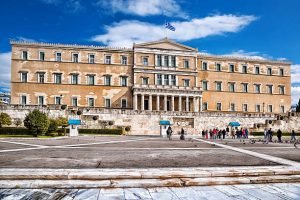 Famous Greek parliament in Athens, Greece
Derailed by an avoidable train accident
In February 2023, tragedy struck when a head-on collision between a passenger train and a freight train killed 57 people, mainly students. Over 100 were injured.
The freight train carried hazardous chemicals not declared on its manifest, resulting in a devastating fireball. Investigations revealed a severely outdated signaling system. The transport minister, a scion of another major political family, resigned, only to be re-elected a few months later.
Public outrage exploded. More than 2.5 million people took part in nationwide protests. Protesters demanded to know why such dangerous cargo had gone undeclared.
At the same time, rail workers had been legally barred from striking over safety concerns due to earlier legislation. Though a parliamentary inquiry was eventually launched in 2025, few expect meaningful accountability.
Enter the European Public Prosecutor’s Office
The European Public Prosecutor’s Office has accused two Greek government ministers of “criminal offenses.” The case involves a fraud in which politically linked Greek citizens who voted for the New Democracy party received millions of EU agricultural funds.
However, these funds were provided to them for pastureland they did not own or had not leased, or for agricultural work they never performed, depriving real farmers of the cash they were entitled to.
Brussels has asked the Greek parliament to investigate this Homeric corruption but no one in Greece expects to see any serious sanction against a political class that believes it is above the law.
Now five ministers have had to resign, but Prime Minister Mitsotakis still floats free above the rottenness of the Greek state his dynasty has controlled since 2019.
Greece’s center-left has lost coherence and impact
Soon after, two government ministers were accused by the European Public Prosecutor’s Office of participating in a fraudulent scheme involving EU agricultural funds. Voters linked to the ruling party allegedly received payments for land they did not own or for work never performed.
Once again, expectations for consequences were low. Despite mounting scandals, Mitsotakis appears largely unaffected. The opposition remains weak and fragmented. The traditional center-left has lost coherence and impact. Other movements lack cohesion or national reach.
As columnist Nikos Konstandaras wrote, “In Greece we are satisfied with grand statements of intent and endless whining… we daub the chaos with digital lipstick.”
The two big questions
Can a revitalized political movement emerge in Greece to break the hold of entrenched dynasties and initiate long-overdue national reform?
Or is Greece destined to remain stuck in a political cycle dominated by inherited power and institutional fatigue?