


By Helleniscope’s Editorial Team
Nothing symbolizes our Hellenic identity better than Mikis Theodorakis’s efforts to bring together the Israelis and Palestinians. Hellenism was never about “hegemony” or “exceptionalism”—it has always been about culture, dialogue, and peace. Mikis embodied this spirit more than any statesman or diplomat of his time. His oratorio Mauthausen, a soul-stirring lament for the victims of the Holocaust, eventually took on the stature of a national anthem in Israel, a rare recognition of a Greek artist’s moral voice. And just a few years later, in an equally powerful gesture, Theodorakis composed the Anthem for the Palestinian Liberation Organization, offering the same musical compassion to a people suffering under occupation. His legacy is not just Greek—it is profoundly human.
Cultural Diplomacy in Action
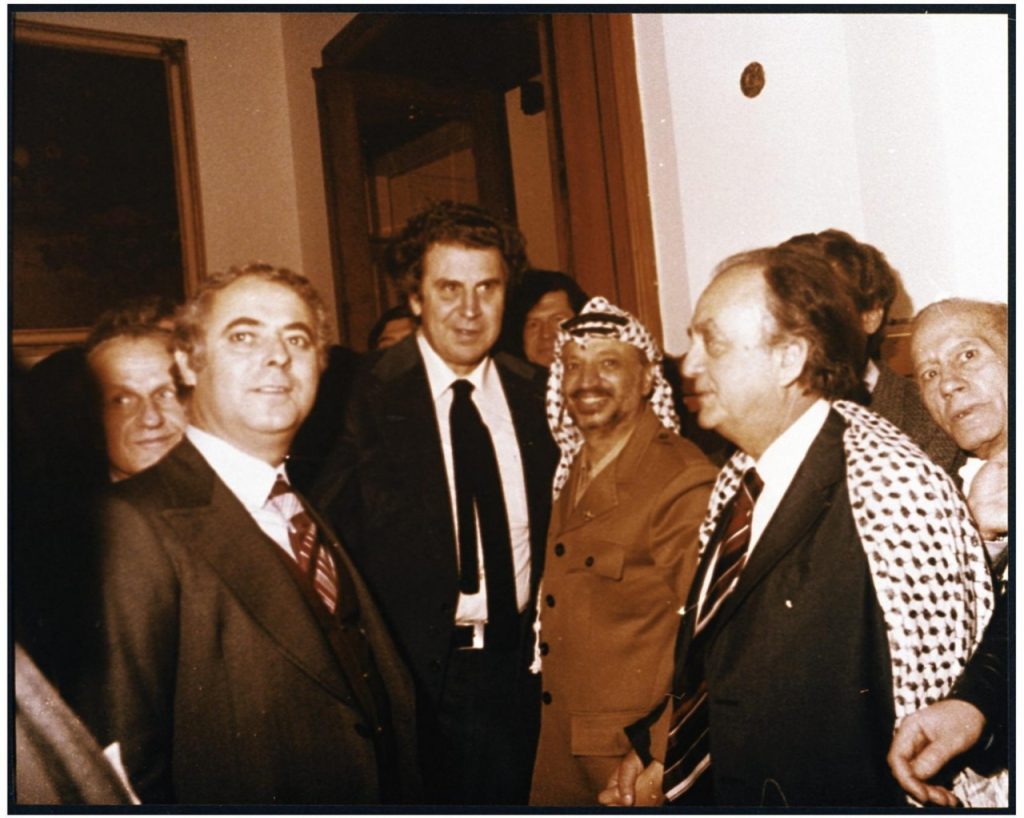
In 1972, Theodorakis made a historic visit to Israel, initially for a concert tour. But his role quickly expanded into that of an informal mediator. He met with Israeli Deputy Prime Minister Yigal Allon, who asked him to deliver a confidential message to Yasser Arafat. Days later, Theodorakis met the Palestinian leader in person and conveyed the message, urging him to begin a dialogue with the Israeli side. This bold step marked the beginning of Theodorakis’s unofficial but deeply respected role as a messenger of peace between two peoples trapped in a cycle of violence.
Oslo 1994: When Music Framed Peace
Perhaps the most powerful symbol of Theodorakis’s influence came during the 1994 Oslo Peace Accords, which formally endorsed the principle of a two-state solution to the Israeli–Palestinian conflict. At the closing ceremony in Oslo, in the presence of Shimon Peres and Yasser Arafat, two compositions were performed that captured the moral and emotional journey of both peoples:
Mauthausen, the musical testament to Jewish suffering in Nazi death camps, was performed as a gesture of recognition and solidarity with Israel.
The Anthem for Palestine, written by Theodorakis, was performed immediately afterward, honoring the Palestinian longing for dignity, homeland, and peace.
It was a moment of rare equilibrium—where both nations saw their pain, their history, and their hope acknowledged on the world stage, not through weapons or rhetoric, but through Greek music.
A Global Hellene for Peace
Beyond the Israeli-Palestinian conflict, Theodorakis extended his peace mission across the Arab world—visiting Algeria, Egypt, Tunisia, Lebanon, and Syria—always advocating for dialogue, cultural understanding, and regional reconciliation. He believed that music was not just art, but a sacred thread binding humanity, especially in places fractured by war.
Final Legacy
One hundred years after his birth, Mikis Theodorakis stands not only as a titan of Greek music but also as a moral lighthouse in the stormy sea of global politics. Where governments failed and diplomats hesitated, he carried the voice of Hellenism—a voice of culture, conscience, and compassion—into the heart of the world’s most painful conflict.
He proved that a Hellene armed with a lyre and truth could reach where armies and emissaries could not. His melodies remain—not as echoes of a bygone era—but as eternal calls for understanding and peace.
August 1, 2025, n.stamatakis@aol.com www.helleniscope.com
DISCLAIMER: The views and statements expressed in this article constitute constitutionally protected opinions of this author.
















What a beautiful tribute to the legendary composer Mikis Theodorakis!Indeed he was the best mediator and reconciliator with his music!