

By Eleni Phufas-Jousma
There are moments in history that do not pass quietly into the archives. These historical eras take root beneath a nation’s skin, shaping memory and identity long after the smoke has cleared. For Greece, two such moments — separated by seven centuries — remain open wounds: the sack of Constantinople by Latin Crusaders in 1204, and the German–Axis occupation of Greece in 1941–44. On the surface, these events belong to different universes: one medieval, one modern; one clothed in the language of Christian piety, the other in the rhetoric of “New Europe.” Yet beneath their differences lies the same brutal logic: European powers seeking domination, cloaking predation in moral language, breaking Greek civilization to advance their own interests.
In April 1204, the Queen of Cities — Constantinople — stood as the most magnificent center of Christian civilization. Its streets shimmered with mosaics, relics, marble, and manuscripts. It was the heart of Orthodox Christendom and the storehouse of ancient wisdom. And yet, under the guise of liberating Jerusalem, a Western crusading army — manipulated and weaponized by the commercial ambitions of Venice — turned its swords on the greatest Christian city in the world.
Niketas Choniates, eyewitness to the catastrophe, wrote of the fury with which the Latin soldiers burst into sanctuaries, smashed icons, raped nuns, slaughtered civilians, and carried off relics in sacks. He described drunken Crusaders dancing on altars, mocking priests, and dragging crosses through the streets. Steven Runciman called the sack of Constantinople “the greatest crime committed by Christians against Christendom.” It was not a miscalculation. It was strategic: Venice had long coveted the wealth and trade routes of Byzantium, and the Crusade offered a perfect pretext to enforce economic domination.
The consequences were catastrophic. The Byzantine Empire fractured into desperate successor states. The empire’s wealth — its relics, manuscripts, statues, gold — flowed westward, enriching Venice and Western Europe. The city itself never recovered, its demographic and economic foundations shattered. The Greek Orthodox Church reacted with righteous fury. Patriarchs, bishops, monks preserved memory with liturgical fire. The memory of betrayal became part of the Greek spiritual bloodstream.
Seven centuries later, the pattern repeated.
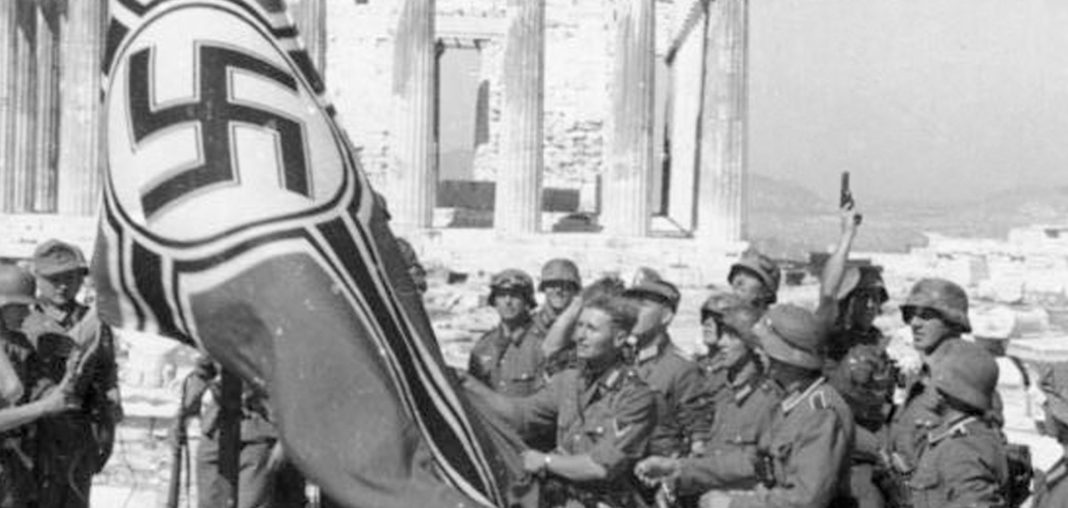
In 1941, Hitler’s Germany swept into Greece and the Balkans. The excuses were familiar: restoring order, preventing chaos, securing Europe. But beneath this rhetoric lay a hunger no different from Venice’s in 1204 — the hunger for strategic advantage, resources, and dominance. Mark Mazower has shown that Germany viewed Greece primarily as a supply basin: a source of food, gold, labor, and strategic control over the Aegean. The invasion was swift, but the occupation was savage.
The winter of 1941–42 brought famine to Athens and Piraeus; 300,000 civilians died as German forces seized grain, olive oil, and livestock. Villages were burned systematically. Distomo was reduced to human ash, Kalavryta turned into a valley of ghosts, Kommeno erased from the world in a dawn massacre. Churches were desecrated, monasteries looted, priests shot in front of their altars. And as if this were not enough, Germany demanded the infamous Forced Occupation Loan — money extracted at gunpoint, transferred to the German treasury, and never repaid.
And here lies a truth that the world rarely acknowledges: every single Greek alive today carries a story of loss from the occupation — a grandfather shot by firing squad, a grandmother who starved in the famine, a family dowry stolen, a home burned, a field seized, a monastery plundered, an icon taken, a child lost to forced labor. The war is not distant in Greek memory. It lives in living rooms, in photographs, in stories whispered at night, in the names carved into village monuments.
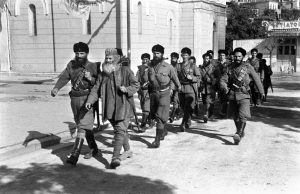
During the occupation, the Greek Orthodox Church acted with bravery that matched its darkest hour in Byzantium. Archbishop Chrysanthos refused to bless the collaborationist government. His successor, Archbishop Damaskinos, issued letters defending Jews, protected children with forged baptismal certificates, confronted German commanders directly, and risked execution. Priests in the countryside hid refugees, buried the executed by night, fed the starving, and became the spiritual backbone of national endurance. It was a moment of profound ecclesiastical courage.
Yet after 1945, something changed.
The Church that thundered for centuries about the betrayal of 1204 fell strikingly silent about the atrocities of 1941–44. No great synodal demand for reparations. No moral campaign for justice. No clarion call for Germany to confront its crimes. Instead, the Church’s voice turned to other global issues — climate, ecology, poverty, migration — all worthy concerns, but curiously distant from the genocide, famine, and pillage that had devastated its own flock.
This silence is part of a larger European phenomenon. The German state insists that the issue of reparations is “closed.” But the truth, which Germany avoids with diplomatic gymnastics, is devastating in its simplicity: the Second World War never ended with a general peace treaty. Unlike World War I, which concluded with Versailles, the Second World War ended through unconditional surrender. No treaty extinguished Greek claims. The 1953 London Agreement explicitly postponed reparations “until the conclusion of a final peace treaty.” That treaty never came. And the 1990 Two Plus Four Agreement — often misrepresented by Germany — restored German sovereignty but deliberately avoided reparations. Silence was weaponized into closure.
And here, the voice of journalist and publisher Giorgos Harvalias explodes through the fog.
In his searing work Jawohl! Blood, Amnesia, and Subservience, (soon to be published in English) Harvalias writes that Greece has been subjected to “a double violence: first the violence itself, then the violence of historical erasure.” Germany’s refusal to confront its crimes in Greece, he argues, is part of a larger European pattern: loot in the moment, deny afterward, then demand Greek silence. It is the same amnesia that followed the Fourth Crusade — when the West stole icons, manuscripts, treasures, relics, and gold, and then built its churches and cities on Byzantine spoils while pretending the crime had never occurred. Harvalias’s insight is devastating:
Europe commits the crime, then insists the Greeks forget it.
The parallels are too sharp to ignore. In 1204, Western Europe humiliated the greatest Christian city in the world and then rewrote the narrative. In 1941, Germany starved, burned, massacred, and robbed Greece — and then insisted, through diplomatic sleight-of-hand, that “the matter is settled.” In both cases, Greece was left with its dead, its ruins, and its memory — while Europe congratulated itself on a narrative of civilization.
Greece remembers what Europe wants to forget.
Greeks carry stories that Europe finds inconvenient.
The grandfathers shot in the square.
The grandmothers who starved.
The daughters raped in the monastery.
The priests hanged from the bell towers.
The libraries burned.
The icons and ancient relics looted and now in foreign hands including museums.
The debt never repaid. The reparations unacknowledged.
A whole society virtually obliterated – both in 1204 and during WWII.
These memories are not obstacles to progress; they are the bedrock of moral truth. They exist not to perpetuate grievance but to illuminate injustice. A nation must remember its dead; a continent must confront its past; and the Church — the ancient steward of Greek memory — must decide whether it will continue its silence or reclaim its prophetic voice.
The story of 1204 and 1941 is the story of Europe’s long, unacknowledged habit of looking eastward for wealth, culture, and strategic advantage, and of demanding that the East remain quiet about the cost. It is the story of a Greek world repeatedly forced to absorb catastrophe without the justice it is owed. It is the story of a debt unpaid — not merely financial but moral, civilizational, and human.
What some may mistake for complacency or for a Christian spirit of forgiveness is nothing of the sort. Greece has not forgotten, and it has not absolved; it has simply carried its silence like a burden imposed by circumstance, diplomacy, and exhaustion. Beneath that silence lies neither amnesia nor resignation, but a memory as sharp as broken glass, waiting for the world to acknowledge what it still refuses to see.
Until that debt is confronted honestly by the German state, the wound will not close. History has not concluded this chapter. Germany has not closed it. The Greek people cannot close it for them. And Europe, whether it wants to or not, will one day have to face the truths it has buried.
For more information get in touch with the International Committee of the German Debts to Greece.












In a fair world, Greece would have been compensated fully by Germany. One of the reasons she wasn’t, let’s not forget is because while Germany was prostrate, at the end of WWII, when Greece had the moral authority, as one of the worst affected nations, when Life magazine, came out with a pro-Greek edition of its magazine, on its front cover photograph of a Greek woman, dressed in black and the headline “What the Germans did to the Greeks”, when empathy for Greece was at a fever pitch, Greeks were busy killing each other for the next 5 years. Greeks were fighting and killing British soldiers in the streets of Athens, while the British were still fighting the Nazis, almost un doing the heroism and pro-allied sympathies during the German occupation.
Greece was lucky to get the Dodecanesse. Why would the allies agree to finance Greece, while there was doubt as to the outcome of the fighting between communist insurgents and government forces. Greece could have fallen to the communists and turned against the West, while they knew that protecting Germany from communism was essential to the West’s survival.
My dear Elen, I congratulate you on the review and parallelism of historical events— the sack of Constantinople in 1204 and the German occupation of Greece in 1941–44. By framing them as repetitions of the same logic of domination cloaked in moral rhetoric, the piece highlights Europe’s recurring pattern of exploitation. This parallelism is one of its strongest rhetorical devices, making the reader feel the continuity of injustice across centuries.
The insistence that memory is not grievance but moral truth is deeply compelling. The text argues that remembrance is not about dwelling on the past but about illuminating injustice. This transforms collective trauma into a source of ethical authority, positioning Greece as a guardian of historical truth against European amnesia.
The essay’s sharpest critique is directed at the Greek Orthodox Church’s post-1945 silence. By contrasting its fiery response to 1204 with its muted stance after WWII, the author raises uncomfortable questions about institutional responsibility. This silence is framed not as forgiveness but as a burden imposed by diplomacy and exhaustion — a nuanced and sobering observation.
The concept of “double violence” — first the act itself, then the erasure — is devastating. It captures how power not only inflicts suffering but also rewrites history to deny accountability. The comparison between looted Byzantine relics in Western churches and Germany’s refusal of reparations underscores how cultural theft and economic injustice are intertwined.
“a memory as sharp as broken glass” is unforgettable.
“Greece remembers what Europe wants to forget” drives the point home with rhythm and force.
The essay refuses closure, insisting that history remains open until justice is done.
The piece could further explore how these unresolved wounds shape modern Greek identity and politics. For instance, how do these memories influence Greece’s relationship with the EU today? That would connect the historical analysis to contemporary debates.
Dimitris Voggolis