
ΕΑΝ ΠΡΟΤΙΜΑΤΕ ΕΛΛΗΝΙΚΑ ΠΑΤΗΣΤΕ ΤΗ ΣΗΜΑΙΑ ΣΤΟ ΚΑΤΩ ΜΕΡΟΣ ΤΗΣ ΟΘΟΝΗΣ
By Helleniscope’s Editorial Team
In the stadiums of Southern Italy, football sometimes becomes a time machine.
Beneath the floodlights, chants rise that are older than the nation itself—names, places, and memories that reach back to ancient Hellas. This video documents rare moments from Napoli and Crotone where supporters invoke their Greek past:
Parthenope and Neapolis, Magna Graecia and Kroton, Pythagoras, Milo, and Alcmaeon.
Not as distant history—but as living identity.
You will hear fans calling themselves Parthenopaioi, descendants of ancient Parthenope.
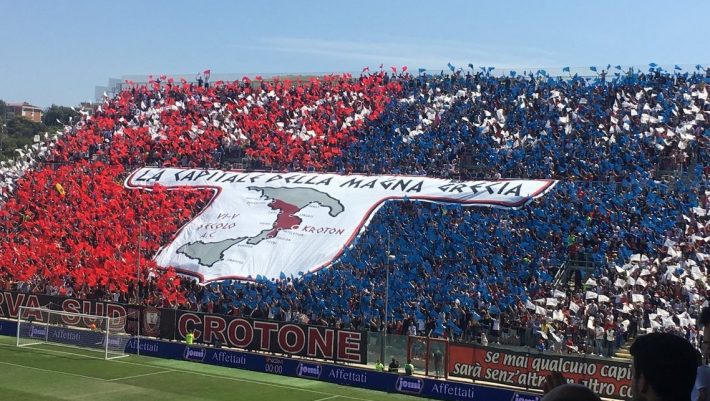
You will see banners proclaiming Magna Graecia, declaring Crotone the capital of a forgotten Hellenic world.
You will witness how myth, philosophy, and memory survive—not in textbooks, but in the curva.This is not about politics – except that at some point in the video below the fans boo the Italian National Antgem!!!
It is about remembrance, pride, and continuity.
About places that were Greek long before they were modern, and voices that refuse to forget.
Watch closely. The past is still singing.
ANALYSIS
Napoli: Parthenope in the Curva
For supporters of SSC Napoli, the word Partenopei is second nature. It appears on scarves, banners, and club branding, a shorthand for belonging that reaches back before Rome—back to Parthenope, the siren and the early Greek settlement that preceded Neapolis, the “new city.”
In the stands, invoking Parthenope is not a literal claim of ethnicity; it is a civic myth turned football language. Napoli’s ultras lean on the poetry of origins to assert difference and continuity: we are from here, and here is ancient. The chant, the name, the iconography do cultural work—binding a modern, global club to a deep local past that predates Italy itself. When Napoli celebrates titles or defies northern rivals, Parthenope functions as a banner of dignity as much as history.

Crotone: “Noi siamo la Magna Grecia”
If Napoli speaks in myth, FC Crotone speaks in geography. In Calabria, the Greek past is not a metaphor but a map. Ancient Kroton was one of the great cities of Magna Graecia, and Crotone’s supporters bring that legacy directly into the curva.
Chants such as “Noi siamo la Magna Grecia” (“We are Magna Graecia”) or “Salutate la Magna Grecia” turn antiquity into a collective self-definition. Banners reference warriors, columns, and dates of foundation. The message is assertive but cultural: a declaration that Calabria’s marginalization in modern Italy contrasts sharply with its centrality in the ancient Greek world. In Crotone, football becomes a loud reminder that the periphery once stood at the center of Mediterranean civilization.
A Wider Southern Pattern
Napoli and Crotone are not isolated. Across the South, similar gestures recur:
Taranto fans invoke Taras, the Spartan-founded city, framing themselves as “Spartans.”
Reggio Calabria and Crotone matches are often framed as a “Derby of Magna Graecia.”
In Syracuse, organized supporters reference ancient foundation dates and figures like Archimedes.
Even Salerno hosts supporter groups styling themselves as “Spartans,” borrowing Greek martial imagery to signal resilience.
What unites these cases is not nationalism, but symbolic archaeology: fans excavate antiquity to articulate who they are today.
Identity Never Dies
In an era of homogenized football branding, Southern Italian supporters use Greek antiquity to resist erasure. Parthenope and Magna Graecia are tools of memory, reminding rivals—and sometimes themselves—that these cities were ancient long before they were modern. On the pitch, ninety minutes decide the score. In the stands, two thousand years still chant back. The result is a constant reminder of their ancestry, in an era when DNA studies offer an extra layer of certainty….