


By Stephen G. Adubato
On a late September morning, I approached the registration table outside the entrance to a small Greek Orthodox church on Manhattan’s Upper West Side. I pulled up a QR code on my phone to be granted access to meet the Ecumenical Patriarch of Constantinople. I was then directed into a holding area. Once there, a parish council member told us that the people working the welcome table had been wrong, and that we were supposed to wait downstairs. I found out five minutes later that the parish council member was also mistaken. I was hardly shocked by the level of disorganization: “I don’t belong to an organized religion—I’m Orthodox,” as the joke goes. Orderliness and regimentation are Rome’s fortes, not Constantinople’s—and certainly not Greece’s.
I was further disappointed by the lack of reverence of the attendees, some of whom were texting, doomscrolling, and even talking loudly in the middle of the patriarch’s homily. Yet I can’t say this shocked me, either. Despite the embedded cultural piety of the Orthodox, we aren’t quite the most reverent of people. Thus, it wasn’t difficult to pick out the converts in the crowd. On top of their decidedly non-Greek phenotypes, their ostentatious demonstrations of piety—dramatically crossing themselves, bowing in front of icons repeatedly, holding prayer ropes, and wearing headscarves—were dead giveaways.
As someone who left Eastern Orthodoxy behind, I find the recent uptick in converts both fascinating and perplexing. I, like many of them, struggle with the predominance of the cultural element in Orthodoxy—it was one of the reasons I left it for Roman Catholicism. Too many cradle Orthodox reduce their faith to a mere cultural phenomenon, equating Christian life to decorating their houses with icons and eating lamb on Easter while downplaying the call to take up one’s cross and follow Christ. And yet, I fear that too many “Orthobros” have swung the pendulum too far in the other direction, dismissing the cultural part as a mere appendage to, or even a distraction from, the essence of Orthodoxy. Rather than casting it aside, recent converts need to learn to contend with the complicated relationship between Orthodox Christianity and culture.
As a baby, I was baptized in both the Catholic and Orthodox Churches—which is canonically illicit in the eyes of both Churches (not that my nominally religious parents cared). I ended up going to the Orthodox Divine Liturgy much more frequently than to Catholic Mass. This was, in part, because my mother’s Greek family members were pushier than my father’s Italian family members. It was also because I preferred the vibrant experience at my mom’s Greek church to my dad’s deracinated Catholic church, where nondescript “white” suburbanites sang drab 1970s hymns and the priest preached about how Jesus wants us to be nice to others. The only thing I liked about Catholicism was when my dad took me to his childhood parish once a year for the intensely Italian feast of St. Gerard.
Yet as much as I loved the cultural richness of our Orthodox parish, I desired more than just culture: I wanted to know and follow God himself. Whenever I asked the priest about how I could know Jesus personally, he said to just keep praying and going to the Divine Liturgy. The more I asked questions, the more he seemed to get annoyed. Even an Orthodox Studies professor at my university dismissed my questions, telling me that the Orthodox Church is the original church—and that, besides, I was Greek: “You can’t convert from being Greek!” The only people who took my questions about faith seriously were Catholics. It was through these encounters that I decided to enter (or re-enter, depending on whom you ask) into full communion with Rome. When I told my Greek grandfather, he berated me for “turning [my] back on our culture.”
Having been exposed to the richness of the Divine Liturgy from such a young age, I found it difficult to attend regular Novus Ordo Masses. And while I was allured by the Tridentine Latin Mass, I was repelled by the ideological charge at the parishes that celebrated it. It wasn’t until I got involved in an ecclesial lay movement focused on forming joy-filled missionary disciples that I started to see my faith flourish. Yet liturgically, I remained stuck. As much as the ethnic aspect of Orthodoxy repelled me, having to choose between drably assimilated parishes and polemical trad ones made me miss it. My nostalgia led me to seek out ethnic Catholic parishes where cultural traditions were intertwined with the liturgy.
Surely, cultural traditions have played a major role in Catholic practice throughout history—especially in comparison to most branches of Protestantism, which tend to draw up a dichotomy between the “purity” of faith and merely “human” inventions. Yet, it’s easier to extricate the ethnic element from Catholicism than from Orthodoxy. This is in part because Orthodoxy’s ecclesiastical model is explicitly arranged around national ties. Catholics may have a history of multiple “national parishes” within the same locale, but said parishes were all under the canonical jurisdiction of one diocese. In Orthodoxy, multiple dioceses can have jurisdiction over the same locale: one bishop for the Greeks, one for the Russians, one for the Antiochians.
The ethnic ties are not just structural, they’re spiritual. For the Christian East, God having become flesh is truly a mystery, one that interpenetrates human experience in ways that transcend human logic. Lacking the legalistic and rationalistic theological foundations of the Christian West, it’s more difficult for the deeply mystical Orthodox to clearly delineate between the “religious” and the “human.” This is both Orthodoxy’s strength and weakness.
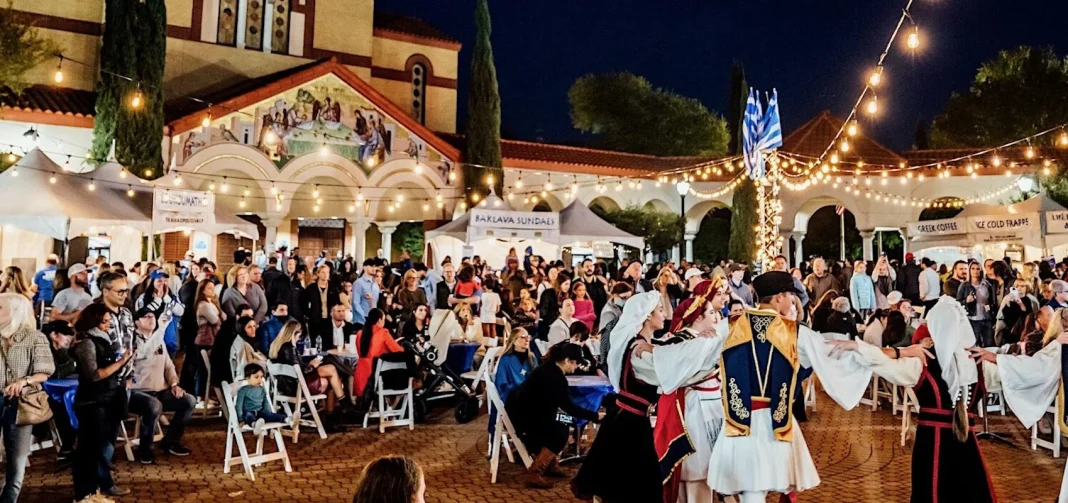
Sadly, too many cradle Orthodox reduce their faith to its cultural expressions, ignoring the demands that it makes on their hearts, minds, and actions. I’ve known many Greeks who are outwardly pious, but who behave as if they never encountered Jesus. Yet the converts who go the opposite extreme naively ignore the spiritual insights that the cradle Orthodox—even the most irreverent ones—have to offer. A lifetime of going through the motions—even without understanding or fully believing in them—imparts faith to a Greek child as if by osmosis. While gestures like cracking red eggs on Easter, walking under the kouvouklion on Good Friday (even if you arrive an hour late), and setting up an icon corner in your house do not amount to a mature, fully conscious embrace of the gospel in themselves, God surely makes himself present through them. He’s even present at the Greek festival, even if you only go for the loukoumades, dancing, and to catch up on church gossip.
Furthermore, cradle Orthodox are a reminder that faith is not the product of one’s moral effort or intellectual striving, nor is it a countercultural identity among others that one can simply choose to adopt. Rather, faith is a gift given by God and transmitted through a particular body of believers—with the emphasis on God’s initiative, not ours.
This is not to say that converts will never fully understand Orthodoxy. As Fr. Andrew Stephen Damick writes, Orthodoxy “is for everyone and doesn’t require a particular cultural identification.” But the Anglo from the Midwest who converts to Orthodoxy from Methodism or nondenominational evangelicalism is likely to have a harder time entering into the mysteries of her newfound religion than someone who breathed the ethereal air of Orthodoxy from a young age. Even my poorly catechized, nominally Orthodox family members grasp certain things about the faith better than the converts who have watched countless reels about early Church history and who can quote lines from the Philokalia and Elder Paisios’s writings from memory. As much as it would be unfair to write off all converts as mere LARPers, those who are content with tossing out Orthodoxy’s cultural dimension wholesale could be accused of never fully understanding it.
Furthermore, converts underestimate the extent to which assimilation and cultural deracination are a slippery slope to secularism. Contrary to the dictates of the Enlightenment philosophes, “religiosity” cannot exist in a vacuum. It cannot be slapped onto one’s life from the top down. One can choose to be deeply religious, but if one’s faith doesn’t sink its roots into all aspects of life—expanding beyond being a mere “lifestyle choice”—it is bound to atrophy into yet another self-referential identity category, one not all that dissimilar to those of Social Justice Warriors and “gender transitioners.”
Converts can, of course, opt to bypass the cultural in-grouping and lack of devotion at ethnic parishes by opting to attend an Orthodox Church of America parish. I’m not quite sure, however, that this can solve the seemingly perpetual tension between faith and culture found in Orthodoxy. Converts who shy away from ethnic parishes will miss out on the value of Orthodoxy’s cultural dimension. And more importantly, they will deprive cradle Orthodox from the opportunity to encounter zealous youngsters who might possibly reignite the dormant spark of faith that was imparted to them by their cultural upbringing. By learning to inhabit the same spaces together, cradle Orthodox and converts can help make the complex tension between faith and culture that is part and parcel of Orthodox Christianity a fruitful one.













Great reading. I am cradle Orthodox but am inspired and motivated by converts. There are many things that we have as cradle orthodox, but also a lot that we need to be reminded of by the converts.
Mr. Adubato, if you read this, won’t you please respond?
I applaud you for calling out the failings of our Orthodox hierarchs and our Orthodox faithful, and for demanding reforms. All Greeks and all Greek Orthodox often complain and criticize, yet we do not see any improvements.
In response to these problems, you chose to convert to Catholicism. It is your right to do so. I respect you for it, it shows you are not a mere “cradle Christian” as you say. It also shows you were not well catechized. There is no point in bringing up our theological doctrinal differences if they are not important to you.
I will never leave Orthodoxy. It is the faith I was born into, the faith of my parents and ancestors and, may I say, the only True faith.
The problems you point out about today’s Orthodox Church are real. They are horrific and each of us will be held accountable for how we deal with these challenges. For me, converting is absolutely not an option. It should hurt all of us when a member of our family, an innocent sheep, leaves the safety of our flock and is lost.
Bocaccio wrote in his Decameron about a Jew who decided to convert to Catholicism after he visited the Vatican and witnessed the greatest corruption ever. It was before the Reformation, when the Pope was selling indulgences for sins before they were even committed. Prostitution was rampant. The pope’s illegitimate children (his “nepos” or nephews) were running around the Vatican and were appointed to high positions (hence the word “nepotism”).
Why did the Jew convert into such a corrupt Church? Because, he reasoned, any religion that survives, even when the Devil tries so hard to strangle it from within, must be the True religion. Not even a corrupt clergy can defile the purity of the True faith.
You are right, sir, to demand that the faithful be vigilant. Escaping your church and converting to another religion is not a solution. May I say, it makes the problem worse, much worse.
This article is puzzling. Perhaps I am not smart enough to get it. The author admits to leaving the Orthodox Church, but he is giving us advice about “staying Orthodox”.
Chicopoulos,
Your “gut-check” appears to be correct…the following quote alone is an indication that the author is actually not fully “in tune” with what is going on…
“….As someone who left Eastern Orthodoxy behind, I find the recent uptick in converts both fascinating and perplexing….”
The author has clearly not understood what is causing a “mass exodus” from the “Western denominations”, precisely because he admits that he was still driving in the opposite lane of that spiritual highway (“left Eastern Orthodoxy behind”)…
Yet later on he admits missing the liturgical richness and meaning that Orthodox liturgical tradition offers. But he doesn’t know why, because it’s possible that his spiritual experiences have been “shallow”… And this is the key point that he is missing…if the faithful are well-versed in Liturgical tradition, there is no way that they would be “lost” in any Orthodoxy Liturgy, in any language that it might be celebrated…If you are really “in tune” with what you are experiencing, then you always know what is going on, as well as always know where you are in the Service, even if you are visiting a jurisdiction that is using a language that is not native to you.
So the real conclusion is this:
When there is proper catechism and a deep understanding, and when there is seriousness on the part of the clergy to stick to tradition instead of innovating, the issue of “culture” becomes SECONDARY to the otherwise consistent (across Orthodoxy) Liturgical tradition…The author failed to discern this super-important point, and fell into a trap of generalizations and unfortunate conclusions.
So what are we really talking about here? What’s the real “complaint”?
– Are we talking about “ethnic” coffee hour, where the “new parishoner” doesn’t feel as welcome? Maybe…
– Are we talking about “ethnic festivals” that appear strange and foreign to the new convert?…perhaps…
But these don’t exactly align with a blanket statement that always associates Orthodoxy with “ethnic divisions” that don’t have “room” for making converts feel welcome…unfortunate behaviors on the parish and individual levels certainly have more to do with that, but certainly not Liturgical tradition itself, in whatever language it may be celebrated.
I agree with some of his criticisms. However, I would never leave the OC for the catholic denomination. The catholics have more little boys abuse scandals, more heresies, more money scandals etc. The numbers are going up in the OC. Sounds like he left because he was always in the middle. A real orthodox would never leave the Church that God created. His reason are very earthly. People are people. They make mistakes. Maybe they act too “greek” or too “russian”, but to leave the Church for this reason is plain silly. Why not critisize the catholic denomination as well, for all the crimes, the abuse of children, the money scandals, the very many heresies, to be fair?
If the Greeks (or Russians or Arabs) identify culturally with their faith, does it really make them less pious? Who is anyone to judge someone else’s spiritual maturity and especially that of a whole ethnos? Greeks have been Orthodox for millennia and have produced Saint after Saint. Hush now. Culture and faith interwoven is not condemnable, rather it can help keep faith at hand even when faith is weak.
I see the “Orthobro” phenomenon as akin to the infatuation one experiences in the first year or two of marriage. That infatuation serves an important purpose and is good–at the appropriate point in the relationship. But the relationship has to mature and deepen over time. The love between spouses after 10, 20 years of marriage is so much greater than the love they had on their honeymoon, even if its expressed very differently.
Mature clergy and mature faithful in a parish will help these new converts settle down and mature in the Church. Or they will burn out and leave–a tragedy. It is imperative that we come alongside these “Orthobros” and teach them what it is to be Orthodox–most of all, by example.
Even all-convert parishes develop a dominant culture, and that is separate from the Faith. It is important for converts to understand this. In places blessed to have multiple Orthodox parishes, priests should encourage their catechumens to attend other parishes as part of their catechesis, so they understand there are different ways to be Orthodox.
The Orthobros can also challenge us who have become complacent with our faith. Even longtime converts get settled in and need to be pushed to grow. We all need each other in the Church.
I think that Orthobro has just become a slur word for converts. I am a convert from before the Orthobro era – 2005.
What I see in the newly converted is a dillema that is not solvable. Culturally they cannot make themselves Greeks or Russians; nor can they fully live their original culture which is equally embbeded with Catholic, Protestant or Humanist values.
What I see in the new converts as well is that most are broadly conservative and as such are personna non gratta among Orthodox liberals in positions of influence and who had hopes of liberalizing the Church. The influx of the opposite philosophy pains them and to some is like seeing their life efforts go down the drain.
Orthodoxy and national identity are not natural matches. There are several and complex reasons for this very development, but one of them is that most Orthodox countries reconquered liberty in the era of nationalisms – 19th to 20th century. That mishmash was promptly condemned as *heresy* in 1872. The Incarnation is in Christ’s body, not in culture. This is the mistake of both the Orthodox nationalist and of the “Defenders of Western Civilization” among Catholics and Protestants. Christ did not come to honor Greeks, make promisea to Russians or create a civilization. He came to begin the creation of a new cosmos through the salvation of what is good in this one and adding to it. This includes matter and the heart of the individuals who are willing. That is why icons show the ones who are being judge as naked. They are not wearing national colors. They are not converts or cradles, socially adjusted or misadjusted, Greeks, Russians or Americans, liberals or conservatives, socialists or capitalists, communists or fascists. They are monaxos in the broad sense: individual persons. We will be judge by how we related to others yes, and that is the communal aspect of it. But I will be judged by my relations to others, not for the relations of the groupa that I happened to belong to.
I believe we as Orthodox are overdue with the enfatuation with nationalism of the liberty movements and with its twin which is cosmopolitanism. It’s neither one polis or all the polis in the world: it is the provisory tent in the desert of this world while we are in pilgrimage towards the New Jerusalem, the eschatological City of God. On the way there, we live like Ecclesiastes tell us to: it is fun to be Greek, American, Brazilian as long as we remember: that is going to pass. Our worldly identities will pass. Identitarism did not start with woke. It started with cultural identity: one polis (nationalism), many (multiculturalism) or all (cosmopolitanism). Those too are vanity and smoke. Those will die with the body. We enjoy then like we enjoy wine, a good book or a holiday in a nice resort. But they will pass, they will all die. And each of us will stand naked before the Lord.
Hmmm… I don’t get some of what you say Stephen but other parts yes. I know that former Anglican priest convert to Orthodoxy Fr. Mark Arey had stepped down to remarry – and now is into Buddhism. Is that what ya mean?
Take it from an apostate.
Thank you Father. That was the point I was making above. This author does not worship with Orthodox converts, he does not spend time in a parish with converts, he is not Orthodox! Why should we put any merit in what he writes on this subject. I am an ethnic Greek (100%) and I consider the “Orthobro’s” and “Orthosister’s” I spend many hours per week with to be a big blessing to our parish.
The troubles with this well-written critique are manifold. For one thing, the author cannot understand whether he is fish or fowl. Yes, Orthodox liturgies are beautiful but Catholics have better administrative structures. He approves of the piety of the converts but condemns the nonchalance of the cradles. As for his concern about the “Orthobros” one can read between the lines and see that he worries about their innate conservatism. He needs to pick a lane.
Etc, etc, etc.
At the end of the day, the Orthodox jurisdiction which he was raised in (GOA) is likewise going to have to pick a lane.
Excellent article. As a former Catholic who became Orthodox 35 years ago – LONG before the “Orthobro” era – I do have a hard time understanding how anyone could prefer the dryness of Catholicism to the richness of Orthodoxy. At the same time, I find the casual approach to God deeply troubling, which is why, if I had the option, I would affiliate with the Russian Orthodox Church – at least the Russians take God seriously, not an attitude I find very frequently among Greeks, though I’m quite sure there are individual Greeks who do that.
Abroad leftists are drawn to Orthodoxy because they think we are all
bolshevik. In the USA, the far right is drawn. I’ve met a former Jewish
Buddhist NRA activist trying to organise OCA churches who was told to go
away. To see the Orthodox approach, observe St Basil’s canons: he banned
aborting women from communion for ten years, repentant murderers for twenty
and soldiers killing in battle two. Could you imagine American right wingers
abiding by all three? And he didn’t specify state sanctions. Orthodox
governance exiled, maimed, blinded and amputated rather than execute. “Eye
for eye” is a maximum, not a minimum. Podhorets closed Prophets saying
ideology is ideolatry is idolatry. Better to worship the created human next
to you than the manmade ideas in your head. Ideas are useful heuristic
approximations, maps but try to get reality to conform to the idea or map can
only lead to atrocity. Ideology is the worship of man made ideas, the Apple
of Edem. It has no place in church. And as for what conservatism really is,
Edmunde Burke never opposed change, rather demanded it occur in deliberated
careful steps, not splattered about mindlessly. Jews answer by question and
Greeks by dialectic because God and truth are incomprehensible mystery.
Muscular Orthobros may draw in pubescent males, but they drive women away.
They don’t want to be Skoptosy circumcised.
Upon further consideration, methinks Mr Adubato “doth protest too much.”