


ΕΑΝ ΠΡΟΤΙΜΑΤΕ ΕΛΛΗΝΙΚΑ ΠΑΤΗΣΤΕ ΤΗ ΣΗΜΑΙΑ ΣΤΟ ΚΑΤΩ ΜΕΡΟΣ ΤΗΣ ΟΘΟΝΗΣ
By Helleniscope’s Editorial Team
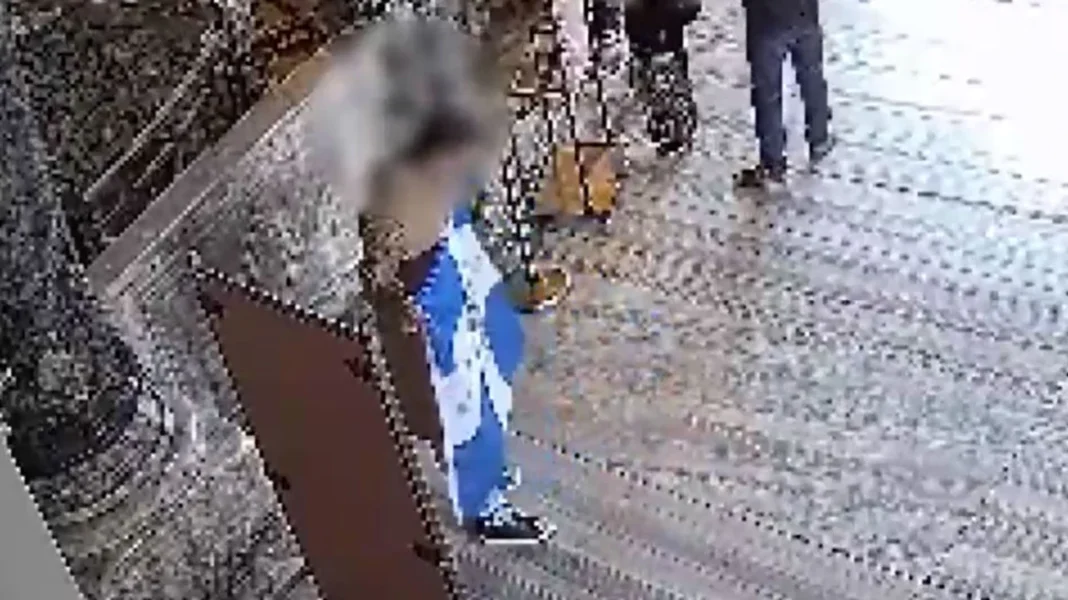
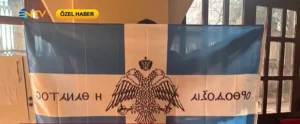
Οn April 14, two Greek visitors—a man and a woman—were arrested after briefly unfurling a banner inside Hagia Sophia in Istanbul. According to reports, the pair had entered as ordinary tourists and moved into the upper gallery area before revealing a flag bearing the Byzantine double-headed eagle and the phrase: “Orthodoxy or Death.”
Security personnel, alerted by surveillance cameras, intervened quickly. The two were later located at their hotel and taken into custody by Turkish authorities.
Official response and media coverage
Turkish authorities treated the incident as a public order and religious sensitivity issue. Prosecutors moved forward with charges related to “insulting or provoking a segment of the public,” and a court ordered the individuals held pending further proceedings.
Coverage in the Turkish press framed the act as:
- A deliberate provocation inside a functioning mosque
- A violation of the site’s strict rules against political or religious demonstrations
- Part of a broader pattern of symbolic tensions tied to Hagia Sophia’s status
Television outlets reportedly aired security footage showing the moment the banner was displayed and the guards’ subsequent response.
Greek authorities, for their part, acknowledged the arrests and indicated that consular assistance was being provided.
A charged message with a wider echo
The phrase on the banner—“Orthodoxy or Death”—has surfaced in multiple contexts in recent years. It has been used among Ukrainian Orthodox believers opposed to church autocephaly, where it functioned as a stark declaration of loyalty during a period of ecclesiastical division.
At the same time, broader rhetoric about Constantinople has occasionally appeared in international discourse. Figures such as Steve Bannon have, in past commentary, amplified slogans like “Free Constantinople,” underscoring how the city continues to resonate far beyond its borders—often in ways that are politically and culturally provocative.
Why Hagia Sophia amplifies everything
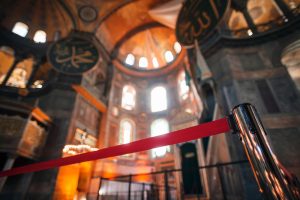
Few places carry the layered significance of Hagia Sophia:
- Once the great cathedral of Byzantium
- Later, an Ottoman imperial mosque
- Then a museum, and since 2020, again a mosque
Because of this history, even a brief symbolic act inside its walls can take on outsized meaning—religious, national, and geopolitical all at once.
A brief act, a wide ripple
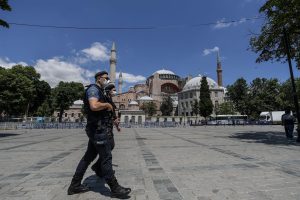
The incident lasted only moments, but its impact spread quickly through media and diplomatic channels.
To Turkish authorities, it was a clear breach of order in a sensitive site.
To others, it appeared as a symbolic expression tied to history and identity.
Between those interpretations lies the enduring reality of Hagia Sophia itself:
a place where the past is never entirely past, and where even the smallest gesture can echo far beyond the moment.
April 17, 2026, n.stamatakis@aol.com www.helleniscope.com
DISCLAIMER: The views and statements expressed in this article constitute constitutionally protected opinions of this author.












I visited Hagia Sophia during the 1990’s when it was still a Museum. If I were to return I would be inclined to bring a prayer book and offer up some prayers.
Especially for those who were martyred when the city fell.
To each his own I guess. This gesture was definitely a brave one considering the dangerous climate in Turkey. Also considering the damage done to Hagia Sophia since the conversion to a Mosque, the Turks should not complain considering how Erdogan has politicized the Great Church.
The Greek world should have been focused on this when it actually mattered. Instead, the Patriarch and his supporters in Greece and the US created a schism and a climate of repression against the canonical Church in Ukraine.
The Council of Florence and the apostasy that occurred there did not save the City.
A lesson not learned. The Patriarch’s American friends like the Evangelical Zionist Mike Pompeo did not help. If the Patriarch had treated the Russians with love and respect we might have a different outcome with regard to Justinian’s Church.
Sad story. No peace on earth.
So according to Turkish authorities in the article, the displaying of a banner “was a clear breach of order in a sensitive site” and thus a Crime. Was not the conversion of an historic Christian Church into a Mosque such a Criminal act as well?
This ironic interpretation is from a faux-democratic Theocracy in Turkey who wants a Christian-Free Polis, but claims to want to join the West where religious freedom is paramount (unless of course you are an a Country with a politically powerful Islamist mob or heaven forbid such a majority).
As we all March in NYC and Philadelphia next Sunday let us declare, Long Live Greece and the Freedom and Genius it freely shared with the World.
Tragically, all this oppression is coming to a City very near and dear to us!
When you offer the options of “Orthodoxy or Death” on the Turkish side of the border, they don’t have any problem fulfilling your wishes with the “Death” part…many neo-martyrs of the Church are a testimony to this historical fact…
The only problem here is, they most likely knew the restrictions, and took the risk anyway. Was it worth it? It really depends…
1) If they felt that by doing this they were honoring their ancestors and making a statement that they don’t acknowledge the current status of St. Sophia as being legitimate, then they will pay the price for delivering an important cultural message to a nation with a track record of uncivilized and barbaric behavior. Despite the price, there is some marginal value in the underlying intent.
2) If they just wanted a “selfie to boast with to their social media circles”, then they lack intelligence and need an ego check. There is zero value in this sort of underlying intent.
Either way, when they scan your passport these days, they have your picture, so if you do something risky in St. Sophia, stay away from the cameras or cover your face so you may have enough time to get out of that country before they visit your hotel room…it’s a 2.5-3 hour drive to the border…they probably should have high-tailed it out of there instead of going back to the hotel…
“If we hear fervent calls to battle, to division, to the salvation of Orthodoxy even to death, when we hear such slogans as, ‘Orthodoxy or death,’ we need to beware of such preachers. The Lord never said, ‘My teaching or death.’ Not one apostle said, ‘Orthodoxy or death.’ Because Orthodoxy is eternal life, joy in the Holy Spirit, joy of life, beauty of life, but death is decay, the result of the fall, and the devil’s influence. Among us even today appear, from time to time, false teachers who tempt the people with the call to save Orthodoxy, to save its purity, and who repeat that dangerous, sinful, and contradictory slogan, ‘Orthodoxy or death.’ In the eyes of such people you will not find love; in them burns the demonic fire of pride, the striving for Church power, and the destruction of Church unity.”
— Patriarch Kirill of Moscow, Homily on the Sunday of Orthodoxy, 2009
Joseph,
So today you decide that words out of Moscow are legitimate and worthy of citation? Very interesting when compared to your “Moscow-bashing” track record, sir…
Anyway, Patriarch Kyril said what he said…however, the statement “Orthodoxy or Death” is historically aligned with the revolution against the Turks…when a muslim tells a Christian that his choices are “convert to Islam or die”, what’s wrong with the response “Orthodoxy or death”? In that particular scenario, Patriarch Kyrill’s quotation supplied above would be considered “dead wrong”, to be honest, as has been corroborated by a multitude of neo-martyrs who were executed by the islamist turks, and by the way, that includes “St. John the Russian”, who is a miracle-worker and is revered across all of Orthodoxy…more than likely, the context of Patriarch Kyrill’s words was referring to something else, so it’s unfortunate you are trying to present it as a universal thing..
Do you truly expect the Turkish patriarch to intervene? If you do then you have fallen out of reality.