

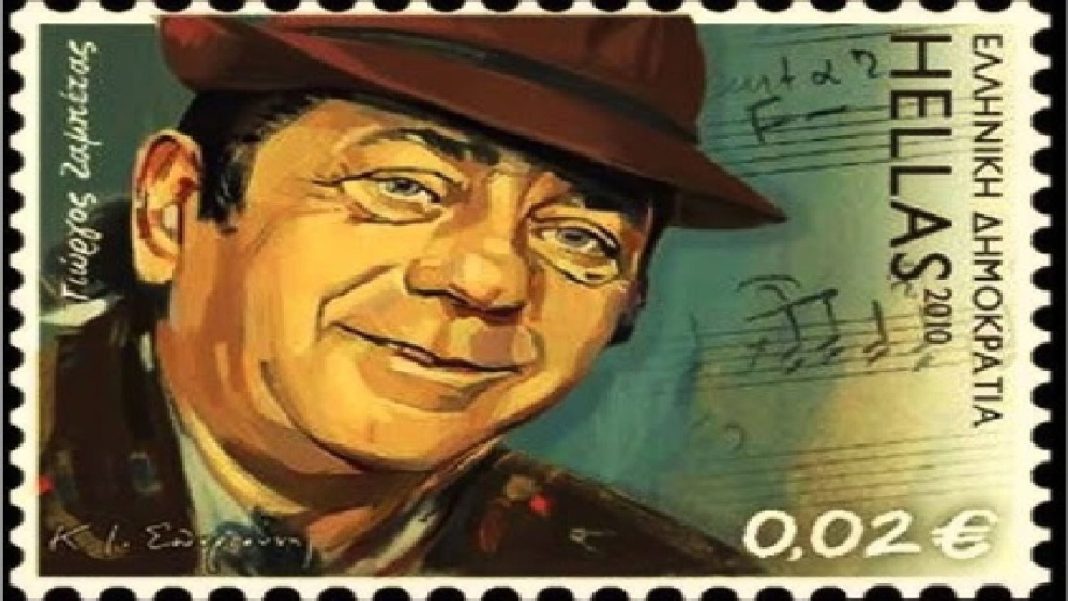
EDITOR’S NOTE (Nick Stamatakis). I have often said that I grew up just two miles from the home of Giorgos Zambetas, in what he proudly called “Egaleo City.” The place itself carries an ancient name – Αιγάλεω – the name of the mountain that rises to the west and overlooks the neighborhood. It was on that very mountain, according to history, that Persian King Xerxes sat on his throne in 480 BC to witness the destruction of his fleet by Themistocles and the Athenian Navy in the famous naval battle of Salamis below.
The western suburbs of Athens had their own distinct “tongue,” a living dialect shaped by experience and necessity. It stretched from Peristeri and Haidari, passed through Egaleo and Kokkinia, my hometown, and reached the port of Piraeus just a few miles further on. This was more than a geographic corridor; it was the cradle of modern Greek music and, by extension, the birthplace of modern Greek culture itself.
At the heart of this world was the notion of μαγκιά – a word often translated as “manliness,” but in truth far more complex. Μαγκιά was, above all, a code of honor. Long before it came to imply a display of dominance or leadership, it meant something simpler and more demanding: to speak plainly, to look others in the eye, to avoid excuses – indeed, to reject the very need for them. It was about speaking straight from the heart.

PHOTO: Onassis used to visit Zambetas whenever he was in Athens…
In its deeper sense, μαγκιά describes a layered social and behavioral phenomenon rooted in Greek popular culture, especially within the world of rebetiko and the marginalized neighborhoods of the 19th and 20th centuries. The “μάγκας” emerged in Athens around the mid-1800s, initially referring to streetwise youths and outsiders, but gradually evolving into a full cultural identity.
The μάγκας was someone fearless, independent, and guided by a personal sense of justice and honor. He often stood in defiance of convention and authority, sometimes with a provocative or defiant edge. Around him grew an entire social language: a distinct slang spoken by rebetes and those living on society’s fringes.
This defiance was entwined with mainstream social values and mainly patriotism and was famously expressed in the area’s total resistance to the Nazis, culminating in the infamous “Bloko” of Kokkinia on August 16, 1944, one of the top expressions of Nazi criminal barbarism in occupied Greece during World War II.
Today, μαγκιά carries both positive and negative meanings, depending on context. It can describe an act of courage and integrity, or, just as easily, behavior marked by bravado, arrogance, or showmanship.
In essence, μαγκιά is not a single act but a way of being—a stance toward life that blends pride, dignity, defiance, and a sense of belonging shaped by social struggle and cultural expression.
Zambetas expressed the positive aspects of this tongue fluently and enacts it in his whole life… ENJOY SOME SAMPLES!!
==============