
ΕΑΝ ΠΡΟΤΙΜΑΤΕ ΕΛΛΗΝΙΚΑ ΠΑΤΗΣΤΕ ΤΗ ΣΗΜΑΙΑ ΣΤΟ ΚΑΤΩ ΜΕΡΟΣ ΤΗΣ ΟΘΟΝΗΣ
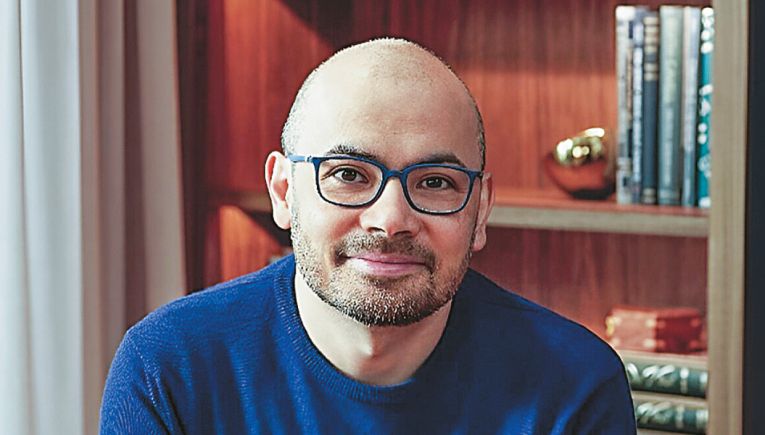
From a Greek-Cypriot family in North London to the Nobel Prize, Demis Hassabis has followed an extraordinary path through chess, neuroscience and artificial intelligence. Proud of his Hellenic roots and what he calls his “Greek way of thinking,” he has emerged as one of the defining scientific minds of our age.
By Helleniscope’s Editorial Team
Some scientists’ careers fit neatly within a discipline: physicist, chemist, mathematician, computer scientist. Demis Hassabis is harder to contain within a single word.
Chess prodigy, computer-game designer, neuroscientist, artificial-intelligence pioneer and entrepreneur, Hassabis has spent his life moving across boundaries that most people regard as fixed. He co-founded DeepMind, built one of the world’s most consequential AI research organizations, and, in 2024, received the Nobel Prize in Chemistry, together with John Jumper, for developing AlphaFold and protein-structure prediction.
Yet behind the formidable résumé lies a more human story—one beginning not in Silicon Valley or in a scientific dynasty, but in a family of immigrants in North London, with roots stretching from Cyprus to Singapore.
Hassabis was born in London in 1976 to Costas Hassabis, a Greek Cypriot whose family came from Famagusta, and Angela, a Chinese Singaporean. His parents were not scientists. They were creative and unconventional—“quite bohemian,” as he has described them. His father pursued many interests, including songwriting; his mother worked at various times in retail and teaching. Neither was remotely absorbed by computers.

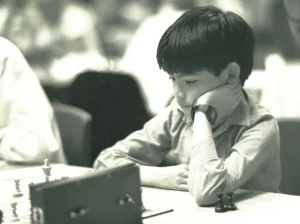
Money was not abundant either. Hassabis has recalled that his parents were immigrants and that the family lived in “quite a poor area of London.” Traveling to chess competitions was expensive, and there was pressure on the young Demis to do well because the family could not casually absorb the cost.
What his parents did give their children was something perhaps more consequential: permission to be unconventional.
They encouraged them to pursue whatever fascinated them, to “go deep” into their interests and not worry if the path looked unusual.
Hassabis did exactly that.
He discovered chess at four and rapidly revealed an exceptional gift for strategy, memory and pattern recognition. By thirteen he had reached master standard and was among the strongest young players in the world.
Chess also gave him something that would redirect his life.
With his tournament winnings, the eight-year-old Hassabis bought his first computer, a ZX Spectrum. No one at home taught him programming, so he taught himself from books.

The pattern of his life was already visible: the chess player asking how intelligence works, the programmer trying to reproduce aspects of it, and the intensely curious child wanting to understand what minds—human or artificial—might ultimately be capable of.
By seventeen he was helping to create the hugely successful computer game Theme Park. He went on to study computer science at Cambridge, graduating with a double first, then worked in the games industry and established his own studio.
But commercial success did not satisfy the deeper question that had followed him from the chessboard:
What is intelligence itself?
So Hassabis took an unusual turn. He went back to university and completed a PhD in cognitive neuroscience at University College London, investigating memory and imagination—how the brain reconstructs the past and mentally creates possible futures.
That journey between computer science and neuroscience became central to his thinking. Hassabis did not regard games, neuroscience, mathematics and artificial intelligence as separate worlds. They were different approaches to the same profound problem: understanding intelligence.
In 2010 he co-founded DeepMind with Shane Legg and Mustafa Suleyman in London. Their ambition seemed almost audacious: understand intelligence, recreate some of its capabilities artificially, and ultimately use that technology to help solve difficult scientific and human problems.
Google acquired DeepMind in 2014.
Then came the breakthroughs.
In 2016, AlphaGo defeated legendary Go champion Lee Sedol. It was a landmark moment because Go depends on an immense universe of possibilities and on something resembling intuition; abilities that had long seemed resistant to traditional computer programming.
But games were never Hassabis’s destination. They were training grounds.
The greater ambition was to turn artificial intelligence toward science itself.
That ambition produced AlphaFold.
Proteins are among the fundamental machinery of life, and their function depends heavily upon the three-dimensional shapes into which they fold. Determining those structures experimentally could require enormous amounts of time and effort. AlphaFold demonstrated that AI could predict protein structures with remarkable accuracy, transforming a challenge biologists had struggled with for decades.
The implications extend across biology, medicine, drug discovery and environmental science.
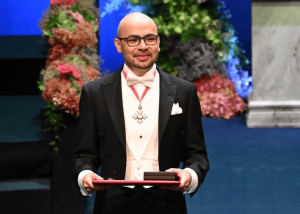
In 2024, the Royal Swedish Academy of Sciences awarded Hassabis and John Jumper half of the Nobel Prize in Chemistry “for protein structure prediction.”
It was recognition of more than one technological breakthrough. AlphaFold demonstrated that artificial intelligence could become an instrument of fundamental scientific discovery.
And here the story acquires a particularly meaningful dimension for the Greek world.
For all the international strands in his identity, Hassabis has never treated his Greek heritage as an incidental genealogical detail.
His father is Greek Cypriot, with roots in Famagusta. His grandfather lived with the family for many years, and Greek was spoken between his father and grandfather. Hassabis has spoken warmly about Cyprus and about the intellectual inheritance of Hellenism.
His formulation is memorable:
“I have a Greek way of thinking.”
He has said that the contribution of Hellenism to Western civilization is “a big part of who I am.”
That connection became even more explicit during his 2025 visit to Greece. Sitting in the ancient Odeon of Herodes Atticus in Athens for a public conversation with Prime Minister Kyriakos Mitsotakis, Hassabis spoke without hesitation:
“I’m really proud of my Greek heritage on my father’s side.”

Growing up, he explained, he immersed himself in the classics, Greek history and mythology. They shaped how he learned to think about the world.
He invoked Plato, Aristotle, Socrates and Archimedes, describing Greece as the birthplace not only of democracy but of science and philosophy.
That connection feels wonderfully appropriate.
The ancient Greek tradition Hassabis admires did not place science, mathematics, philosophy, art and questions about human nature into hermetically sealed compartments. They belonged to one larger search for understanding.
Hassabis’s favorite work of art, significantly, is Raphael’s School of Athens—that imagined gathering of the great minds of antiquity. What attracts him is precisely its union of science, philosophy, art and inquiry.
His own life has followed a surprisingly similar intellectual pattern.
The boy studying a chessboard learned to think several moves ahead. The teenager programming games learned to build artificial worlds. The neuroscientist studied memory and imagination. The AI scientist searched for general principles of intelligence. And eventually the Nobel laureate turned those principles toward one of biology’s great puzzles.
From chess tournaments that strained the family budget to a computer bought with his own winnings; from a North London childhood to Cambridge, DeepMind and the Nobel ceremony in Stockholm—the distance traveled is extraordinary.
Yet one quality connects every stage: curiosity.
Hassabis represents an older and perhaps increasingly important ideal of the scientist—not merely the narrow specialist, but the polymath willing to cross disciplines in pursuit of fundamental questions.
For Hellenes around the world, there is an additional reason to follow his extraordinary journey with pride. His achievements cannot and should not be reduced to ancestry. Science is universal, as is the promise of the discoveries he is helping to make.
But neither should his Hellenic inheritance be relegated to a footnote.
He himself does not relegate it.
In his Greek-Cypriot family, his Famagusta roots, his fascination with Greek history and mythology, his admiration for the ancient marriage of science and philosophy—and in his own declaration that he possesses “a Greek way of thinking”—there is an unmistakable thread of Hellenism in the formation of one of the defining scientific minds of our age.
Perhaps that is the most fitting way for Helleniscope to see Demis Hassabis: not simply as a Nobel laureate who happens to have Greek roots, but as a great contemporary scientist who proudly acknowledges those roots among the influences that taught him to ask very large questions.
And the question at the heart of his life’s work could scarcely be more Greek:
What is intelligence—and how can understanding it help humanity better understand itself and the world?
August 23, 2026, www.helleniscope.com, n.stamatakis@aol.com
DISCLAIMER: The views and statements expressed in this article constitute constitutionally protected opinions of this author.