

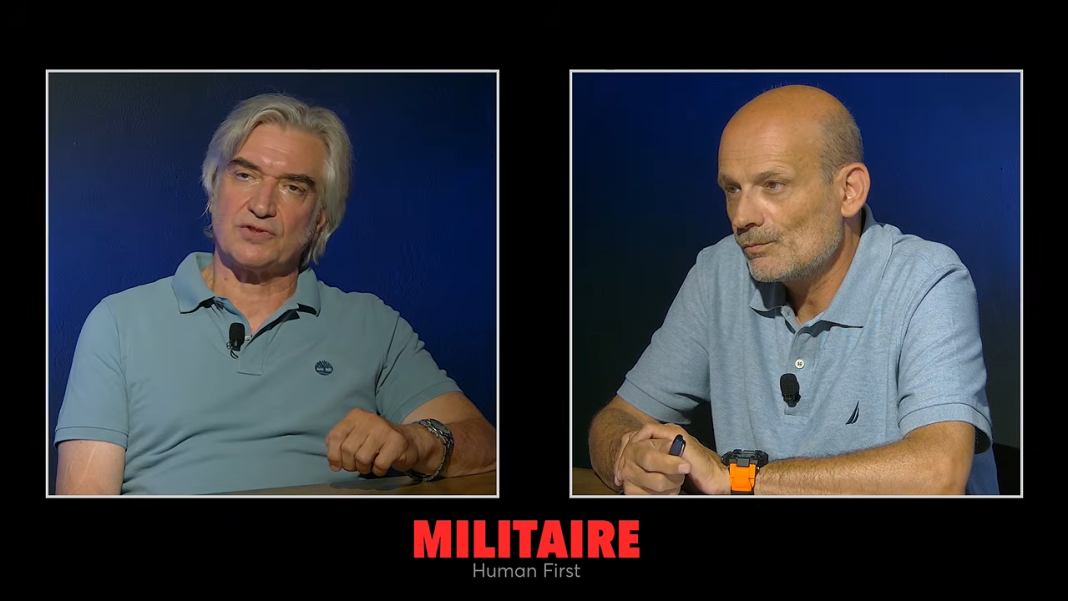
EDITOR’S NOTE (Nick Stamatakis). What is the “Achilles Shield,” the much-talked-about “dome” that we bought from Israel at a cost of €3.6 billion—and we will see how high that cost ultimately rises? Does it actually fit Greece’s defense needs? Could it end up proving to be an “Achilles’ heel” rather than a “shield,” especially after confirmation that the source code will not be in Greek hands?
What about the continuous Turkish violations in the Aegean carried out with cheap UAVs and countered with fighter aircraft—interceptions that cost Greece an enormous amount of money? Are we going to wait for the… Shield in order to deal with them, or is there already a solution? And if so, why aren’t we using it?
Retired Air Vice Marshal Dimitris Pantelatos is revealing and highly detailed in his interview with Militaire News. You can watch the video below and read Marshal Pantelatos full analysis at the bottom of this post.
===============
=====================
Shield or Achilles’ Heel?
September 6, 2026
By Dimitris Pantelatos (*)
September 4, 2026
According to data from the Stockholm International Peace Research Institute (SIPRI), Turkey possesses an estimated stockpile of 322 ballistic missiles, ranking it seventh worldwide in such weapons and placing it ahead of countries such as India, South Korea, and France. According to the same data, Greece possesses 165 missiles.
The stockpile includes MGM-140 Army Tactical Missile System (ATACMS) Block 1 missiles, as well as domestically developed systems such as the J-600T Yıldırım I and II, Bora, and Tayfun. Turkey’s missile capabilities are the result of a program launched by the Turkish Armed Forces in the 1990s. Initially, in cooperation with China, it developed the Yıldırım missile, with a range of approximately 150 kilometers, and later the Bora missile, developed by Roketsan with a range of approximately 300 kilometers through cooperation with the Chinese state-owned defense company CPMIEC. The Tayfun missile represents the most advanced stage of the program. Turkey carried out a test launch of this ballistic missile over the Black Sea in October 2022, with the missile reportedly reaching a distance of 561 kilometers and with an ultimate objective of reaching 1,000.
In the field of drones, Turkey produces as many as 120,000 drones annually—nearly 10,000 units per month—reflecting a shift toward the mass production of low-cost weapons systems that can also be employed on the tactical battlefield. Baykar and other Turkish aerospace companies hold a significant share of global exports of armed drones, which now operate in 34 countries.
Missiles, projectiles, and smart munitions constitute Turkey’s largest category of defense-system exports, with sales amounting to $3.7 billion.
Turning to our own situation, and in order to understand the operational endurance limits of forces involving air-defense systems against Turkish missiles—such as the Patriot and THAAD systems operating in the Gulf, which correspond to the Barak MX and David’s Sling systems of the future Greek “Achilles Shield”—we can make a rough working assumption by looking at the consumption to date of American munitions of this type in the Gulf. Although the war between the United States and Iran has now lasted more than 180 days since it began, the conflict has not been characterized by continuous daily active combat, as periods of ceasefire and diplomatic negotiations have intervened.
The first phase (March–April 2026) involved active fighting, followed by a diplomatic lull (April–July 2026), after which, in July 2026, the ceasefire collapsed. Consequently, active military operations amount to roughly half of the aforementioned period—that is, approximately 90 days as of the time these lines are being written.
At the beginning of the war, the American stockpile of missiles used against aircraft, drones, and other missiles was reportedly 2,200 Patriot and 452 THAAD interceptors. During the first phase of operations, the United States used 65% of the former and 50% of the latter to counter Iranian drones and missiles. Thus, average daily expenditure was 23 American Patriot missiles and four THAAD missiles. It should be noted that replenishing them would require between one and four years, depending on the ability of American companies to respond to Trump’s call for accelerated production.
The above reasoning also takes into account the fact that, from the beginning of the conflict, the United States and Israel have enjoyed complete air superiority and dominance in the area of operations, as well as comprehensive battlefield surveillance, allowing them to continuously target Iranian drone and missile launchers and thereby limit attacks against them. Nevertheless, during the first period of the conflict, every 12 to 18 hours the United States was expending a number of THAAD missiles equivalent to what it produces in an entire year. Rubio stated in this regard that Iran can produce one hundred missiles per month, creating the need for a tenfold increase in the production of the American missiles required to intercept them.
According to information that has been leaked concerning the “weapons” of the Achilles Shield, these include:
a. Two David’s Sling batteries, each with four launchers, with each launcher containing 12 launch cells for an equal number of Stunner missiles, and a total of 98 missiles for one full load.
b. Each BARAK MX battery in a standard configuration consists of three launchers, each with eight launch positions. These are expected to replace seven HAWK systems, for a total of 168 missiles for one full load.
c. Ten SPYDER AiO batteries, each consisting of three units with at least four launch cells, for a total of 120 missiles for one full load.
A rough calculation of the above requirements gives a total of 386 missiles for one load and 1,158 for three loads. According to a simplistic correlation with the expenditure of such munitions in the Gulf, these would be sufficient for approximately one and a half months, provided that the conditions of a possible conflict with Turkey resembled those of the U.S.–Iran war—that is, that all the aforementioned assets remained untouched during the period under examination and that, from the beginning of the conflict, Turkey lost its ability to establish air superiority. In any case, it follows that, at current prices for military equipment, for three full missile loads, approximately one-third of the acquisition cost of the Israeli system would concern the missiles with which it would be equipped.
Obviously, all of the above—which could be characterized as rough or even inaccurate—could be verified or disproved using the simulation and war-gaming capabilities available to the Hellenic National Defence General Staff (HNDGS), through the development of operational experimentation scenarios. The author had the honor of designing and implementing the first such experiment in the Armed Forces in 2008. The use of such tools is essential in Force Structure planning and in examining the effectiveness of the relevant planning, and obviously should be considered a prerequisite for any decision to acquire such a system.
The aforementioned weapons-consumption figures, whether accurate or inaccurate, demonstrate the need to prioritize a domestic capability to manufacture the missiles, with the aim of achieving a degree of autonomy and securing the associated supply chain, given the significant geographic dispersal of these assets and the expected difficulties in accessing them under wartime conditions.
Judging from their activities to date, this need does not appear to be served by the involvement of 19 Greek companies—one of which is 91% Israeli-owned—that will contribute to implementing the contract, valued at €750 million. Greek participation controlled by Israel does not necessarily guarantee an effective transfer of know-how that is beneficial from a national perspective. It must therefore be clarified both how much and what kind of expertise the domestic defense industry will acquire through implementation of the contract, as well as what percentage of the subsystems will be manufactured domestically through the creation of dedicated production lines or supported from within Greece.
Matters become even more complicated because of the murky situation surrounding the claim of full national ownership by Greece of the Command and Control system and the provision to Greece of its source code.
The official announcement by the Greek Ministry of National Defence refers to a “unified and holistic command-and-control system,” without identifying the entity that will develop it. By contrast, according to the official announcement of the Israeli Ministry of Defense, the new national Command & Control system that will integrate all of Greece’s air-defense capabilities will be developed by Rafael.
There is hardly any need to emphasize the strategic importance of the National Command and Control System. Access to the source code governing it is therefore clearly important, as that code governs the real-time interpretation of the strategic, operational, and tactical picture, the assignment of corresponding roles to military forces at different levels, and targeting. By itself, however, such access is not sufficient to give the system genuine autonomy and, above all, independence from external interference.
A characteristic example is that, despite the far more limited technological capabilities of that era compared with today, more than twenty-five years ago the corresponding software and hardware that provided the air picture of Greek territory to the operations centers of the Hellenic Air Force General Staff and the HNDGS was developed “in house” by the Hellenic Air Force (HAF). The HAF studied the interfaces with all sensors then available and designed and implemented a system displaying air activity within the Greek FIR and beyond, without “shopping” from anyone. The purpose of the HAF was precisely to remain independent of third parties by retaining the rights to the software and intellectual property. This gave it the long-term ability to modify and develop the system, control its architecture and configuration in anticipation of the integration of future radars and other sensors—Electronic Warfare systems, Counter-UAS, UAV, ISR—and other operational assets.
It should be noted that this air picture, transmitted through cryptographic devices, was also shared with the National Security Center for the 2004 Olympic Games, which had been established at the Attica General Police Directorate, for monitoring air traffic over Attica and the other Olympic cities.
Twenty-five years ago, the HAF demonstrated that it possessed the knowledge and capability to develop such a system, and in the present case it could do so again, provided it were given the necessary software information for the individual systems making up the air-defense network. Even a limited degree of dependence through contractual lock-in to a particular provider or manufacturer of the relevant software and hardware can be expected to predetermine the country’s future procurement choices and, most importantly, would not guarantee exclusive national use and exploitation of the data obtained through the interfaces of the system’s components—missile launchers, radars, etc.—particularly when the software governing their operation is not known to the purchaser.
The example of Norway is striking: years after taking delivery of its F-35s, Norway discovered that, because of the way their software had been programmed, fundamental and sensitive information concerning their activities was being transmitted, scandalously, outside the country to the manufacturer. In addition, we should recall the reason Turkey was expelled from the F-35 program after acquiring the S-400, as well as the transfer of the Cypriot S-300 systems to Crete, which many believe was connected to their radar’s ability to monitor the wider area of Palestine. In all these cases, the possibility was recognized or suspected that data could be transmitted and exploited in parallel by third parties in ways not included in the systems’ intended operation. The problem becomes even greater when sensors from which the information is obtained are involved but are neither owned by the purchaser nor, potentially, even known to be involved—for example, satellites.
In connection with the above, consideration should also be given to the role of the HERON unmanned aircraft based on Skyros and operated on lease by the HAF and the Coast Guard during the Israeli Navy’s operation last April. The Israeli Navy intercepted 22 vessels belonging to an international humanitarian mission in international waters, 600 nautical miles from the coast of Gaza, in the maritime area south of the Peloponnese and west/southwest of Crete.
Taking all the above into account, and without resolving the issues mentioned concerning the system’s supply and support chain and exclusive national control over the development and management of its command-and-control software, projecting 35 months forward from August 31, 2026—the date on which the contract for the “Achilles Shield” was signed—the deliverables will also produce the following results:
- Greece will have a satisfactory picture of the theater of operations in its area of interest, without necessarily possessing the ability to conduct prolonged air-defense operations.
- The same applies to Cyprus.
- Israel will possess a complete fused picture of the Aegean and the Eastern Mediterranean and will become the obvious supplier of defense equipment relating to the air and missile defense of Greece and Cyprus.
- Some members of Greece’s current leadership team, as well as some in the opposition, will advertise that, with the assistance of Israel’s new ambassador, they were vindicated by their voters in their effort to portray the “Achilles Shield” as the country’s sole and necessary defense solution.
(*) Air Vice Marshal (Pilot), retired