

source – i-epikaira. blogspot.com – ΑΚΟΛΟΥΘΗΣΤΕ ΤΟ ΣΥΝΔΕΣΜΟ ΓΙΑ ΤΟ ΕΛΛΗΝΙΚΟ ΚΕΙΜΕΝΟ
By Epikairos
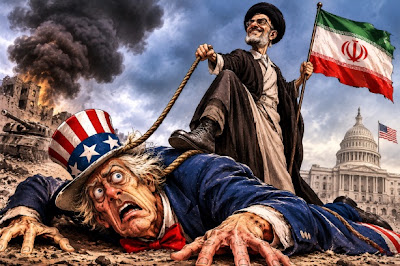
There is a delusion in Western strategic thinking: that military superiority automatically translates into political submission. America went into Iran to change its regime. Iran, however, instead upended the political landscape in Washington. It sounds paradoxical, but this is the irony of the war that began on February 28. The battlefield was in Iran, but the political earthquake struck America.
Washington and Tel Aviv possessed the resources to win the military confrontation: air power, missiles, intelligence, technology, and overwhelming firepower. They eliminated Iran’s supreme leader, destroyed critical infrastructure, and inflicted enormous losses. Yet they failed to achieve their objective: forcing Tehran to surrender and dictating what would follow.
Being able to flatten a country is one thing; being able to govern it or determine its political course is quite another. As it turned out, Iran did not need to defeat the American military. It merely had to deny it the political outcome it sought and drive the cost of the war to staggering levels.
Iran’s trump card was the Strait of Hormuz, as well as the vulnerable Gulf states—the de facto protectorates under the American security umbrella — which suddenly found themselves on the front lines of the war. Iran did not confine its attacks to American military bases. It struck ports, airports, energy facilities, and critical infrastructure in countries that had entrusted their security to American protection for decades.
Here, Tehran achieved something significant. It confronted the Gulf monarchies with a dilemma with no easy solution: respond militarily and risk even more devastating strikes, or confine themselves to defense and diplomacy. Some carried out limited retaliatory actions, but none could independently bear the burden of a direct confrontation with Iran. Consequently, their protection became an additional cost for the United States. Rather than serving as a deterrent shield, the American presence in the Gulf became yet another source of vulnerability.
The benefits of Iran’s strategy were therefore manifold…
The Pentagon calculated missiles and targets. What it could not calculate, however, was how many votes those missiles would cost Trump.
Energy disruptions, fuel prices, and inflation brought the war from the Persian Gulf into the everyday lives of Americans. Voters do not want to keep paying the price for the strategies pursued by politicians and military planners. When a war presented as supposedly necessary for American security drives up the cost of living, the White House’s explanations carry little weight.
The November 3 elections handed Democrats control of both the House of Representatives and the Senate. This was more than a straightforward electoral defeat for the Republicans. Let us recall how the MAGA movement was built. It promised to put America first, end endless wars, and abandon imperialistic policies that cost billions of dollars overseas. Ultimately, it found itself doing precisely what it had condemned. It entered yet another war in the Middle East, without a clear answer as to how or when it would end. And it paid the political price.
There is something else that cannot be ignored. American support for Israel is no longer a politically cost-free proposition. For decades, Washington treated Israeli policy choices as something of an extension of its own foreign policy. The war with Iran exposed the cost of this relationship, and what was once regarded as virtually automatic American support for Israel can no longer be taken quite so much for granted.
Washington may possess the world’s most powerful war machine, but it cannot indefinitely ignore a weary American public. Of course, a president who has lost his congressional majority is not necessarily one who will choose prudence. After all, we are dealing with a politician whose broader choices hardly exude wisdom. He may seek a way out through negotiations—which are currently deadlocked—but he may also attempt another show of force to recover his lost prestige—or lose whatever remains of it.
Tehran undoubtedly faces enormous problems. Yet it has demonstrated that an adversary’s superiority is not sufficient to impose submission. And that is a lesson that directly concerns us.
Trump went into Iran to change its regime. In the end, Iran changed the “regime” in Washington. There is a historical rule that empires tend to forget: you may project military power across the entire world, but sooner or later, the bill comes due at home.
In 416 BC, the Athenians declared to the Melians:
“δυνατὰ δὲ οἱ προύχοντες πράσσουσι καὶ οἱ ἀσθενεῖς ξυγχωροῦσιν”
“The strong do what their power allows them to do, and the weak yield and accept what their weakness forces upon them.”
— Thucydides, Book V, 89.
One year later, those same Athenians set sail for Syracuse, convinced their fleet was strong enough to impose their will. The expedition ended in catastrophe. They did not merely lose a battle; they lost virtually their entire expeditionary force, their fleet, thousands of men, and a huge share of their strategic power.
Two years after that devastating defeat, they also lost their system of government.
The regime that was overthrown was not that of Syracuse… it was that of Athens.
Hubris is not defeated by the adversary. It is defeated by itself.
That is a law.