


ΕΑΝ ΠΡΟΤΙΜΑΤΕ ΕΛΛΗΝΙΚΑ ΠΑΤΗΣΤΕ ΤΗ ΣΗΜΑΙΑ ΣΤΟ ΚΑΤΩ ΜΕΡΟΣ ΤΗΣ ΟΘΟΝΗΣ
By Helleniscope’s Editorial Team
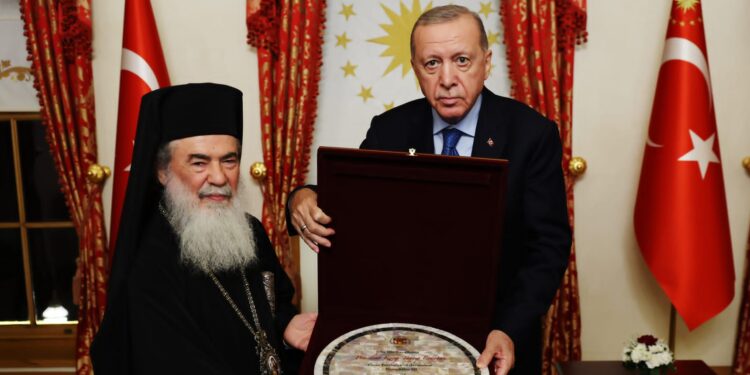
The meeting of Turkish President Recep Tayyip Erdoğan with Patriarch Theophilos III of Jerusalem on September 13, 2025, at the Dolmabahçe Presidential Office in Istanbul, was laden with symbolism and quiet significance. On the surface, the event was marked by the exchange of gifts and affirmations of respect for Jerusalem’s sacred heritage. The Patriarch presented Erdoğan with a framed replica of the Covenant of ʿUmar, the historic 7th-century charter guaranteeing protections for Christians in Jerusalem after its conquest by Muslim forces. In his remarks, Theophilos stressed the enduring importance of both this covenant and the Ottoman-era “Status Quo” arrangement, which secures the delicate balance of custodianship among the city’s holy sites. Erdoğan, in turn, voiced Türkiye’s commitment to safeguarding Jerusalem and sharply criticized Israeli actions that, in his words, undermine the city’s sanctity and the coexistence of its communities.
Yet, for all the ceremonial flourishes, what stood out was what was not issued: no joint communiqué, no published record of concrete agreements. Given the level of representation—the Turkish president himself, joined by Foreign Minister Hakan Fidan, Communications Director Burhanettin Duran, and Chief Advisor Akif Çağatay Kılıç—this silence is telling. The absence of an official declaration suggests that the real substance of the encounter was meant to remain behind closed doors. That in itself points to the meeting’s geopolitical weight.
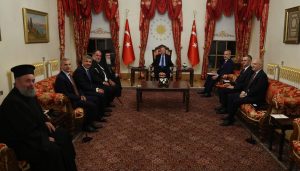
For Erdoğan, the encounter offered a stage on which to project his dual role as both defender of Muslim heritage and patron of Christian patrimony – in other words, to emphasize his “Neo-Ottoman” vision. Domestically, this plays into his long-running effort to brand himself as a global statesman whose reach extends beyond the Muslim world. Internationally, it reinforces Türkiye’s self-appointed role as guardian of Jerusalem’s multi-faith character and its message to both Christian and Muslim audiences that Ankara can be trusted to speak on behalf of their concerns.
For the Patriarch, the gift of the Covenant of ʿUmar was not a mere gesture but a deliberate reminder that Islamic rulers throughout history bore a responsibility for the protection of Christians. By invoking that heritage, Theophilos appealed directly to Erdoğan’s religious and political conscience, while simultaneously anchoring Christian claims in the historical framework of Muslim stewardship. The repeated references to the Status Quo likewise underscore a rising anxiety in the Churches of Jerusalem: that the fragile arrangements protecting holy sites could be eroded by unilateral actions, particularly under the current Israeli government.
Viewed from a regional lens, the meeting fits neatly into Ankara’s larger strategy of leveraging religious diplomacy to assert influence over the Jerusalem question. By hosting Theophilos in Istanbul, Erdoğan inserted Türkiye once again into the complex web of Christian, Muslim, and Jewish custodianship over the holy city. The Patriarch’s presence in Constantinople—the historic seat of the Ecumenical Patriarchate—adds an extra layer of Orthodox intrigue, even though this dimension remained unspoken in official accounts.
Whether this encounter will yield tangible outcomes remains to be seen. As of now, it appears to have been a carefully choreographed performance of symbolic politics. Still, in diplomacy, silence can speak as loudly as words. The absence of a communiqué does not diminish the meeting’s significance; it magnifies it. Both sides know the stakes are high, and for that very reason they chose to leave much unsaid.
September 14, 2025, n.stamatakis@aol.com www.helleniscope.com
DISCLAIMER: The views and statements expressed in this article constitute constitutionally protected opinions of this author.











Did he stop by the Phanar Patriarchate too, or did he just meet with Erdogan and his officials?
If he did, it was perfunctory. In other words, the EP is a non-entity.
And yet rumor on the street is that Elpidophoros “demands” that any clergyman visiting even for private reasons to the US notify the Archdioces to “obtain permission” to even fly over…ridiculous stuff by an Archbishop that is in a territory that is simultaneously claimed by multiple hierarchs from other jurisdictions, in clear violation of the Canons…
Did Bartholomew also “demand” the same and provide “permission” to Theofilos to conduct a personal visit?
This insightful analysis effectively unpacks the symbolic and geopolitical layers of the Erdogan-Patriarch Theophilos meeting, highlighting the unspoken tensions and strategic motivations at play in Jerusalems complex religious diplomacy.
He totally ignored the Phanar and went directly to meet Erdogan. This is very risky tactics – and it may backfire…