

ΕΑΝ ΠΡΟΤΙΜΑΤΕ ΕΛΛΗΝΙΚΑ ΠΑΤΗΣΤΕ ΤΗ ΣΗΜΑΙΑ ΣΤΟ ΚΑΤΩ ΜΕΡΟΣ ΤΗΣ ΟΘΟΝΗΣ
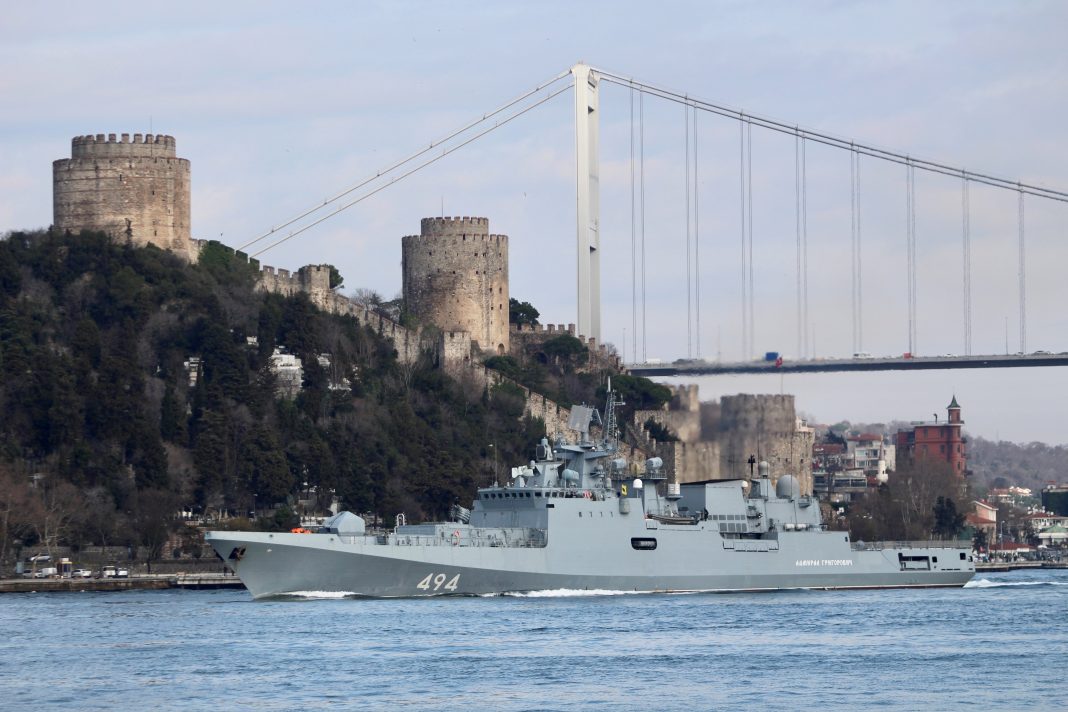
OUR MAIN PHOTO: Russian Navy frigate navigates the Bosphorus, the strategic maritime gateway controlled by Turkey that connects Russia’s Black Sea Fleet to the Mediterranean.
Recent diplomatic and cultural developments suggest a cautious reopening between Athens and Moscow. Despite Russia’s close energy ties with Ankara, Turkey’s control of the strategic straits and its growing ambitions in the Aegean and Eastern Mediterranean create powerful geopolitical interests shared by Greece and Russia.
By Helleniscope’s Editorial Team
A series of recent diplomatic and cultural developments suggests that Greece and Russia may be cautiously exploring a restoration of relations after nearly five years of estrangement. Behind these seemingly unrelated developments lies a fundamental geopolitical reality often overlooked by Western analysts: Greece and Russia share a powerful strategic interest in limiting Turkey’s dominance over the Aegean and Eastern Mediterranean. Despite the extensive energy cooperation between Moscow and Ankara, the two countries remain historical geopolitical competitors whose interests frequently collide from the Black Sea to Syria, Libya, and the Caucasus.
The central issue is geography. Turkey controls the Bosporus and Dardanelles, the maritime gateways connecting Russia’s Black Sea Fleet with the Mediterranean’s strategically vital warm waters. Under the 1936 Montreux Convention, Ankara possesses substantial authority over military passage through these straits, an authority it exercised after Russia’s invasion of Ukraine in 2022 by restricting the movement of warships. Consequently, Moscow’s ability to maintain a naval presence in the Mediterranean depends partly on decisions made in Ankara, an uncomfortable strategic vulnerability for a major naval power.
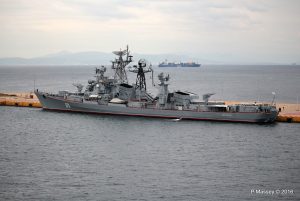
PHOTO: The Russian destroyer Smetlivy visits Piraeus in October 2016 during Greek–Russian cultural celebrations, illustrating the longstanding naval and cultural relationship between the two countries.
The Aegean therefore holds considerable importance for Russian naval strategy. Historically, Greece has permitted Russian warships to use designated anchorage areas under bilateral arrangements. A 2019 Kathimerini report cited five such berths, while later reporting identified anchorages near Astypalaia and Kythira. These longstanding arrangements illustrate why Greece’s maritime position matters to Moscow. Russia has an interest in preserving navigational access and preventing Turkey from becoming the uncontested dominant power across the Turkish Straits and the wider Eastern Mediterranean.
Against this strategic background, the October 30 United Nations Security Council vote on Libya becomes particularly interesting. Greece and Russia both abstained from a resolution extending the UN mission, although their objections differed. Athens protested the weakening of references to international maritime law following renewed support in Libya for the controversial Turkish-Libyan maritime agreement, while Moscow opposed aspects of the political transition that could undermine its regional influence. Nevertheless, both countries withheld support from the same resolution against a backdrop of growing Turkish ambitions.
Other developments reinforce the possibility of a gradual diplomatic thaw. On October 2, Vladimir Putin appointed Yuri Gorlach, an experienced diplomat and former Russian representative to NATO, as Moscow’s new ambassador to Athens. His background suggests that Russia is assigning considerable diplomatic expertise to its Greek mission, although the appointment itself does not prove a change in policy.
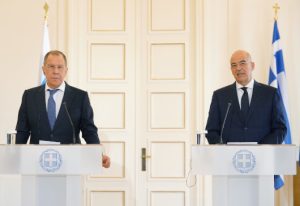
PHOTO: Greek Foreign Minister Nikos Dendias meets Russian Foreign Minister Sergei Lavrov in Athens in October 2020, before the deterioration of Greek–Russian relations following the invasion of Ukraine.
Meanwhile, Russian cultural activities have become increasingly visible in Greece. An international Russian-language and cultural forum took place in Thessaloniki on October 16–18 under municipal auspices, with support from the Russkiy Mir Foundation and expected participation from numerous Russian universities. Earlier in October, Russian cultural organizations participated in another Thessaloniki festival, while a Russian water-polo club was permitted to compete in Athens under carefully managed conditions. These activities suggest selective openings, even though Greece has not confirmed any formal reversal of its 2022 restrictions on cooperation with Russian state cultural institutions.
Significantly, former foreign minister Dora Bakoyannis’s reported advocacy of renewed communication with Moscow had already become a subject of questioning at a Greek Foreign Ministry briefing in June, indicating that reconsideration of the bilateral relationship was entering mainstream political discussion.
None of this means Greece is abandoning its Western alliances or that Russia is preparing to confront Turkey on Athens’ behalf. Moscow’s substantial economic relationship with Ankara makes such an assumption premature. Nevertheless, Russia’s long-term interest in preventing Turkish maritime hegemony creates a potential area of strategic convergence with Greece, particularly if Turkish ambitions increasingly threaten the regional balance.
The emerging picture is not yet an established Greek-Russian alliance or even close cooperation, but rather a possible pragmatic reopening driven by geography, maritime interests, and the enduring rivalry with Turkey. In the Eastern Mediterranean, where geography frequently proves more enduring than temporary political alignments, this possibility deserves serious attention.
Final note: Any raprochment of Greece and Russia is bound to progress quite fast given that Russia appreciates the help of the “informal Greek diplomats”, the shipowners who collectively own and operate over 20% of global shipping. Russia has extensive close ties with the shipowners. As Helleniscope has mentioned many times, these shipowners should be allowed to have an advisory board operating within the Greek Foreign Ministry on Filellinon Street.
Sources
- Greek Foreign Ministry — June 3 briefing
Carnegie Endowment — Turkey’s control of the straits and the Montreux Convention.
Carnegie Endowment for International Peace- Chatham House — Russia–Turkey competition and counterbalancing.
November 1, 2026, www.helleniscope.com, n.stamatakis@aol.com
DISCLAIMER: The views and statements expressed in this article constitute constitutionally protected opinions of this author.



Thank you for this very interesting article, which explains WHY Russia would ever go to war with Turkey.
From an Ecclesiastical and cultural perspective there is going to be some unity. However influential leaders from the highest levels of foreign policy and the church administration have made a choice to alienate themselves on the Hellenic side with strong influence from NATO “partners”. Greece will have to leave NATO, and the US will have to leave NATO, and a new multilateral defense and economic system which includes the US will have to be put implemented for this to have any chance at success. And the US leadership will have to be able to play nice with Russia, China, and even Iran. Frankly for all this to align seems quite unlikely. Plus from a Eurasian standpoint Turkey holds some cards, and Iran holds some cards, besides Russia. I am not sure what the solution is for Greece but where I do know we have a stronghold is in the international shipping and trade finance markets. We play in the highest levels there however we need to find ways to diversify and take advantage of other institutions that are facing pressure to liquidate as this whole system goes belly up, and that will take serious coordination.
I am afraid that Greece will get nothing but trouble if it counts on Russia fighting Turkey on its behalf.
Russia is too preoccupied elsewhere. The US must keep its ties to NATO and the US, even with their mixed history.
Correction: I meant that Greece must keep its ties to NATO and the US, even with their mixed history.