

By Helleniscope’s Editorial Team
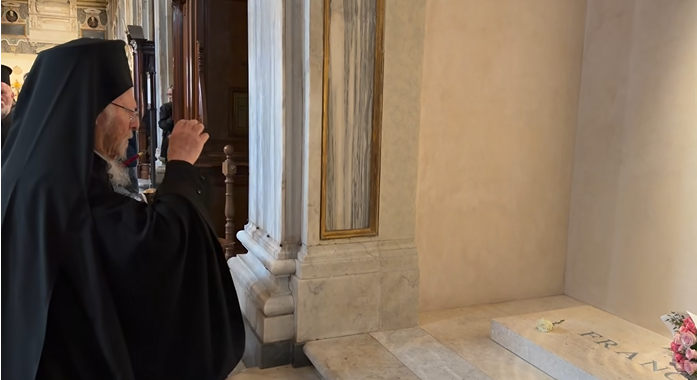
Once again, Patriarch Bartholomew has raised serious concerns among Orthodox Christians through a public gesture that appears to blur the boundaries of Orthodox ecclesiology. On October 28, 2026, during a visit to the tomb of Pope Francis at Rome’s Basilica of Santa Maria Maggiore, the Patriarch laid flowers and offered prayers for the deceased Pontiff. Particularly troubling is the reported chanting of “Αἰωνία ἡ μνήμη” (“Memory Eternal”), joined by accompanying clergy, together with the Patriarch’s apparent gesture of blessing over the tomb. These are not insignificant ceremonial details. Within Orthodox tradition, such liturgical expressions carry profound theological meaning and cannot simply be dismissed as gestures of personal friendship or diplomatic courtesy.

YOU CAN WATCH THE VIDEO BY CLICKING HERE
Ultimately, when dealing with Bartholomew, the issue that answers ALL the questions is MONEY. It is very well known that the Vatican pays the Istanbul Patriarchate an annual “stipend” of God knows how many millions… Similarly, the Foreign Ministry of Greece is known to pay them about $10 million annually in cash delivered by the diplomatc mail…
As for the rest, the “dogmatic” question is not whether Orthodox Christians should show compassion or respect toward the departed. Rather, it is whether publicly offering Orthodox memorial prayers for a Roman Catholic Pontiff aligns with the Church’s canonical and doctrinal tradition, particularly while fundamental differences concerning papal supremacy, infallibility, and the Filioque remain unresolved. Has the unity of faith been restored, or are the faithful being gradually conditioned to accept the appearance of ecclesiastical communion without the necessary unity of doctrine? The Orthodox Church’s Holy Fathers, including St. Mark of Ephesus, defended these distinctions at considerable personal cost. Their witness cannot be reduced to a historical formality whenever contemporary ecumenical priorities demand otherwise.
What makes this episode especially disturbing is its public and unmistakably ecclesiastical character. The participation of other Constantinopolitan clergy in the chanting only deepens the concern. Such actions, performed openly and circulated widely, inevitably communicate a theological message to the faithful, whether intended or not. The Ecumenical Patriarch owes Orthodox Christians a clear explanation of how these gestures accord with the Church’s received tradition. True Christian love does not require suspending doctrinal truth, and genuine unity cannot be achieved through symbolic acts that precede agreement in the faith. The issue is not personal hostility toward the late Pope Francis, whose ultimate judgment belongs to God alone, but fidelity to the Orthodox faith entrusted to its shepherds.
November 2, 2026, www.helleniscope.com, n.stamatakis@aol.com
DISCLAIMER: The views and statements expressed in this article constitute constitutionally protected opinions of this author.



the faithful are being gradually conditioned to accept the appearance of ecclesiastical communion without the necessary unity of doctrine.
Mk 14:63 ὁ δὲ ἀρχιερεὺς διαρρήξας τοὺς χιτῶνας αὐτοῦ λέγει, Τί ἔτι χρείαν ἔχομεν μαρτύρων;
63Then the high priest tearing his robes says, “What more need do we have for witnesses?
Mk 14:64 ἠκούσατε τῆς βλασφημίας·
64You have heard the blasphemy.
Unfortunately though, in this case, it is the laity that is “tearing its robes”…the Constantinopolitan Synod of “high priests” doesn’t seem to be doing anything about all this. In fact, if you pay close attention to the video, those Constantinopolitans who were accompanying the Patriarch joined him in the chanting of “αιωνια η μνημη”….
Ecumenism is the smaller of our problems right now. We have Islam slowly dominating in our western societies, ethnically cleansing Christians in the Middle East, in 1-2 generations there will be no trace of them left. At the same time, part of the Catholic church are telling us that Muhammad actually received revelation from God (!!!!!!) and that Islam must be welcomed in our societies.
https://www.lifesitenews.com/news/italys-catholic-bishops-promote-koran-as-revealed-word-of-god-in-schools/
You forget who has been funding the “beheaders” of ISIS for decades: Our establishment (Led by Senators McCain and Lindsey Graham – now burning in hell) and Israel. And you also forget who has welcomed Al Saraa – the former beheader and now “President” of Syria in the White House: Donald Trump. Go vote for him and his party – and then expect to protect the Christians.
It would be wrong if Patriarch Bartholomew served a funeral service for Pope Francis, but he did not. He is not vested in the video. Pope Francis was Patriarch Bartholomew’s friend.
Is it wrong to pray for our departed friends who are not Orthodox? Of course not. May our merciful God save them and may their memory be eternal.
Agreed.
Joseph,
Who are you kidding?
Why does the petition state “υπερ των ευσεβων και ΟΡΘΟΔΟΞΩΝ ΧΡΙΣΤΙΑΝΩΝ” (for the pious and Orthodox Christians)? Is that because the Orthodox Church routinely prays for heretics? Absolutely not. Are you a Uniate that hasn’t set foot in an Orthodox Service before? Is Bartholomew trying to add the additional words to that petition: “and for a few heretics that are my personal friends”?
Does “vesting” vs. “non-vesting” change the fact that he is a public figure, and that when he is in public, he has to conduct himself as an Orthodox bishop? Whatever happened to the broader application of 1 Cor 8.13?
“…Wherefore, if meat scandalize my brother, I will never eat flesh, lest I should scandalize my brother…”
A Patriarch is a public figure, and ALWAYS has to be mindful of not scandalizing the flock when he is out in public.
Nevertheless, Bartholomew knew exactly what he was doing, he knew the cameras were rolling, and he didn’t care that he would scandalize anyone.
And speaking of the role of a public figure…
Is it ok for Bartholomew “cease being Patriarch” for a few minutes in a public setting to divert his activities to “non-Orthodox” practice? If he himself feels the answer is yes, he should do us all a favor and resign… he can stop the charade and simply “cease acting Orthodox” for good, and he can join the likes of that traitor Vyssarion back in 1439, and even get his own apartment in the Vatican so he pray at Pope Francis’ tomb all day if that’s what makes him happy these days.
https://en.wikipedia.org/wiki/Bessarion
And to address your other claim, it’s a very lame excuse that he didn’t have liturgical vestments while simultaneously reciting an OFFICIAL Orthodox prayer and offering the OFFICIAL Orthodox “priestly blessing” with sign of the cross with the movement of his hand ? And whatever happened to those Canons about Praying with Heretics, or even visiting a heretical place of worship (which technically the Vatican has plenty of examples of)? Are you going to try to peddle a flawed legalistic Uniate argument that they don’t specify the words “pray for heretics”? Refer back to the aforementioned petition that intentionally prescribes “for pious and Orthodox Christians” and feel free to explain why it is so intentionally descriptive, then.
“Memory eternal” should only be chanted for Orthodox Christians. The correct way to pray for non-Orthodox is to say, “May they rest in peace” (per a Russian Orthodox Bishop).
Mrs. Mutton,
St. John of Shanghai (Russian Orthodox Bishop) did make an exception:
“As an exception for those persons who during their lives demonstrated goodwill towards the Orthodox faith and took part in its life to the best of their abilities, a prayer for the reposed [zaupokoinoe molenie] may be served, consisting of the chanting or reading of the seventeenth kathisma (Psalm 118) with the addition of a short litany for the repose of the departed and [the chanting of] ‘Eternal Memory.’”
https://www.pravmir.com/selected-decrees-and-instructions-of-st-john-of-shanghai-and-san-francisco/
Whether Pope Francis could be considered such an exception is of course debatable, but apparently Patriarch Bartholomew did.
Yeah. right…Pope Francis having “goodwill” towards the Orthodox Faith?
Don’t you remember how his “prayers for peace in the Ukraine” were received by God when he released the 2 doves on that day in 2014?
https://www.cbsnews.com/video/doves-released-at-vatican-attacked-by-crow-and-seagull/
Marcos, please don’t present such foolishness as a sign from God. Did not the residents of Constantinople fervently raise their prayers to the Theotokos during the fall of Constantinople? Why did she chose to allow the city to fall? We must be careful how we interpret events.
Spot on, Markos!
JK,
Have you read in the psalms “they shall have eyes, but they will not see”?
You may want to open your eyes a bit more, and ask around from those scientists who know what the statistical probability is of that scene unfolding in a natural manner in the middle of a major city like Rome, and then you can decide if you want to deny if it was an “unexplainable sign” or not… just remember though, according to Patristic teaching, those who deny miracles from God are the ones who are guilty of “blasphemy against the Holy Spirit”…(read up on that in the Patristic explanations of that verse)….go ahead, research, and then feel free to tell us your decision…
Amen
Marcos, what did St Mark of Ephesus do for a year and half in Florence. I don’t think that he was hanging out at the local taverns. He debated with the Roman Catholic theologians, visited their churches and prayed with them, though he would not share the Eucharist with them. A very different model than what you present.
Jk, comparing – even in passing – Bartholomew with Mark of Ephesus is quite “rich”… Ha.. ha…
Yeah, can you immagine St. Mark of Ephesus considering “dialog” with the aim of “one shared chalice”? Pffff….
https://spzh.eu/en/news/96863-patriarch-bartholomew-says-catholic-dialogue-aims-at-one-shared-chalice.html
St. Mark of Ephesus traveled to Italy, to Ferrara and then to Florence, with the high hopes of a canonical union and healing of the schism. While he was there he realized, through his cordial dialogue with Roman Catholics, that it wasn’t going to happen. The council primarily had a political agenda and at the expense of the dogmatic teachings of the Orthodox Church. The Roman Catholics were in a position of power, while the Orthodox were under political duress. So the Roman Catholics had no intention and were not willing to give up their heresy.
We can assume, though, that he would have been in favor of “one shared chalice” if the Roman Catholics had given up their heretical beliefs. St. Mark reposed in 1444, the year before the council officially ended. Through God’s providence, he was not alive when the declaration of false Union was officially signed in 1445.
The schism between Rome and Constantinople has reached nearly one thousand years now. The Roman Catholics are still in a position of power, whereas the Orthodox are largely not. The Russian Church is somewhat of an exception, though, being a great power. Yet quite sadly, so many Orthodox Christians today are willing to accept the heretical neo-Donatism of the Russian Church in exchange for the great power of Russia. Much like the mindset of those who joined the false council of Ferrara-Florence, they have cast their pearls before swine.
Joseph,
You were actually doing well, up until the very last paragraph…
It is Constantinople that is turning more Uniate year over year (like Byssarion in 1439), and casting pearls before the swine (by Communing with deposed Schismatics, by bishops who kiss the hand of the Pope, by giving Cardinals censers at Pascha service in NYC to “bless” the Orthodox, common prayers with heretics, – etc, etc,etc)…how many examples of “casting pearls to the swine” via Constantinopolitan hands do you yet need to see before you realize what everyone else has already realized?
If St. Mark of Ephesus could not heal the schism, Barto can’t either. Not only he is not healing any schisms, but he is creating new ones. Yes, he realized, through his cordial dialogue with Roman Catholics, that it wasn’t going to happen, but unfortunately Barto is incapable of this realization. The Roman Catholics were in a position of power, just like the Roman Empire was in a position of power. Yet, Christ did not try to “consolidate” his power with the heretics. Neither did St. Mark make any compromises. Illogically, Barto follows neither St. Mark, nor Christ. The Roman Catholics had no intention and were not willing to give up their heresy (btw, it is heresies now, not heresy). They did not do it then and they won’t do it now. For us it is clear; only Barto doesn’t understand this…
Joseph,
And by the way, you are citing the Roman Catholic “opinion” of the end of the council, which was in fact years after the delegation had returned to Constantinople…why are you citing the Roman Catholic point of view? Are you telling us you are Uniate?
Markos, Ferrara-Florence was a Uniate council officiated by Roman Catholics, so of course the “official” end was determined by the Roman Catholics.
Joseph,
There’s a “tale of two cities” on when it ended. You are aligned with the wrong city…not a surprise, because you are mostly aligned with the Uniates on this forum anyway…
I had no intention of comparing the two but challenging the perspective Marcos continues to present. St Mark prayed with hertetics and visited their places of worship.
JK,
It’s a good thing that history lessons are far more reliable from primary sources and eyewitnesses who recorded the events of the Ferrara conference, and not from people like you.
Let’s start with a quote from a history book titled “ο Αγιος Μαρκος ο Ευγενικος και η Ενωσις των Εκκλησιων” – Νικολαου Π. Βασιλειαδη 6th edition (2007), which confirms that the Orthodox were provided with their own places of worship, starting from the time the ships landed in Venice:
“….Ειναι χαρακτηριστικον ομως και τουτο. Οι Βενετοι παρεχωρησαν εις τους Ορθοδοξους κε ενα ιερον ναον, δια να τελεσουν την Θειαν Λειτουργιαν…”
And given that opening statement, what was one of the first things that Silvester Syropoulos’ firsthand eywitness account of the happenings of Ferrara say (source: Η Ιστορια της Συνοδου Φερραρας-Φλωρεντιας – Συλβεστρου Συροπουλου – εκδοση Ροδοστολου Χρυστοστομου 2012, section 4, chapter 23)?
“…Εν εκεινη τη ημερα μετα μεσημβριαν διεμηνυσατο ο πατριαρχης τω παπα, οτι ‘Ημεις μετα το εισελθειν εις τα ορια της σης μακαριοτητος ουκ εποιησαμεν ουδε το τυχον επισκοπικον, την παρακελευσιν διατηρουντες των θειων και ιερων κανονων΄ νυν δε ελθοντες ενταυθα, ζητουμεν ινα εχωμεν την συνηθη ημιν εκκλησιαστικην ακολουθιαν και την λειτουργιαν ημων και πασαν την ταξιν, ην ημεις εχομεν, μετα θεληματος και ενδοσεως της μακαριοτητος σου. Ο γαρ πατριαρχης μετα το παραμειψαι την Κερκυραν, ψαλλομενων των εσπερινων υμνων και εν τριηρει και εν χερσω και εν αυτη τη Βενετια πασων των ακολουθιων και των λειτουργιων τελουμενων, ουκ εδιδου την συνηθη ευλογιαν εν τω τελει των υμνων ημιν τε και τοις εκεισε ευρισκομενοις. Δι’ο και τα τοιαυτα εζητησεν. Ο δε παπας ΕΝΕΔΩΚΕ ΤΑΥΤΑ ΚΑΙ ΔΙΩΡΙΣΑΤΟ, ΙΝΑ ΕΧΕΙ ΤΗΝ ΙΔΙΑΝ ΤΑΞΙΝ Ο ΠΑΤΡΙΑΡΧΗΣ ΩΣ ΒΟΥΛΕΤΑΙ.
And if that is not enough for you to be convinced that there was clear “segregation of services” (aka NO COMMON PRAYER) during the entire duration of the deliberations, (always according to the eye witness Silvester Syropoulos) look at what bishop Gregory (one of the ones with St. Mark of Ephesos) told the Patriarch at the beginning of that Ferrara adventure (Section 4 chapter 31):
Εγω οταν εις ναον εισελθω Λατινων, ΟΥ ΠΡΟΣΚΥΝΩ ΤΙΝΑ ΤΩΝ ΕΚΕΙΣΕ ΑΓΙΩΝ, ΕΠΕΙ ΟΥΔΕ ΓΝΩΡΙΖΩ ΤΙΝΑ’ ΤΟΝ ΧΡΙΣΤΟΝ ΙΣΩΣ ΜΟΝΟΝ ΓΝΩΡΙΖΩ, αλλ’ουδε εκεινον προσκυνω’ δι’ οτι ουκ οιδα πως επιγραφεται, αλλα ποιω τον σταυρον μου και προσκυνω. Τον σταυρον ουν, ον αυτος ποιω, προσκυνω και ουχ ετερον τι των εκεισε θεωρουμενων μοι.
So this latter quote is clear about the mindset going into Ferrara…”I aint venerating anything in the Latin temple”, was the mindset going into the conferences.
But even towards that very last “day of betrayal”, this is how Syropoulos describes the state of St. Mark of Ephesos, just before the signatures started being placed, and of course St. Mark walked away from the “treasonous delegation” (Section 10 Chapter 5):
Ο δε γε Εφεσου εκαθητο μεν σιωπων και αλγων επι τοις γινομενοις.
And that’s what the historical eyewitness account was…much different than your “assumption” isn’t it?
Most importantly, follow the cash and where it’s stashed.
“ Ultimately, when dealing with Bartholomew, the issue that answers ALL the questions is MONEY. It is very well known that the Vatican pays the Istanbul Patriarchate an annual “stipend” of God knows how many millions… Similarly, the Foreign Ministry of Greece is known to pay them about $10 million annually in cash delivered by the diplomatc mail…”