



A prime example is what AB Elpidophoros said on that historic day in St. Demetrios of Astoria (July 14, 2019): He preached to the congregation that the term “heretical man” means “troublemaker/someone who divides others/who introduces hatred.” Is it a chance that Saint Mark Of Ephesus (Ευγενικός) called the Latins “Heretics”?
By Markos (Helleniscope’s regular commentator and occasional editor)
There has been a lot of back-and-forth debate lately about the importance of understanding original Greek or whether “hearing the word,” reading translations, or simply “imitating” role models is sufficient to succeed in an Orthodox journey. There is no doubt that many of our Orthodox saints would qualify as “illiterate” nowadays, just as many heretics in history were theoretically “very literate” (Arius and others).
The advocacy to study the original language comes mainly from the angle that St. Kosmas warned us about…”απο τους διαβασμενους θα ερθει το κακο…” (evil will come from the literate ones)…most heresies out there today can be traced to some misinterpretation of original scriptural text. When we refer to Orthodox texts, we are referring to Greek Gospels, and the Greek Septuagint as a starting point for the Ecumenical Synods, etc. Eusebius was a contemporary of the first Ecumenical Synod, and in his work “Ecclesiastical History,” he clearly spelled out the “canonical books of the old/new Testaments,” as well as mentioned that the Fathers rejected other books as being of “dubious origin.”
Faith for 15 centuries (when printing presses were not around and most people were illiterate) came from “hearing”…that concept is linguistically and historically related to the ecclesiastical use of the word catechumen (for those that understand the original Greek), κατ + ηχον, going back to the days of the thunderous / resounding (ηχος) word of God from above (being sent down – κατω) on the day of Pentecost…so there’s no disagreement with those that maintain that “hearing the word” can be sufficient to succeed in a spiritual journey….yes, that can happen.
However, if the one “preaching” to the ones “hearing” has misinterpreted the words, like the Ethiopian in the chariot (a reference to the book of Acts, to satiate your passion for scripture), or the same one reading is reading off a “script” of scripture that has not been translated correctly, then “Houston, we have a problem/heresy”… The phrase from Acts, “Do you understand that which you are reading?” addressed to the Ethiopian, applies today as well, and not just in the 1st century AD. And now, it can also be extended to “Do you understand that which you are hearing from the guy who doesn’t understand what he is reading”?
How is it possible to rely on a kaleidoscope of variant English translations for a 100% understanding when there are no two exact translations of the original in English? That’s the whole point here.
That’s the point that seems difficult to get through to several commentators in this forum, no matter how many times it is spelled out in English. We seem to persistently end up with a broken record of diversional and twisted responses on this topic every time…all of them attempting to minimize the importance of every Orthodox individual’s understanding of how the Church Fathers interpreted the original words and not just their responsibility to “read on their own time, from a translation of dubious accuracy”…(This understanding includes the times when there were debates about words in the original Greek language)
By the way, Helleniscope is correct in a previous response referring to Elpidophoros, but by extension to other “scholars” as well and what they are doing with their own “interpretations.”…
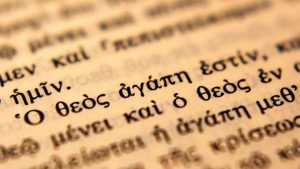
But perhaps we need a couple of tangible examples to stop talking “theory” here…
There’s an entire contingent of “scriptural scholars” in the English language that has been trying for years to alter the English translation of the word αρσενοκοίται in Corinthians, in order to fit the LGBΤQ-Z alphabet soup agenda, even though it’s clearly a compound word that is previously found in its broken down form in a sentence of Leviticus 18:22 (Septuagint Greek)… That desperate attempt is ongoing and easily searchable on the internet.
Similarly, in another scandalous example, Elpidophoros also tried to “teach the people of St. Demetrios in Astoria” what the word “αιρετικος” meant, and provided a definition that was different from the one St. Basil presented in his 188th letter, on the pretext that “you Greeks in America don’t know Greek”….
https://www.newadvent.org/fathers/3202188.htm
“…Thus they used the names of heresies, schisms, and unlawful congregations. By heresies, they meant men who were altogether broken off and alienated in matters relating to the actual faith; by schisms, men who had separated for some ecclesiastical reasons and questions capable of mutual solution; by unlawful congregations gatherings held by disorderly presbyters or bishops or by uninstructed laymen. …”
-St. Basil
However, Elpidophoros, on that historic day in St. Demetrios of Astoria (July 14, 2019), preached to the congregation that the term “heretical man” means “troublemaker/someone who divides other/who introduces hatred” in Greek, and does not refer to those belonging to “other churches”… That’s certainly not congruent to what St. Basil wrote in letter 188, and certainly not congruent with our historical use of the term in ecclesiastical history, or in the Canons of the Church… Is Archbishop Elpidophoros planning also to tell us now that he knows Greek better than St. Basil or the other Church Fathers did? Here are his words, exactly, especially starting in the 10th minute:
And why did he do this? Because he said “that’s what the sermon is for, to explain to you all things that are difficult to understand in the ancient language”… He’s taking advantage of people who have not studied ancient Greek and the Fathers, of course, but do you, “o reader of ONLY English,” feel that an English translation was going to help you avoid Elpidophoros pulling the wool over your eyes in this situation? Many of these translations don’t use the term “heretic” either in this Titus translation (KJV did, however, and that was the “original English translation”)… Several modern translations use the term “divisive” or “factitious” which is precisely what Elpidophoros tried preaching in Greek… I personally don’t believe the avoidance of the term “heretic” in Titus 3:10 in modern English translations is an “accident” in later years… Its avoidance coincidentally fits well within the WCC agenda for those who want to start doing some detective work.
And an additional point of interest… the Greek Archdiocese of America, for some unknown reason keeps using the word “factitious man” in English translations of the letter to Titus when it is recited on Sundays of the Fathers, while we hear precisely the term “άνθρωπον αιρετικόν (heretical man)” in the Greek version (that to several commentators’ points “few understand,” anyway in the USA). Is all this by chance? This also fits well with the agreements between Constantinople and Rome after Vatican II to focus on “similarities” and not differences, tone down the rhetoric, and stop the “anathemas”…
Is it also a chance that St. Mark of Ephesos was the only one insisting at the Pseudo Council of Ferrara that the Latins were “heretics”, while the compromisers that “signed the bottom line” insisted on the term “schismatics”, which is exactly the term the “compromisers of the faith” that we observe today continue to insist on? Exactly who ended up being a Saint of the Church and who did not, after Ferrara?
Ultimately, these examples are exactly why everyone (even modern Greek speakers) should invest time in understanding the patristic interpretations of the original Greek of the New Testament so that when the next “Ethiopian upon the chariot” shows up to preach nonsense or even heresy to us from the pulpit, he can be called out on the spot, based on the correct patristic and Orthodox interpretation of the original words…














It’s difficult for lay people (who are not Greek) to study Greek if they are not Greek. I think your article was on point about understanding Greek translations. Thank you so much for your wise words.
Nobody says that it is easy. But when there is a serious issue, a heresy in our case, we have to go back to the original texts. And if we cannot read and understand the “Alexandrian” Greek of the Bible, then we have to refer to the expert philologues and theologians. Relying on the myriad translations is likely to lead to misunderstandings and more…
If what you say is true, how can we have so many saints that knew no Greek. The message of Pentecost was that people could hear and understand in their own language. Markos, if translations are poor and don’t accurately convey the original meaning why would you accept the Septuagint, which by the way there are many versions, to be an accurate translation.Patristic interpretations of Scripture are
Important to help us to understand Scripture yet many fathers had variant interpretations of Scripture. The fathers differed even on the number of sacraments. For instance, John of Damascus counted only 3 sacraments and included the funeral service as a sacrament. Should we consider him a heretic.
I still look forward to the day when you become as passionate about the gospel as you are about the Greek language. By the way, a few semesters of Greek at a local college will in no way help to understand the original texts.
On the day of Pentecost, indeed, the Holy Spirit was the “translator-in-chief”. It can’t get more perfect than that. We can’t go back in time with our modern-day recording devices, to record these simultaneous “non-human” translations in multiple languages of the time, although that possibility would have resolved a lot of this confusion we are experiencing today.
Nevertheless, the original 70 Apostles took that miraculous “translation given by the Holy Spirit”, and spread it to the nations. Unfortunately for the skeptics, for whatever reason, the Greek survived as the “original text” in the East, and its Latin translation in the West (but we’ve said before the linguistic structure of Latin is far closer to Greek than English’s structure is, so Latin’s accuracy is much higher than English because it’s less constrained). And again unfortunately for other skeptics, this academic notion of Aramaic vs. Greek texts (being recorded first) is always suspect in light of the fact that only Greek/Latin/Hebrew was used on the inscription on the Cross.
Nevertheless, like we said previously, oral preaching and teaching to illiterate masses was a big way that the Word spread in multiple languages. Whether or not it was written down as accurately as it was delivered on the Day of Pentecost, whether or not those first texts after Pentecost survived in those “other languages” (like they did in the Greek), as long as the oral teaching and tradition remained accurate, the disciples were Orthodox, and saints were generated in multiple languages (to answer the first question). In later years, saints Cyril and Methodius did a glorious job in imitating the 70 Apostles, working hard with the help of God to translate matters as accurately and patristically as possible, and the fruits of their labor include
the known legacy of multiple Slavic saints, who with their own tenacity to imitate Christ, the saints, and the Church Fathers, as well as to “keep the traditions of their teachers” to “the last iota and comma”, as they were taught by saints Cyril and Methodius, (who had Apostolic succession in the true sense – including in the oral and written Word), kept the Faith and Tradition strong for centuries afterwards. In short, these cultures and speakers of non-Greek languages worked hard for centuries to “not stray” from the path, and to reject “new teachings” as best as possible. The fruit of their labor was more saints, yes…
Disagreement between Church Fathers and heresies always existed, however. That is stating the obvious, and on its own that observation is useless and a diversionary tactic in discourse. That’s exactly why we have a Synodic Church, to defend against heresy, and come up with a common word. That’s why the day of Pentecost is really a “first Synod”, because it gave us the model of all Fathers (Apostles & successors) being literally “on the same page of Faith”, with the grace of the Holy Spirit. That was an example of “in that hour what you are to say will be given to you…” (Matt 10:19)…that’s why all heresies are decisively condemned and dealt with at Ecumenical Synods, traditionally. In a Synodic Church, when one of the “teachers” starts preaching incorrectly, the others will put him in his place. Do you all remember what happened in Galatians 2:11-2:16, when Saint Peter (whose tomb the Vatican incorrectly cites as a “rock” justifying “primacy”) engaged in behavior that was non-Christian, leading even “Barnabas astray”, and St. Paul had to admonish him and bring him “back on track”? That’s how things work in healthy Synods.
When the majority of a Synod strays into heresy, then the controls are lost (see Papal infallibility / Protestant dogmas of salvation by faith alone / etc), and they lead the flock astray, too, and then you see a decline in the “production of saints” that you are alluding to. It is in the face of heresy where understanding of the original text becomes critical. As long as an Orthodox Church (in whatever language) has retained its original faith and teachings, as close to the “perfect translation of Pentecost” as possible, they will keep producing saints, yes….once they stray into heresy (the Filioque was first introduced in a local council in Toledo, Spain, by the way, and slowly infected the West from there), it becomes quite difficult to do so. St. Theophan the Recluse wrote a phenomenal letter admonishing his fellow Russians who were even talking to the Western prosyletizers that were roaming Russia at the time…he battled heresy because he stuck to the traditions and teachings of his forefathers, and didn’t even entertain a discussion with the heretics…his strong message was based on faith “how could our forefathers and saints be wrong? There is no need to even discuss anything with these heretics today”… Remember the letter to Titus? He followed it perfectly, NOT using the translation of “heretical man” that Elpidophoros used in Astoria…he used St. Basil’s definition… That’s exactly how “multiple languages” can produce saints…
As for the Septuagint…”multiple versions” exist of many manuscripts, too…that’s a classic situation, and we only have a fraction of surviving manuscripts today to try and determine that puzzle…however, we’ve talked about this multiple times before, and it doesn’t seem to get through…
a) New Testament Scripture is also full of “direct quotes” from the Septuagint (obviously whatever version was on hand in the 1st century AD, but those versions would have been more abundant and accurate than whatever has survived today)
b) The Church Fathers also had access to many manuscripts that have since been destroyed, and per the above comment about Eusebius, they were well aware of what copies were “of dubious origin”. Again, a Synodic Church makes some decisions about dogma and accuracy of texts, in the absence of “the copy” from 246 B.C. (but who knows…maybe they did have access to “the 1.0 copy” back then in Alexandria…yet it is certain they had access to more accurate data than you and I will ever have, no matter how much we pontificate 2000 years later)…
c) The Church Fathers also wrote commentaries on the Old Testament, and based on those works, and we know exactly the “versions” they used, even if some of their explanations may have varied. At some point, we have to trust the Church Fathers who trusted those versions, and their interpretations and teachings that were based upon them. Otherwise, we will end up with chaos.
d) As a side note, do you think it is by chance that there were “70 Apostles” present on the day of Pentecost, and the Septuagint was called “of the 70”, because 70 (technically 72) scholars were “locked in a compound” by Ptolemy for a couple years and told they couldn’t leave until they all agreed on a translation (After Ptolemy had threatened to burn Jerusalem to the ground after they initially denied his request to supply translations of the sacred texts)? Do you think that all this was by chance in the year 246 BC, at the hands of a pagan named Ptolemy? Wasn’t that gathering of Ptolemy interestingly reminiscent of a “Synodic model” of sorts? Was the hand of God at work in this instance, preserving an important scriptural text in Greek at the hands of mostly Jewish scholars, well ahead of the phrase in Matthew 21:43 (at an era when there was no incentive to “alter the texts” due to the threat of Christianity being treated as a “dangerous heresy” by the “keepers of the Scriptures/Laws”[Scribes & Pharisees who were told to translate the Septuagint] )? It’s an interesting historical angle to explore…
Nevertheless, spreading skepticism about these concepts millenia later is not aligned with our acceptance of Synodical continuation of the Day of Pentecost. Those who are aligned with the original spirit and teachings of Pentecost (and centuries of Apostolic succession derived from it) will not fall into heresy, but where heresy and debate thereof does arise, it remains critical to understand the original text. Plain and simple.
P.S. Your sources on St. John of Damascus are questionable at the least…different discussion for a different day.
Responding to JK’s last point separately…I personally witnessed “Bible-thumping” Protestants signing up for classical Greek classes in a US University, in order to fulfill their goal of understanding original text, because they were tired of all the English variant translations out there. If it worked for them, it can definitely work for you or anyone else, too…
If you are curious to verify, feel free to show up to a local US University ancient Greek class, see who is there, and ask why they are taking the class…
Markos always a great post!
Markos, by the way, there were many heresies well before the NT was translated into any other language. The apostle Paul addressed the heresies of the gnostics and the judaizers in the NT. Heresy is not a product of fault translations but rather faulty hearts. Heretics are those who purposely distort the scriptures and teachings of the church to promote a personal agenda.
Anyone who speaks or studies other languages knows that translations never do the original text justice. Even a modern translation of Shakespeare can miss key elements that make the text flatter, less nuanced, and less meaningful. How much more so a text translated from Hellenistic Greek to modern English.
Suffice that sycophant means slander in Greek (St Paul, Aristophanes) and French but flatter in English.
English is Magog because of Hun, Lapp, Finn and American Indian.
Gibbon loved the Turks because he was one.
Of course, no translation is perfect. I often wonder how accurate the translation of Jesus’ words from Aramaic to Greek are.