


ΕΑΝ ΠΡΟΤΙΜΑΤΕ ΕΛΛΗΝΙΚΑ ΠΑΤΗΣΤΕ ΤΗ ΣΗΜΑΙΑ ΣΤΟ ΚΑΤΩ ΜΕΡΟΣ ΤΗΣ ΟΘΟΝΗΣ
How Moscow’s Medal to Patriarch Theophilos III Reshapes the Balance of Power in the Orthodox World.
By Helleniscope’s Editorial Team
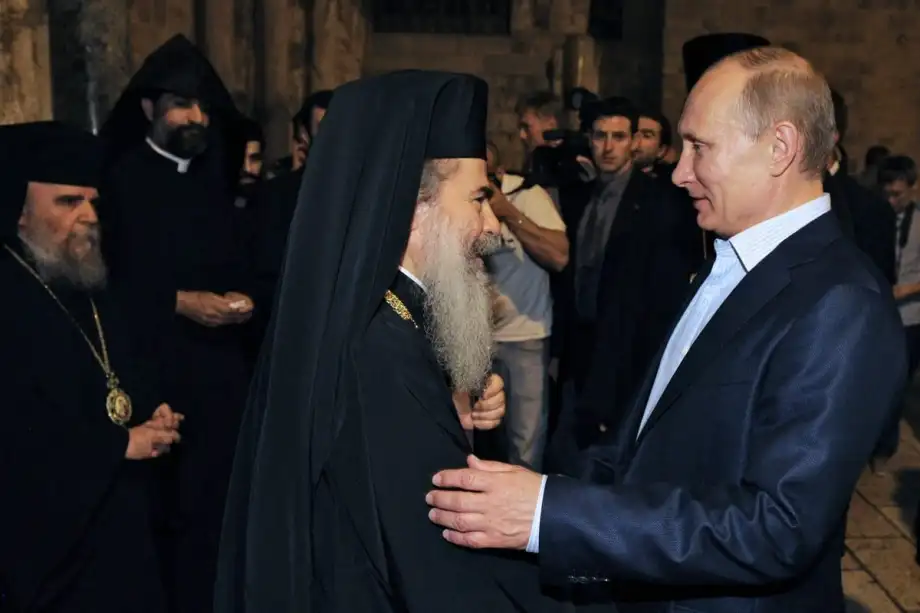
In mid-November, the Kremlin quietly issued a decree that sent ripples through the Orthodox world: Vladimir Putin would award the Order of Friendship—one of Russia’s highest state honors—to Patriarch Theophilos III of Jerusalem. On paper, the reason sounded benign enough: the Patriarch had contributed to the international promotion of events marking the 80th anniversary of the Soviet victory in World War II. But for those familiar with the Orthodox fault lines and the Kremlin’s use of religious diplomacy, it was immediately clear that this was far more than a commemorative medal.
A “Thank You” Wrapped in Strategy
Moscow does not hand out such distinctions casually. The award places the Patriarch of Jerusalem—custodian of the Holy Places and one of the most ancient thrones of Christianity—into the center of Russia’s evolving religious soft-power strategy. The Kremlin has long viewed Orthodoxy as a cultural vector capable of reinforcing Russian influence well beyond its borders. Jerusalem, where ancient tradition meets modern geopolitical competition, is fertile ground.
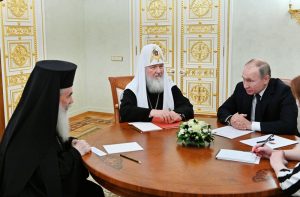
Theophilos III has maintained cordial relations with Moscow for years. Meetings with Putin have consistently revolved around the protection of Christians in the Holy Land—an issue Russia often uses to position itself as a global defender of Orthodoxy. This award cements that narrative and signals Moscow’s desire for a deeper alignment with the Jerusalem Patriarchate.
Caught Between Moscow and Constantinople
For the Jerusalem Patriarchate, this isn’t just a medal—it’s a delicate balancing act. Theophilos III presides over a church caught between the gravitational forces of the Ecumenical Patriarchate on one side and the Russian Church on the other. Jerusalem’s importance is not only spiritual but symbolic; whichever great Orthodox center claims its friendship gains prestige and leverage across the broader Orthodox world.
Accepting high honors from Moscow inevitably raises eyebrows within the circles of the Ecumenical Patriarchate, especially against the backdrop of the ongoing schism over Ukraine and the wider contest for primacy in the Orthodox world. Jerusalem, historically striving to keep a neutral posture, suddenly appears a bit closer to Moscow’s orbit.
Signals to the Middle East
Beyond church politics, the timing is not accidental. The Middle East is in a period of heightened instability. Russia wants to deepen its relevance in the region—militarily, diplomatically, and spiritually. Honoring the Patriarch of Jerusalem allows the Kremlin to extend a hand to Christian communities in the Holy Land, reassert its historical protector role, and enhance its image as a stabilizing force.
A Medal With Consequences
Whether Theophilos III embraces the award fully or keeps it at arm’s length remains to be seen. The gesture will be interpreted differently across the Orthodox landscape:
To the Russian Church, it is a diplomatic victory, a sign that Jerusalem is receptive to Moscow’s overtures.
To Constantinople, it may appear as another encroachment by Russia into territory historically aligned with the Ecumenical Patriarchate.
To local Christians, especially Arab Orthodox faithful, it introduces yet another external influence into an already complex ecclesiastical environment.
What is certain is that this medal is not merely a decoration. It is part of a larger strategic puzzle—one in which the Holy Places, the Orthodox world, and geopolitical realities are tightly interwoven.
November 19, 2025, n.stamatakis@aol.com www.helleniscope.com
DISCLAIMER: The views and statements expressed in this article constitute constitutionally protected opinions of this author.













Wonderful moment for Russia and Theophilos.
Patriarch Theophilos is a true Patriarch!
He condemns the persecution of the Ukrainian Church and supports the canonical Church.
The State of Israel is currently surrounded by Russian influence, yet relations between the Russian Federation and the Israeli government are strained, to say the least. The Russian Federation has repeatedly condemned the Israeli war in Gaza, is allied with Iran, has a strategic partnership with Hezbollah, an active military base in Syria, and close relations with Egypt. This award from Putin to the Patriarch of Jerusalem is something of a billboard, advertising Russian influence within the State of Israel, specifically by the Jerusalem Patriarchate.
My concern is with how the Israeli government will interpret this. Perhaps the Jerusalem Patriarchate is banking on earning the respect of the Israeli government by this award, kind of like being a high-profile friend of the Mafia. Yet being a friend of the Mafia never ends well.
You are ignoring that there are two milion Russians or Russian Jews are living in Israel (in an Israeli population of 8 milion: this is the main reason Putin maintained good relationships with Israel, and this mainly why Israel never took part in the Western sanctions against Russia. But recently the masks fell off after the West’s defeat in Ukraine. The underground connection between the Zionists of London and those in Israel is now very clear. Israel is used to undermine and destabilize Russia in any way possible. They have failed and they will fail in the future. Putin applied his deep knowledge of Russian Patriotism and returned Russia to its roots: 30,000 Orthodox Churches have been built during the 25 years Putin rules! Need I say anything more? With Orthodoxy spreading deep roots in Russia, destabilizing it will be impoassible.
Vladimir Putin has said multiple times that the State of Israel is “almost a Russian speaking country”:
https://www.timesofisrael.com/putin-says-he-considers-israel-a-russian-speaking-country/
This plays directly into the “Russian World” ideology, where the use of Russian language is the primary cornerstone, serving as a key tool that defines a transnational community that the Kremlin claims the right to influence and “protect”, as it has in Ukraine. It’s very likely, at some point, that another proxy war will break out between the U.S. and Russia that will take place in Palestine.
While there is no singular viewpoint about Putin among Russian speaking Israelis, it should be noted that a huge number of Russian Jews fled Russia after the Russian invasion of Ukraine:
https://theconversation.com/jews-are-leaving-russia-again-is-history-repeating-itself-189090
Add to that the tourism revenue: Russians by far seem to “own” the Holy Land in terms of tourist visits and pilgrimages from Russia. The Russian people show their appetite for all things Orthodox, from venerating at holy sites to miracle-working icons and saints’ relics, they’re in the lead both in sheer numbers but also per capita. There have been popular folk songs glorifying Christ and Orthodoxy. You don’t find this kind of devotion in other historically Orthodox countries.
Joseph, as always—you are entertaining!
I’m not laughing.
AXIOS to both men!
YES. TRULY WORTHY MEN!
Cardinal Bartholomew must be sweating bullets now.
Axios to both President Putin and Patriarch Theophilos. Anaxios to the thrice wretched Bartholomew. Black Bart may have done in the last ten years what the Turks could not do in the last 500. Permanently destroy the Ecumenical Patriarchate. As an American of 100% Greek ancestry, given what I have seen, give the Phanar to the Turks. We have already defiled it more than the Turks ever could.
Joseph,
As I said before, you are either very young and confused or very naive. Stop being paranoid about Russia. You probably still think Ukraine is winning the war! No, it will never happen.