


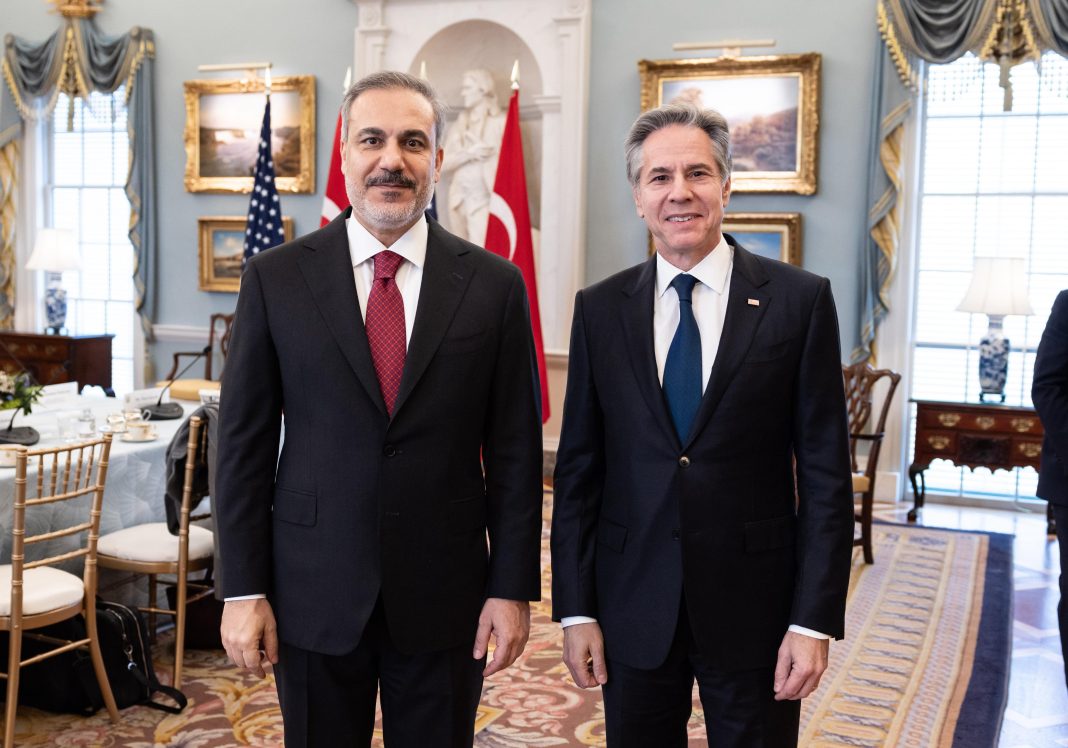
PHOTO: From the recent visit in early March of Turkish FM Hakan Fidan to DC…
EDITOR’S NOTE (Nick Stamatakis): The author of the article below, Mr. Mohamad Hasan Sweidan, notes with clarity that Erdogan, in his usual manner, pronounces big curses against his “enemies,” in this case, Israel, but takes very few practical steps to hurt them. During the past six months, Erdogan used furious rhetoric against Israel but never lifted his finger to stop the flow of oil from the port of Mersina to Israeli ports. During the visit of Turkish FM to DC in early March, several steps were taken to advance the strengthening of Turkey-US relations: Mr. Fidan gave many signs that Turkey wants to be a strategic partner of the US once again.
I think this process will not be easy at all this time. Turkey depends almost exclusively on energy from Russia: Two massive gas pipelines are currently crossing the Black Sea and one nuclear energy plant is almost ready to operate, while two more are planned. The suspicion many Greeks have is that to entice Turkey back to the West, it will have to offer her some of the energy sources of the Eastern Mediterranean. These sources do not belong to Turkey but to Greece and Cyprus… This process has already started with Mitsotakis and others playing their usual role of the puppet, eagerly collaborating to whatever treasonous (for Greece) plans the DC establishment promotes…
===================
To woo Washington, Erdogan will sell out Palestine
After Ankara and Washington successfully swapped Sweden’s NATO accession for an F-16 fighter jet deal, Turkiye is focused on accelerating that rapprochement and is willing to sweep divisive issues – like genocide in Gaza – under the rug.
MAR 20, 2024

By Mohamad Hasan Sweidan
On 7–8 March, Turkish Foreign Minister Hakan Fidan and Intelligence Chief Ibrahim Kalin visited Washington. The trip garnered attention as it marked Turkiye’s first official visit to the US following the conclusion of the ‘Sweden for F-16’ deal, whereby Ankara accepted Stockholm’s accession to NATO in exchange for US Congressional approval of the sale of 40 F-16s to Turkiye.
During the visit, the two Turkish officials met with their US counterparts Antony Blinken and William Burns, along with National Security Adviser Jake Sullivan, and their respective foreign ministers chaired the seventh meeting of the US–Turkiye Strategic Mechanism.
US–Turkish rapprochement
The thaw in US–Turkish relations has been palpable, as noted by Jeff Flake, the US Ambassador to Ankara, during a televised interview: “Especially in recent months, the two countries have developed shared areas. We observe improvements in defense, trade, and interpersonal relations.”
A closer examination of the joint statement released following the meeting illustrates the transition of Turkish–American relations into a more favorable and cooperative phase.
Established in 2021 and inaugurated on 4 April 2021 amidst escalating discord between Turkiye and the US, the strategic mechanism was conceived to address and improve the strained bilateral relations.
The joint statement issued by the Strategic Mechanism this month included several crucial points, each carrying significant implications:
Both parties addressed the ongoing war in Ukraine, condemning Russia’s actions as ‘unacceptable’ while emphasizing the importance of upholding Ukraine’s unity and sovereignty. However, it is worth noting that Ankara’s endorsement of the statement’s rhetoric aligns more closely with Kiev’s perspective, a deviation from Turkiye’s previous neutral stance. This marked shift will undermine President Recep Tayyip Erdogan’s aspirations to mediate the conflict impartially.
Playing to the audience
On Israel’s brutal military assault in Gaza, the statement merely referred to an “ongoing crisis” and “underlined the importance of finding a path towards ending the conflict and addressing the humanitarian crisis immediately.” This is a war that Erdogan has, on the record, framed as a “genocide” and called its aggressors in Tel Aviv “war criminals.”
While both parties expressed support for the “two-state solution” as an end goal to the war, the statement’s release coincided with a fiery speech by Erdogan in Istanbul in which he attacked Israel, calling it “the Nazis of our time.” The contrast between the two statements is a real-time reflection of how Turkiye addresses its different target audiences.
On the issue of combatting terrorism, the statement endorses joint US–Turkish efforts against organizations like the PKK, ISIS, and Al-Qaeda across regions spanning from Africa to Central Asia. They also recommitted to counterterrorism consultations and discussions on the Syria file, including the adherence to UN Resolution 2254 and supporting a “Syrian-led, Syrian-owned political process.”
The two parties addressed a multitude of regional issues in West Asia and Africa in alignment with the broader US strategy outlined by National Security Advisor Jake Sullivan, which focuses on partnership-building, deterrence, diplomacy, regional integration, and “democracy promotion” in these geographies.
This includes cooperation in military industry, energy, and trade development, reflecting the existing $30 billion trade volume between Washington and Ankara.
Significantly, the parties discussed leveraging financing opportunities under the Global Infrastructure and Investment Partnership – a western initiative intended to rival China’s Belt and Road Initiative (BRI). This partnership includes the controversial India–Middle East–Europe Economic Corridor (IMEC), aimed at enhancing regional connectivity and economic development very much to the benefit of Israel.
New Turkish military action in Syria and Iraq?
As the municipal elections in Turkiye draw near – with Erdogan seeking to reclaim his Justice and Development Party’s (AKP) control of Istanbul and Ankara after notable previous losses – there’s a tangible resurgence in Turkish rhetoric advocating for military action in northern Syria and Iraq.
According to reports from the Turkish news agency T24, the Turkish armed forces are gearing up for an operation against the People’s Protection Units (YPG) and the Kurdistan Workers’ Party (PKK) inside its neighboring states following local elections on 31 March.
After a 4 March cabinet meeting, Erdogan spoke of Turkiye’s readiness for a comprehensive operation against the Kurdish separatist groups and reiterated Ankara’s objective of establishing a security corridor spanning 30 to 40 kilometers along the Turkish–Syrian border.
Although the military rhetoric is undoubtedly influenced by Erdogan’s bid to attract nationalist voters in the upcoming elections, it is also connected to the recent Turkish–Iraqi diplomatic breakthrough following a high-level Turkish delegation’s visit to Baghdad.
The meeting in the Iraqi capital led to a security deal in which both countries committed to take action against the PKK. A joint statement read:
Both sides stressed that the PKK organization represents a security threat to both Turkiye and Iraq, and it is certain that the presence of the organization on Iraqi territory represents a violation of the Iraqi constitution … Turkiye welcomed the decision taken by the Iraqi National Security Council to list the PKK as a banned organization in Iraq. The two sides consulted on the measures that must be taken against the organization and its banned extensions [PKK’s alleged offshoots] that target Turkiye from within Iraq’s territory.
Fidan’s senior adviser, Nuh Yilmaz, praised the move, saying, “Turkiye and Iraq decided for the first time to fight jointly against PKK terrorism.” In a post on platform X, he added: “A decision that will mark a turning point! We will see results gradually!”
Strategic interests come first
According to a well-informed Turkish source:
Turkey’s main purpose is very clear. The presence of the PKK in Metina and Gara [in northern Iraq] has the potential to seriously threaten the Iraq Development Road Project … We both would like to remove PKK from these two areas as well as secure the area for the construction of the project, reaching both objectives in one step.
Ankara and Baghdad seek to counter any threat to this development road project, a land corridor linking the port of Faw in Basra to the Turkish border and from there to Europe.
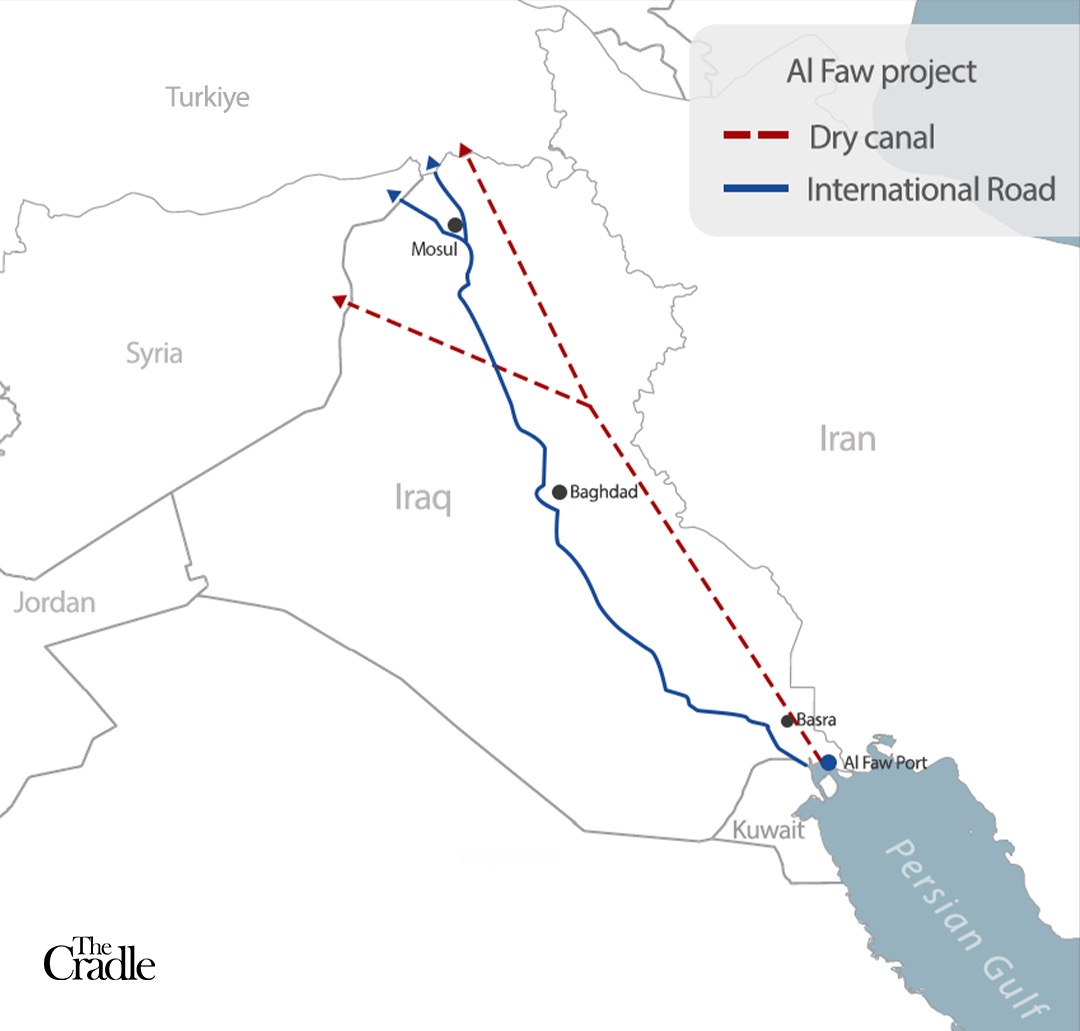
In this context, Erdogan is expected to visit Baghdad for the first time since 2012, where, some speculate, he will try to conclude a border control security agreement with the Iraqi government and seek to convince Baghdad to support future Turkish military operations against the PKK.
Despite Turkiye and Erdogan’s vocal criticism of Israeli atrocities in Gaza, recent interactions between Ankara and Washington indicate a pragmatic approach in their dealings, through which Turkiye hopes to be reinstated as an important US strategic partner.
While the Turkish president is stepping up anti-Zionist rhetoric on his domestic front, his administration maintains substantial economic ties with Israel, exporting various vital goods and services to the occupation state.
Although a Washington–Ankara rapprochement is still in its nascent stage, recent developments reveal the old allies are on a positive trajectory to repair bilateral relations after a period of strained diplomatic ties.
Erdogan’s foreign policy approach – as exemplified by his rhetorical Gaza stance and material support for Israel – makes clear Turkiye’s shift toward prioritizing strategic interests over ideological ones.














The issue is not whether Turkey will fight the PKK and Kurdish communist Terrorist of Iraq and China , but will they fight the U.S, UK and Israli Terrorist in Iraq and Syria also , which is currently occupying both Iraq and Syria ..despite being ordered out of their countries by the Syrian and Iraqi governments who are blatantly waging Economic warfare with Economic Sanctions which Terrorize the people fo Syria by depriving them of revenue needed to take care of their children and rebuild their country, and bombing with Israel territories of Syria and Iraq .. illegally to protect their proxy ISIS and Al Queda terrorist to overthrow the elected government of Syria and Iraq !
If Edrogan fulfills his promises to not only the leaders of Iraq , Syria and Russia ..to help in making Syria cleaning out all foreign Terrorist .and re-establish the Sovereign of all the territories of Syria to the people of Syria and as written in the recent memorandum with Russia, then it is more than enough to ultimately begin a response to the genocide of the people of PALESTINE! lETS BE CLEAR WHETHER IT IS EDROGAN, MISTOTAKIS, BIDEN OR DONALD TRUMP …ALL THE RETHORIC IS AN ACCEPTED PART OF THE EVANGELICAL CALIPHATE RULING PARTIES OF AMERICA TO DECEIVE THE POPULIST WHO TRULY DO NOT SUPPORT THE ACTIONS OF THE RULING EVANGEICAL RULING CALIPHATE OF AMERICA AND iSRAEL , BUT IN THE END ..THEY WILL DO NOTHING TO PROTECT THEIR POWER AND MONEY , MOST THREATENED BY BEING ENEMIES OF THE INTERNAITONAL CRIME SYNDICATE OF U.S AND ISRAEL!..