
ΕΑΝ ΠΡΟΤΙΜΑΤΕ ΕΛΛΗΝΙΚΑ ΠΑΤΗΣΤΕ ΤΗ ΣΗΜΑΙΑ ΣΤΟ ΚΑΤΩ ΜΕΡΟΣ ΤΗΣ ΟΘΟΝΗΣ
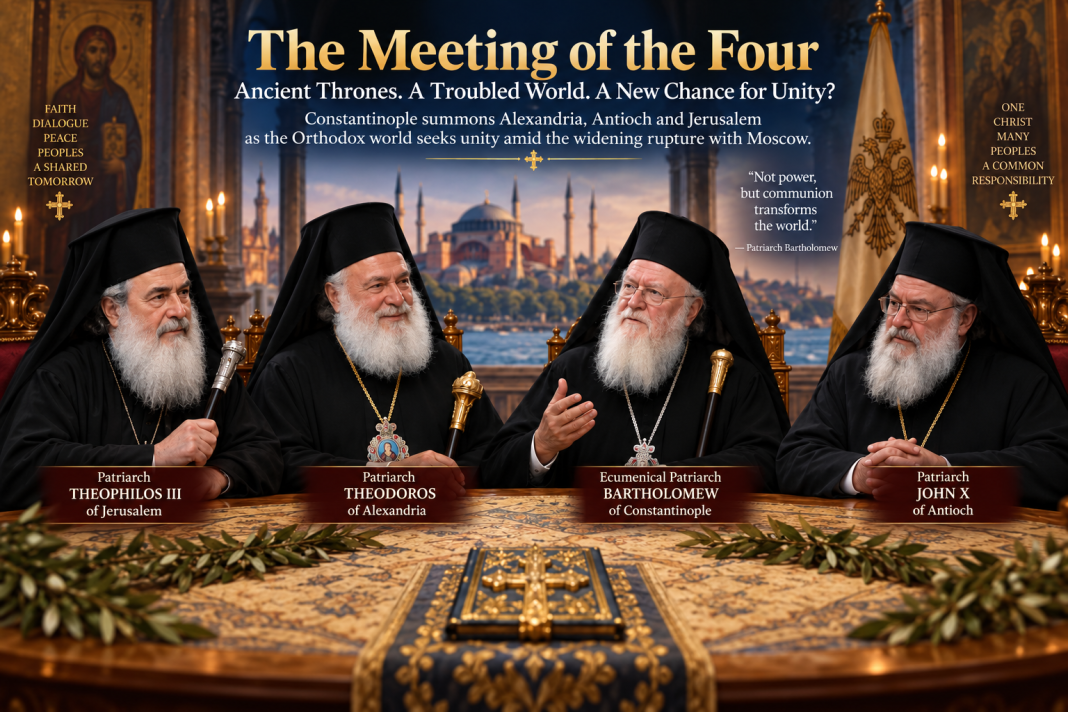
OUR MAIN PHOTO: An artistic rendition of the proposed meeting
Constantinople summons Alexandria, Antioch and Jerusalem as the Orthodox world searches for unity amid the widening rupture with Moscow.
By Nick Stamatakis
The initiative announced by Pat. Bartholomew is more significant than the reports’ restrained wording suggests. On September 4 in Budapest, Bartholomew disclosed that he had invited the Patriarchs of Alexandria, Antioch and Jerusalem to Constantinople for a “brotherly Synaxis” on November 30, 2026, the feast of St Andrew and the throne feast of Constantinople. His language was deliberately historical: the four are the surviving ancient Eastern Apostolic Thrones which, together with Rome, formed the old Pentarchy, and he argued that they now carry a special responsibility to address the “great and pressing challenges” confronting Christianity. This framing matters because it makes the meeting less a pan-Orthodox council and more politically consequential (definitely acting as an agency of the declining Western powers): Moscow sits conspicuously outside this ancient-patriarchal framework.
Ukraine inevitably hangs over the gathering. Alexandria recognized the Orthodox Church of Ukraine in 2019 and subsequently became embroiled in a bitter jurisdictional confrontation with Moscow in Africa. Antioch, by contrast, explicitly opposed Constantinople’s unilateral handling of Ukrainian autocephaly, insisting in 2018 that the question required pan-Orthodox consensus. Jerusalem likewise has never recognized the OCU, and Theophilos has maintained unusually close relations with Moscow. There is, however, an important nuance: before the Tomos, in 2018, Theophilos publicly endorsed the general principle that an Orthodox nation could possess an independent Church. His subsequent position has therefore been less a rejection of Ukrainian ecclesiastical independence in principle than opposition to the way Constantinople created and recognized the new structure.
The geopolitical environment has certainly changed. Post-Assad Syria is now much more dependent upon accommodation with Washington: the United States removed Syria from its terrorism-sponsor list on August 24, while Damascus has even signaled willingness to reduce Russian oil imports as its relations with Washington deepen. This gives Antioch powerful incentives not to appear tied exclusively to Moscow. Jerusalem is under an even more complicated set of pressures. Theophilos met President Trump in June, has sought American support concerning Christians, Gaza and Church properties, and now speaks of meeting both Putin and Zelensky with Trump’s endorsement. Yet this mediation should not be interpreted simply as an American-induced turn: Jerusalem formally offered mediation between Russia and Ukraine already in 2023.
For that reason, Bartholomew’s initiative seems primarily a reconciliation effort combined with institutional repositioning, rather than a straightforward American campaign to line up the patriarchs against Moscow. Theophilos himself convened the 2020 Amman meeting—attended by Moscow and intended to heal the Ukrainian rupture—while Constantinople stayed away. Bringing Theophilos and John X now to the Phanar would reverse that dynamic: instead of Moscow gathering the dissatisfied Churches around Jerusalem, Constantinople would bring the ancient Patriarchates back into a common conversation. External pressure may facilitate this, but the likely objective is subtler: rebuild Orthodox communication, reaffirm Constantinople’s coordinating role, and gradually deprive Moscow of the argument that Antioch and Jerusalem constitute a permanent counter-bloc. Whether this becomes anti-Moscow alignment or genuine reconciliation will depend on what, if anything, the November Synaxis says about Ukraine.
A further dimension is Bartholomew’s increasingly explicit commitment to rapprochement with Rome. In November 2025, he and Pope Leo XIV jointly reaffirmed their determination to work toward the eventual restoration of full communion between the Catholic and Orthodox Churches, presenting the anniversary of Nicaea as a platform for new steps toward Christian unity. This could make the November Synaxis especially delicate. It would, however, be too strong to say that Antioch and Jerusalem are certain to reject Catholic–Orthodox reconciliation itself: Antioch has officially spoken of overcoming Christian division and continuing dialogue with both Eastern and Western Churches, while Jerusalem has hosted the international Catholic–Orthodox theological dialogue. Their likely resistance would concern the terms of unity, papal primacy, and any attempt by Constantinople to advance far-reaching ecclesiological changes without pan-Orthodox consensus—precisely the procedural objection Antioch raised over Ukraine. Bartholomew may nevertheless calculate that today’s geopolitical environment gives him greater leverage: strong Western diplomatic backing for Constantinople, close relations with the Vatican, and the growing dependence of Middle Eastern Christian institutions on Western political protection could make Antioch and Jerusalem more willing to remain inside a Constantinople-led process. Western political and globalist support is the main tool used in the background to support Bartholomew’s heretical efforts.
September 6, 2026, www.helleniscope.com, n.stamatakis@aol.com
DISCLAIMER: The views and statements expressed in this article constitute constitutionally protected opinions of this author.







Who reveres Bart? Who respects Bart? S H A M E .
All aboard……all aboard the western-eastern elitist, global-homo, geopolitical, gravy train wreck!
I need to read more Saint John Chrysostom. Perhaps the Big Four should do the same.
I’m betting that, if this meeting does take place, Little Bartholomew will leave empty handed and disappointed.
Unfortunately, this article below is a bit more revealing about what he wants to “discuss”… it appears he is going to try to convince the 4 ancient Patriarchates to “restore the acknowledgment” of Rome’s title as ‘first among equals’…
https://www.romfea.gr/oikoumeniko-patriarxeio/78426-oikoumenikos-patriarxis-to-proteio-tis-romis-einai-diakonia-agapis-entos-tis-ekklisias
So Bart is worried about “ earthly” titles. An old stupid man leading Greek Orthodox Christians. Who put Bart on his “throne?” And why?
BART sing-a-long: I’ve Got the Power.”
https://youtube.com/shorts/9SCfXRt2poI?is=QW4gPvzCWlvp4sHU
He mocks Orthodox Christianity.
The Patriarchs of Antioch and Jerusalem should reject this invitation. It will be an attempt to bully them into submission. Jerusalem should try another Amman style gathering.
Only an Ecumenical council including all Churches can make binding decisions. This includes the Russian Church. Even if this “council” comes together it is not binding on any local Church.
If Patriarch Bartholomew thinks the world situation gives him leverage, he is going to be disappointed. In the end, he cannot open the school of Halki. In July, news reports suggested Halki was going to reopen in September.
The Patriarch failed to consider that Washington never cared about him or his Patriarchate. They hate Russia and used him to carve up the Russian Church. Patriarch Bartholomew’s actions have been and continue to be destructive and immoral.
In the end, he is a Turkish subject and the US will not disrupt relations with Turkey to help him. He really is not in a good position. This attempt to gather the four Eastern Patriarchs will fail to convene or will be ignored by the rest of the Churches.
Russophobia brought the Phanar and Washington together. Washington will soon be rid of the Phanar as its use is coming to an end.
Let’s pray that the four Patriarchs focus on how to fix the broken unity of the Orthodox Church, It would be foolish to discuss unity with Rome at this time which would only further divide the Church. Moscow and Constantinople must first reconcile before any major decisions are made. I think of the change of the calendar which was made without the full representation of the Church. It created a schism that still has not been healed to this day. The Church of Russia represents nearly 40%b of the Orthodox Church. Patriarch Bartholomew needs to work with Patriarch Kiril for the well being of the Church. To fail to do so spells disaster. In my opinion, the Council of Crete failed because Patriarch Bartholomew’s agenda wasn’t arrived at in a conciliatory way.I believe he was trying to do an end run around the reality of fact that the Russian Orthodox Church represents such a large part of the Church. Let’s pray that the four patriarchs meet with humility and love of the Church foremost in their minds
P.S.I have one big fear about the meeting of the four Patriarchs. The date of the proposed meeting is November 30. That is St, Andrew’s day. The day that the Pope or a Cardinal comes to the Phanar to celebrate St. Andrew’s day. Constantinople reciprocates this ecumenical gesture by going to Rome on June 29, Sts. Peter and Paul. This raises the question, why would Patriarch Bartholomew want the meeting of the four Patriarchs on November 30? Probably wants the other Patriarch to do some “ecumenical stuff”.Maybe because unity with Rome takes priority over reconciliation with Moscow in the mind of Patriarch Bartholomew. Let’s pray that wisdom takes priority over foolishness.
Vary should be excommunicated until he repents. One can excommunicate the Patriarch without having to bring communication with the church.
I don’t understand this laissez fare attitudes by the other patriarchates and even Putin. It’s the church that we are sending not a boys club.
This has gone on too long. No recognition of Bart. This is worse than if he was dead. I don’t get it. Judas = 30 pieces. Bart = $20 MILLION.
When Moscow was elevated to patriarchal status in 1589 by Patriarch Jeremias II of Constantinople, the Russian tsar wanted Moscow to be second place in the diptychs, before Alexandria, Antioch, and Jerusalem. Of course this caused quite a stir. It was afterwards, at two councils of Constantinople occurring in 1590 and 1593, that the other historic patriarchates finally agreed that Moscow was to be fifth place, after the others, and as Rome was no longer in communion and no longer commemorated as first.
The Church of Constantinople eagerly awaits for Rome to return to Holy Orthodoxy. May it be blessed that she does.
In the current Russian usage of the diptychs, Moscow is now third, after Antioch and Jerusalem. One might wonder though if this could change after the scheduled council in November. If the other invited patriarchates attend, could it be that Antioch and Jerusalem will recognize the OCU? If so, would Moscow then make itself first in their diptychs? We shall see.
The official “row” of the diptychs may have symbolic value… But for the faithful, Constantinople’s abandonment of the Faith is what really counts. Adopting Ecumenism, justifying “woke” culture and LGBTQ “rights” is of the essence….
“The Church of Constantinople eagerly awaits for Rome to return to Holy Orthodoxy”?? Good luck waiting… It will never happen as Rome will never abandon its primacy and other dogmatic tenets.
Antioch and Jerusalem are not recognizing the criminals dressing up like bishops and calling themselves the OCU. Moscow does not care about being first in the dyptychs. The care about proper ecclesiology and Church order.
Joseph, if Antioch and Jerusalem recognize the OCU, I’ll eat my hat. And, since that won’t be happening, I guess that my hat will be safe,
Alex, the patriarchs of Antioch and Jerusalem have both visited the phanar this year. Perhaps that’s why Patriarch Bartholomew is emboldened now to call them to a meeting.
I’ll tell you what, if they don’t recognize the OCU at this meeting, then I’ll eat a Turkey BLT!
Those who recognized the thugs calling themselves OCU did so within a year after the Phanar sent exarchs into Ukraine.
And even in Greece and Cyprus there are bishops who do not recognize the OCU. No Churches will
Be moving to recognize the OCU eight years after the crisis began.
Antioch has longstanding ties to the Russian Church. So does Jerusalem.
Jerusalem maintained communion with ROCOR during the twentieth century. Jerusalem continues to use the traditional calendar and has never accepted Constantinople’s claims of authority.
There is a strong Russian presence in the holy land. Jerusalem gets along with the Russians. It is very unlikely to disrupt that relationship for the OCU.
When the schism started, Patriarch Theophilos cancelled a meeting with Ukrainian President Poroshenko and met with visiting bishops from Russia instead. Under Patriarch Theophilos, OCU “bishops” and “priests” were caught trying to serve at the holy sepulchre and were expelled.
Jerusalem asked the Ukrainian Orthodox Church to send them the names of bishops and priests who will be visiting to verify they are canonical. Jerusalem has been consistent on supporting the canonical Ukrainian Church.
Joseph, no one in their right mind would ever recognize a schismatic structure. They are literally committing theft and crimes against the canonical Ukrainian Orthodox Church. They are not orthodox but out for money. No serious orthodox christian can join them or recognize them. You are delusional if you think otherwise.
Barto made his pacts with the pope, we will never join him or recognize any schismatics such as the RCC or OCU as being legitimate.
Joseph,
First of all, let’s see if they all show up, before we speculate on what they will discuss and conclude.
At Kolymbari, disagreements over the agenda ahead of time resulted in “low attendance”.
Secondly, this tangent about who is first or fourth in the diptychs is kind of pointless and off-topic, especially when we live in an era where the majority of Orthodox Christians (and bishops for that matter) are not even living in the jurisdictions represented by the 4 from the “original pentarchy”… It is quite “suicidal” for anyone in the “minority” to act as the “big boss”, and create a Schism with the “majority” of the Orthodox, especially in this outrageous and anti-canonical manner of “recognizing” a bunch of deposed Schismatics after officially having recognized them as deposed Schismatics previously. In fact, when you only have a small percentage of Orthodox under your jurisdiction, how relevant are you in the big picture, realistically?
Finally, yes, it would be nice for Rome to wake up one day and the “new pope Leo” declare a return to alignment with the (Orthodox) Pope Leo III’s beliefs (while rejecting all subsequent dogmatic “innovation”)…it will be much easier to talk about a “return to Orthodoxy” under those conditions. In the meantime, with all the shenanigans we witness on a daily basis, including Orthodox bishops aligned with the Phanar “kissing the Pope’s hand” on video footage available on the internet, we are not talking about any “return to Orthodoxy” on behalf of the Vatican, but rather an “abandonment of Orthodox Tradition” by a group of neo-Λατινοφρονες who still insist on wearing Orthodox vestments and posing as Orthodox spiritual leaders even though their hearts have already been united with the Vatican (in a Uniate manner)…
The last time Bart tried something like this, he invited the Arcb of Cyprus, under the rubric of “the ancient patriarchates”.
He probably will, as AB Georgios consents to his autocephaly in Ukraine. However, a powerful minority in Cyprus, and particularly the Metropolitans of Limassol, Morphou, and above all the powerful Monastery of Kykkos, are opposing… Most people do not know that Kykkos Monastery is a huge (mostly real estate) property holder on Cyprus, much bigger than the Church of Cyprus… And it enjoys a great symbolic power to go with it…
No use in backseat driving, let’s see how this goes. What they do will show who they are.
BTW, the AI generated pic above proves again GIGO: Lil Bart couldn’t grow a beard that thick no matter how hard he tried. God had his reasons for making him look like a possum with mange.