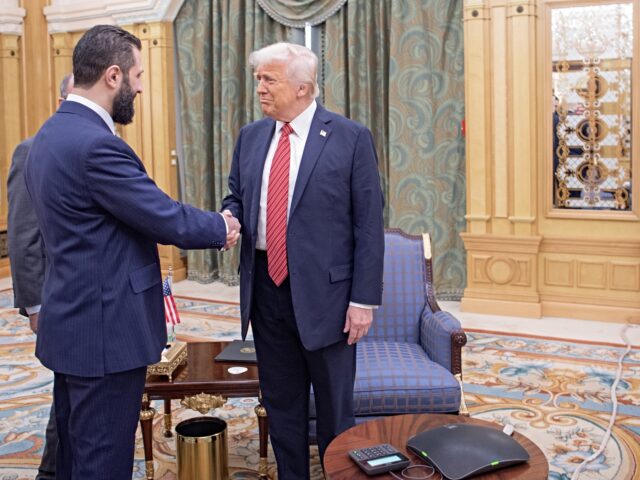

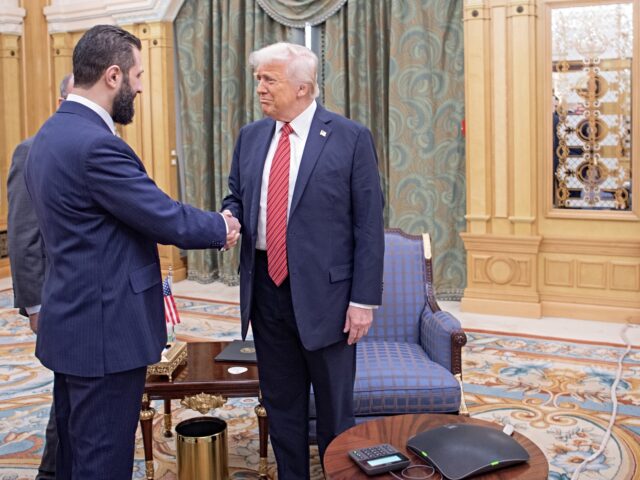
EDITOR’S NOTE (Nick Stamatakis). Ahmed al-Sharaa (also known by his “nom de guerre” Abu Mohammad al-Julani), seen here in a friendly meeting with President Trump, was less than a year ago designated as a terrorist by the United States due to his leadership roles in jihadist groups, including al-Qaeda in Iraq and the al-Nusra Front, which later became Hay’at Tahrir al-Sham (HTS). He was once the subject of a $10 million U.S. bounty under the Rewards for Justice program. 

However, following a meeting in December 2024 between al-Sharaa and U.S. Assistant Secretary of State Barbara Leaf, during which al-Sharaa committed to combating terrorism and supporting a political transition in Syria, the U.S. government announced it would no longer pursue the reward for his capture. God only knows “how much” was the exchange that transformed him… 

Just yesterday, President Donald Trump met with al-Sharaa in Riyadh, marking a significant shift in U.S.-Syria relations. Trump praised al-Sharaa and announced plans to lift U.S. sanctions on Syria to aid in the country’s reconstruction.  Al Sharaa, learning lessons from Qatar and others offered to build a “Trump Tower” in Damascus – a blessed, sacred Arab city, almost synonymous to Paradise for the Arabs…

Despite these developments, HTS remains designated as a terrorist organization by the U.S. government.

================

SOURCE – REUTERS.COM

Trump Tower Damascus? Syria seeks to charm US president for sanctions relief

  • Syria trying to woo Washington for sanctions relief, engagement
  • Pro-Trump activist says Sharaa making a business-focused pitch
  • Chances of a Trump-Sharaa meeting remain slim
  • US still internally deliberating Syria policy, no consensus yet
DAMASCUS/WASHINGTON, May 11 (Reuters) – A Trump Tower in Damascus, a detente with Israel and U.S. access to Syria’s oil and gas are part of Syrian leader Ahmed al-Sharaa’s strategic pitch to try to get face time with U.S. President Donald Trump during his trip to the Middle East, according to several sources familiar with the push to woo Washington.
Jonathan Bass, an American pro-Trump activist, who on April 30 met Sharaa for four hours in Damascus, along with Syrian activists and Gulf Arab states has been trying to arrange a landmark – if unlikely – meeting between the two leaders this week on the sidelines of Trump’s visit to Saudi Arabia, Qatar and the United Arab Emirates.

The Reuters Tariff Watch newsletter is your daily guide to the latest global trade and tariff news. Sign up here.

Syria has struggled to implement conditions set out by Washington for relief from U.S. sanctions, which keep the country cut off from the global financial system and make economic recovery extremely challenging after 14 years of grinding war.
Signalling a possible shift in Washington’s policy, Trump said on Monday that he may ease U.S. sanctions in response to a query from his Turkish counterpart.
“We’re going to have to make a decision on the sanctions… We may take them off of Syria, because we want to give them a fresh start,” Trump told reporters.
“Many people have asked me about that, because the way we have them sanctioned, it doesn’t really give them much of a start. So we want to see we can help them out. So we’ll make that determination,” he said.
Proponents of more U.S. engagement with Syria hope that getting Trump into a room with Sharaa, who still remains a U.S.-designated terrorist over his al-Qaeda past, could help soften the Republican administration’s thinking on Damascus and cool an increasingly tense relationship between Syria and Israel.
Part of the bet for the effort is based on Trump’s history of breaking with longstanding U.S. foreign policy taboos, such as when he met with North Korean leader Kim Jong Un in the demilitarized zone between North and South Korea in 2019.
“Sharaa wants a business deal for the future of his country,” Bass said, noting it could cover energy exploitation, cooperation against Iran and engagement with Israel.
“He told me he wants a Trump Tower in Damascus. He wants peace with his neighbours. What he told me is good for the region, good for Israel,” said Bass.

Sharaa also shared what he saw as a personal connection with Trump: both have been shot at, narrowly surviving attempts on their lives, Bass said.

Syrian officials and a presidency media official did not respond to a request for comment.
Sharaa spoke with Saudi Arabia’s de facto ruler Crown Prince Mohammed bin Salman on Sunday, according to the Syrian presidency.
A person close to Sharaa said afterwards a Trump-Sharaa meeting remained possible in Saudi Arabia, but would not confirm whether Sharaa had received an invitation.
“Whether or not the meeting takes place won’t be known until the last moment,” the person said.

‘PUSH UNDERWAY’

To be clear, a Trump-Sharaa meeting during the U.S. president’s visit to the region is widely seen as unlikely, given Trump’s packed schedule, his priorities and lack of consensus within Trump’s team on how to tackle Syria.
A source familiar with ongoing efforts said a high-level Syria-U.S. meeting was set to take place in the region during the week of Trump’s visit, but that it would not be between Trump and Sharaa.
“There is definitely a push underway,” said Charles Lister, head of the Syria Initiative at the Middle East Institute.
“The idea is that getting to Trump directly is the best avenue because there are just too many ideologues within the administration to get past.”
Washington is yet to formulate and articulate a coherent Syria policy, but the administration has increasingly been viewing relations with Damascus from a perspective of counterterrorism, three sources including a U.S. official familiar with the policy-making said.
That approach was illustrated by the make-up of the U.S. delegation in a meeting last month between Washington and Syrian Foreign Minister Asaad al-Shibani in New York, which included a senior counterterrorism official from the State Department, two of the sources said.
U.S. officials conveyed to Shibani that Washington found steps taken by Damascus to be insufficient, particularly on the U.S. demand to remove foreign fighters from senior posts in the army and expel as many of them as possible, the sources said.
The U.S. Treasury has since conveyed its own demands on the Syrian government, bringing the number of conditions to more than a dozen, one of the sources said.
The U.S. State Department declined to disclose who attended the meeting from the U.S. side and said it does not comment on private diplomatic discussions.
White House National Security Council spokesperson James Hewitt said the actions of Syria’s interim authorities would determine the future U.S. support or possible sanctions relief.

‘OLIVE BRANCH’

A key aim of Syria’s overtures to Washington is communicating that it poses no threat to Israel, which has escalated airstrikes in Syria since the country’s rebels-turned rulers ousted former strongman Bashar al-Assad last year.
Israel’s ground forces have occupied territory in southwestern Syria while the government has lobbied the U.S. to keep Syria decentralised and isolated.
Israel has said it aims to protect Syrian minority groups. Syria has rejected the strikes as escalatory.
Sharaa last week confirmed indirect negotiations with Israel aimed at calming tensions, after Reuters reported that such talks had occurred via the UAE.
In a separate effort, Bass said Sharaa told him to pass messages between Syria and Israel that may have led to a direct meeting between Israeli and Syrian officials.
But Israel soon resumed strikes, including one near the presidential palace, which it framed as a message to Syria’s rulers to protect the country’s Druze minority amid clashes with Sunni militants.
“Sharaa sent the Israelis an olive branch. Israel sent missiles,” Bass said.
“We need Trump to help sort this relationship out.”
=====================
Trump Speaks Positively of Syrian Leader Following Meeting
RIYADH, SAUDI ARABIA - MAY 14: (----EDITORIAL USE ONLY - MANDATORY CREDIT - 'BANDAR AL-JAL
Bandar Al-Jaloud/Saudi Royal Court/Handout/Anadolu via Getty

President Donald Trump spoke positively of his meeting Wednesday with Syrian leader Ahmed al-Sharaa in Saudi Arabia.

While taking questions with reporters aboard Air Force One en route from Saudi Arabia to Qatar, Trump was asked how he found al-Sharaa during the meeting alongside Crown Prince Mohammed bin Salman in Riyadh.

“Great…Young, attractive guy, tough guy, strong past, very strong past– fighter. But he’s got a real shot at pulling it together,” Trump said.

As Breitbart News’s John Hayward noted, al-Sharra is a former al-Qaeda and Islamic State lieutenant who came to power in December after he led rebels in toppling dictator Bashar Assad.

He was appointed as president in January.

Trump notably announced he was lifting sanctions on Syria on Tuesday in a major development in the region.
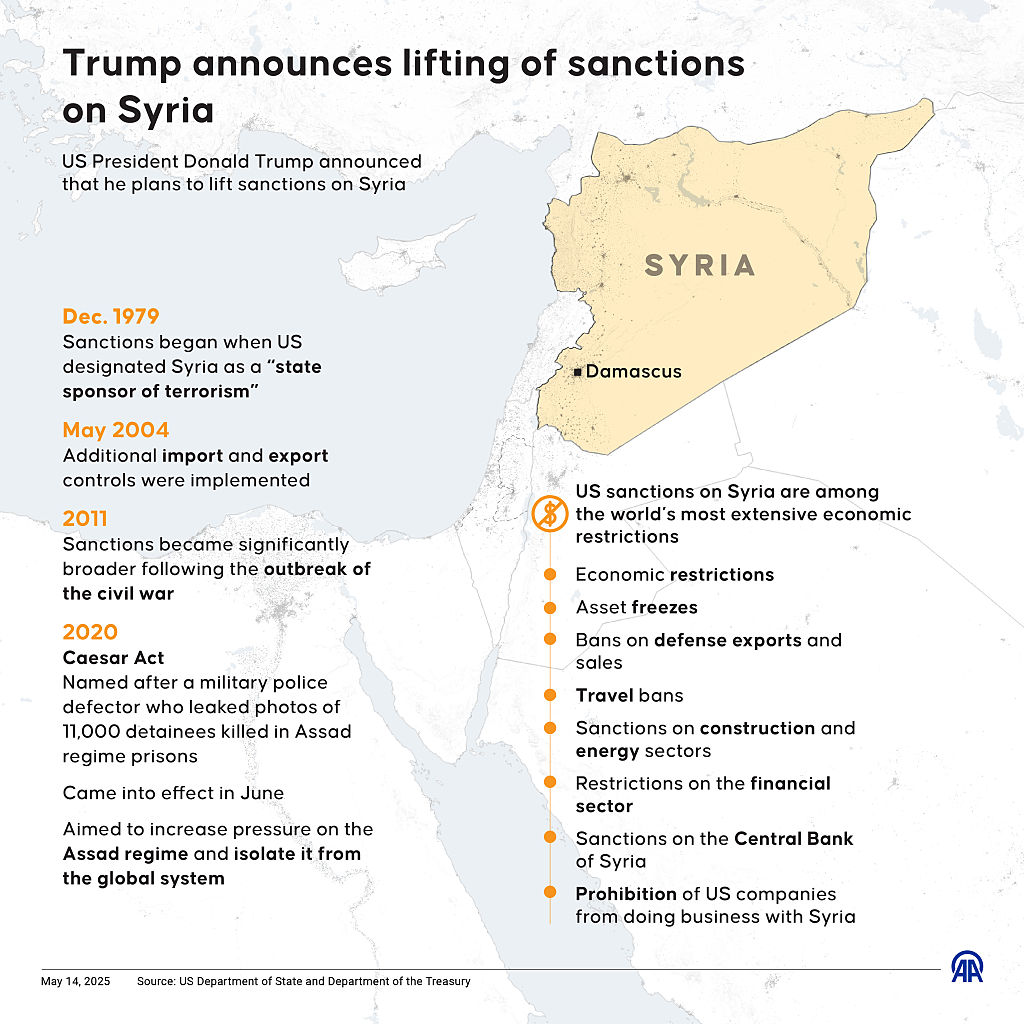
Details of U.S. President Donald Trump announced plans to lift sanctions on Syria. (Mehmet Yaren Bozgun/Anadolu via Getty Images)

During the meeting on Wednesday, which Turkish President Recep Tayyip Erdoğan dialed into remotely, he and bin Salman lauded Trump’s move to lift the sanctions, according to White House press secretary Karoline Leavitt.

“President Trump thanked President Erdogan and the Crown Prince for their friendship, and told President Al-Sharaa that he has a tremendous opportunity to do something historic in his country,” Leavitt wrote in a post on X.

Leavitt wrote that Trump encouraged al-Sharaa to join the Abraham Accords, to call on all foreign terrorists to depart Syria, to “Deport Palestinian terrorists,” to help prevent a resurgence of ISIS, and to take on “responsibility for ISIS detention centers in Northeast Syria.”

Al-Sharaa expressed his gratitude to all participants in the meeting, per Leavitt:

President Al-Sharaa thanked President Trump, the Crown Prince, and President Erdogan for their efforts to put together the meeting, and recognized the significant opportunity presented by the Iranians leaving Syria, as well as shared U.S.-Syrian interests in countering terrorism and eliminating chemical weapons.

He further expressed a desire for Syria to emerge as a critical component in global trade.

“President Al-Sharaa concluded with his hope that Syria would serve as a critical link in facilitating trade between east and west, and invited American companies to invest in Syrian oil and gas,” Leavitt noted.
LEAVE A REPLY

Please enter your comment!
Please enter your name here