
EDITOR’S NOTE (Nick Stamatakis). I will need a whole book to narrate my multiple connections to Karpathos, through family and research, and in many other ways… My mother and my paternal granmother were born there, I spent many youthful summers on the island and at age 26 I wrote a Master’s Thesis on the biggest of all the peculiarities of the island: the “primogeniture” system of inheritance of the island, known as inheritance by the “Kanakarides” and “Kanakares” (first-born sons and daughters). But as a child and a teenager, growing up among family from Karpathos (and Serifos/Crete), I had the chance to witness the art of making “makarounes” by hand many times and many more to taste them – and the taste of the pasta with the caramelized onions is always with me… It’s something you can never forget…
This recent post by the Italian daily “Repubblica” made them an international sensation. The ties between Italy and Karpathos are many: my mother and all my aunts took Italian during elementary school as Italy occupied the whole Dodecanese between 1912 and 1947. Let me close here with a short video of making “makarounes” in Karpathos, followed by the report from “La Repubblica”/ToVima.
Those of you living near Baltimore, I am sure you can look for a taste of “Makarounes” in the many restaurants in the “Greek Town” owned by people from Karpathos… I think you have a good chance to find them there… Enjoy!
===============
Greek Pasta ‘Makarounes’ and the Island ‘Where Time Stops’ Capture Italian Press Attention

The recent feature of the Greek island of Karpathos in the renowned Italian daily La Repubblica shines a well-deserved spotlight on its breathtaking beauty and rich gastronomical heritage
The Italian daily newspaper La Repubblica opens its praise for the Dodecanese island of Karpathos with the phrase, “una faccia, una razza”—a well-known expression highlighting the deep cultural and physical kinship between Greeks and Italians.
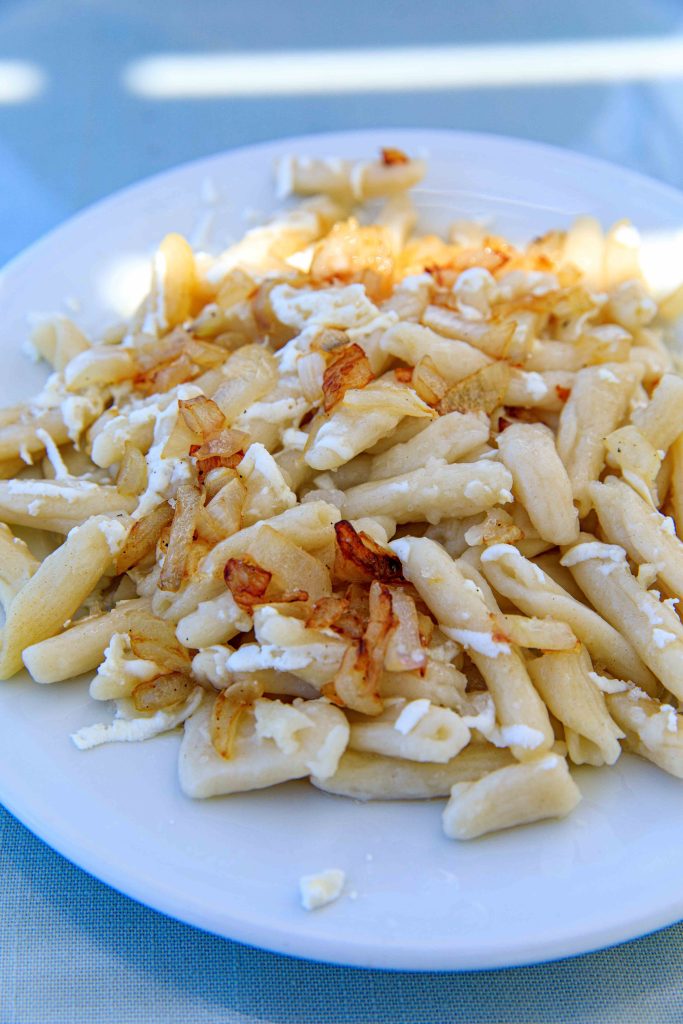
The article’s author draws a vivid picture of this connection through a local culinary tradition: makarounes, a handmade pasta still kneaded daily by women on the island. This practice, he notes, “speaks to visitors of identity and hospitality, a testament to a tradition that refuses to disappear.”
The author compares makarounes to the Italian cavatelli, both in shape and texture, and in their handcrafted curves. In the windswept heights of the village of Olympos, makarounes are served with “chopped onion fried in abundant oil and a generous sprinkling of myzithra”—a mature sheep or goat cheese reminiscent of Italy’s ricotta salata…

But what connects an Italian writer to Karpathos?
Alessandro Allocca explains: “Between 1912 and the post-World War II period, Karpathos, like many other Dodecanese islands, was occupied by the Kingdom of Italy following their victory over the Ottoman Empire. Many of the soldiers came from Southern Italy—Molise, Puglia, Abruzzo—the same regions where cavatelli pasta remains a staple. It’s not hard to imagine an exchange, a fusion, a mutual adaptation.”
Local tavern owners Marina Kanakis and Sofia Hatzidaki Fourtouna ask, “Cavatelli or makarounes, who inspired whom? What difference does it make?” Both remain devoted to the art of hand-kneading dough, while just a few meters away, tourists gather around simple tables covered in paper tablecloths, surrounded by olive groves.
The Italian journalist shares his own perspective: “Beyond origins, what’s striking is the feeling of standing on a bridge between two worlds. Walking through the streets of Olympos or savoring a plate of makarounes at a seaside taverna, one gets the impression that time has stood still. In this pause, Greece and Italy find common ground—in everyday gestures and simple flavors, all captured perfectly in a plate of pasta.”
Karpathos’ island earned last month a coveted spot on the annual Freedom Travel list of Europe’s top seven unique travel experiences for 2025. Its appearance in the Italian press not only celebrates its stunning landscapes but also its unique culinary traditions that bridge cultures. Such international attention helps to further elevate the island’s profile, inviting travelers to discover the timeless charm and flavors where Greece and Italy beautifully intertwine.

Mrs. Rigopoula at her shop with local hand-woven textiles, traditional scarfs and mini traditional costumes for dolls, Olympos village, Karpathos Island, on August 10,2021