


ΕΑΝ ΠΡΟΤΙΜΑΤΕ ΕΛΛΗΝΙΚΑ ΠΑΤΗΣΤΕ ΤΗ ΣΗΜΑΙΑ ΣΤΟ ΚΑΤΩ ΜΕΡΟΣ ΤΗΣ ΟΘΟΝΗΣ
The New York City mayoral front-runner has become the political vessel for a generation betrayed by greed, inequality, and elite capture.
His rise signals that the middle-class collapse and the exhaustion of neoliberal capitalism have finally found a voice — and a name.
By Nick Stamatakis
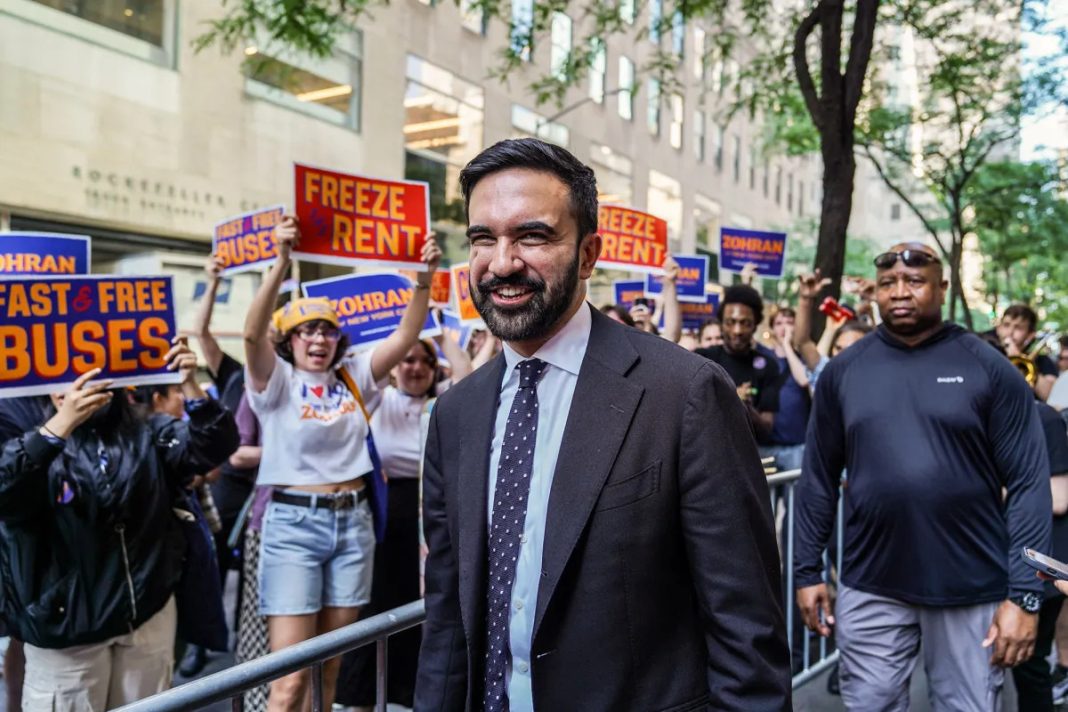
When betting markets move as one, they are not predicting mere victory — they are registering a social shift. In Zohran Mamdani’s case, the surge is unmistakable: the money now says the race is over. Yet the real story is not about odds or polling. It is about why so many New Yorkers — from renters in Queens to professionals in Brooklyn — have decided that Mamdani speaks for them. What the markets are measuring is not momentum, but a reckoning. Mamdani has become the focal point of a rebellion against an economic order that has stripped citizens of both wealth and dignity.
From the Postwar Middle-Class Miracle to the Age of Greed
The postwar decades forged a grand compromise between capital and democracy.
Haunted by the specter of communism, Western elites accepted profit limits and expanded the welfare state. One wage could buy a home, raise a family, and support the very idea of citizenship. In Europe, healthcare and college education are still largely free today. That middle-class security was not generosity — it was self-preservation.
But with the collapse of communism in 1990, the ideological guardrails vanished. Capitalism, unchallenged and unashamed, reverted to its oldest vice: greed. Industrial capitalism gave way to financial capitalism, where money itself became the raw material of profit. Financial corporations currently borrow at near-zero rates to buy homes and land, while citizens pay more than seven percent for mortgages. The result: the return of hierarchy, debt, and dependence — the social architecture of feudalism dressed in the language of the free market.
The Re-Feudalization of Everyday Life
The modern barons wear suits, not crowns, but their dominion is no less real.
Asset managers, hedge funds, and private-equity firms have become the landlords of the republic. They own the homes people rent, the hospitals they visit, and the debt that defines their lives. The middle class, once the backbone of democracy, is shrinking into memory. This is not inequality — it is dispossession. The working majority has been transformed from stakeholders into tenants of a system designed for the one percent.
Mamdani’s rhetoric cuts through this reality with clarity. He does not campaign merely against injustice; he names its architecture. He speaks to a generation that senses it has been evicted from both prosperity and power.
The Political System as a Closed Circuit
In such a world, politics itself begins to lose legitimacy. Many Americans, especially younger ones, view their government as a closed loop — a system that listens only to money. Mamdani’s campaign taps into that fatigue. His critique is not abstract populism but a precise diagnosis: democracy has been captured by wealth.
He frames his message as a recovery of sovereignty — an effort to restore the idea that policy should serve citizens, not capital. His bluntness about corporate landlords, speculative finance, and the corrupting power of moneyed lobbies feels less radical than restorative, a reminder of what democracy was meant to be.
Anti-Zionism: The Debate That Changed Everything
The defining moment of the campaign arrived in early June, when Mamdani’s debate performance electrified the city. He articulated his anti-Zionist position — opposition to the political ideology of Zionism’s influence on U.S. foreign policy, not opposition to Israel or to Jewish identity — with unusual moral clarity. By separating criticism of a state from prejudice against a people, Mamdani broke a political taboo and invited honest debate.
That distinction resonated widely, even among segments of New York’s Jewish community, including the Hasidic voters, who saw in him a man of principle rather than opportunism. The debate redefined him overnight — from activist to statesman — and his commanding victory in the June Democratic primary confirmed that a new political language had found its audience.
The Economic Earthquake Beneath the Campaign
Mamdani’s rise would be impossible without the underlying despair of ordinary citizens.
The forces behind his success are demographic and economic: working families priced out of housing, young adults trapped by debt and inflation, and a pervasive feeling that the investor class has repossessed the American dream. Why is any administration – especially the Trump administration – allowing BlackRock, Vanguard, and other financial firms and hedge funds to “invest” in single-family homes? They borrow at 0%, while our younger citizens borrow at over 7% to get a mortgage and start a family… They create a “bubble” in our real estate market at the same time as they price regular citizens and especially the younger generation out of the market…
Mamdani’s campaign transforms that despair into coherence — a call to reclaim democracy from plutocracy, housing from speculation, and citizenship from servitude. What Wall Street sees as populist volatility, the people recognize as moral clarity. The betting markets are merely translating the same realization into numbers: the city of capital is turning against capital itself. And the voters will likely prove it true…
Toward a New Equilibrium
Should Mamdani win, his victory will mark more than a generational or ideological milestone. It will signal that the era of political complacency — the notion that capitalism can be both ruthless and fair — is over. His campaign suggests that the coming political realignment will no longer center on party labels but on a simple moral question: who owns the future, the few or the many?
Mamdani’s rise is not an accident of charisma but a symptom of history. The revolt against the new feudal order has begun, and in the city that once embodied modern capitalism, its first mayor may soon be its most eloquent dissenter.
November 4, 2025, n.stamatakis@aol.com www.helleniscope.com
DISCLAIMER: The views and statements expressed in this article constitute constitutionally protected opinions of this author.











Well, clap for a dissenter or lay down and die. Take a stand, or accept your fate.
YES Understood… 🆘
However – Zohran will prove once again,
Socialism Does Not Work!
And I clairvoyantly see him in big time trouble in few months AND not finishing his term.
Well, if you look back in history, this is very much how popular revolts happen. Any look at financial data proved that the top 1% has amassed currently more wealth than any other time in the last two centuries – certainly in the last 100 years. The math is simple: You oppress the masses, you take away their hope and their freedom, they will revolt and soon put you on the guillotine.
Μιά σύγχυση διακρίνω στον Mamdani. Θυμάμαι στην Ελλάδα το τότε (1941-49) εμφανισθέν ΕΑΜ (=Εθνικόν Απελευθερωτικόν Μέτωπον), το οποίον λιγώτερο ασχολήθηκε με τον πόλεμο κατά των Γερμανών.
Περισσότερο ασχολήθηκε με τον κοινωνικό μετασχηματισμό του Ελληνικού λαού, να τον κάνει κομμουνιστικό. Αυτήν την κομμουνιστικοποίηση θεώρησε πιό σπουδαίαν από την ελευθερία των Ελλήνων από τη Γερμανο-ιταλική_βουλγαρική κατοχή.
Κανείς δεν κατάλαβε τότε (1941-49 στην Ελλάδα) ότι υποκρυπτόταν μιά νέα θρησκεία και μάλιστα βαθύτατα αντιΧριστιανική.
Τα συνθήματα liberte, egalite & fraternite παρέσυραν τους λαούς, όπως το ΕΑΜ στην Ελλάδα, ως πολύ πιό σπουδαία από τη Δικαιοσύνη, η οποία έλειπε από τη συνθηματολογία των μαζών.
Δεν νοείται libetre, egalite & fraternite χωρίς την (αποκρυπτομένη στους λαούς) Δικαιοσύνη πάντοτε παντού και γιά όλους (Justice for all, hier & now, all over the world).
Η Δικαιοσύνη εξασφαλίζεται μόνο από την (εσωτερικήν) πίστη των λαών και δεν επιβάλλεται με την εξωτερική βία.
Ελπίζω να μη παρασυρθούμε από πρόχειρα συνθήματα και να παραθεωρήσουμε βασικές ανάγκες της πανανθρώπινης ψυχής.
Πίσω μας και επάνω μας στέκεται ο Θεός ο Αληθινός και όχι η όποιαδήποτε άλλη θρησκεία (Κομμουνισμός, Μασωνία κλπ), που οικοδομούν την ειρήνη πάνω στην πίστη και στην αλήθεια.
Κατά Montesqieu στο βιβλίο του De l Esprit des lois καταχωρείται “δεν είναι Δίκαιο κάτι επειδή είναι Νόμος αλλά πρέπει να είναι Νόμος κάτι που είναι Δίκαιο”.
Χωρίς Δίκαιο δεν οικοδομείται ελευθερία, ισότητα, αδελφότητα και ελπίδα.
Άνθρωπος χωρίς μυαλά (δηλ. το Δίκαιο, ως Θεό της αγάπης, της ειρήνης και της ελπίδος), όλο φτιάχνει και χαλά και ο Θεός απ΄ τα ψηλά τον κυττάζει και γελά (Γ. Βιζυηνός).-
Mamdani’s saliant points on financial greed & his catch phrases really sold it to his naive Democrats but rest of New Yorkers are terrified of this AOC invention & fear greater crime & more Moslems will arrive to dismantle NY & move if this Uganda rich brat wins. Mamdani has made derogatory comments against police & proposed to defund them; it’s unheard of in history! We all suspect NY will learn never to vote Democrat again.
My guess is that he will have (I think he already has) his position on police funding – if he wants to have a political future.
Mamdami represents “Left Populism.” Trump represents “Right Populism.”
Intelligent reply.
Very well and balanced written article. Mamdani is a phenomenon that does not point to any imminent political revolution. After all, NYC is a bubble. It does not represent the rest of America. I can’t see any other cities, not even San Francisco or Seattle, well known “leftist” cities following in NYC’s footsteps.
And I can bet that when-not if- he takes over as mayor, most of his promises will not be executable. Taxation is up to the State to approve. And Huchul made it clear. She will not raise taxes. Federal grants will certainly dry off, knowing Trump’s hatred twords “communists” and especially Moslem ones. Mamdani can not follow up on his promises without the State or fedferal government’s approval.
Finally, he might not have won, if there was any decent opposition. Cuomo, Adams (who dropped off) and Sliwa? Give me a break.
I am looking forward for the real democrat for N.J governor to win. Mikkie Sherrill.
The part in the article that got my attention was the phrase about Mamdani’s supposed “opposition to the political ideology of Zionism’s influence on U.S. foreign policy, not opposition to Israel.”
Can the two beliefs be separated? Have the many Muslims in Gaza, the West Bank, and those participating in the many anti-Israel demonstrations in the US or around the world ever been hoping to merely moderate Israel’s policies, perhaps to scale back some of the Israeli borders? Or have their wishes rather been to destroy Israel completely and to kill those Israelis who will not move away from Israel?
The old photos of the burning of Smyrna in 1922 continue to stay in my mind.
It’s always easy to generalize the hate emerging of ethnic conflict, take it from a specialist in ethnicity and identity, yours truly. But the reality is that Israel itself is a deeply divided country between the Zionists and the traditionalists…. The American Jewish community, as recent polls show, is mostly anti-Zionist. But AIPAC money have hijacked the Congress and most of institutional American Jewish society. And they make a lot of nonsensical noise. The reality is they have lost support in Smerican society completely. The more they act out, the more they threaten, the more support they will lose.
I am not going to post any comments, besides that this article tells the real story about this revolt of the everyday New Yorkers who, day after day, feel excluded from the right to have a comfortable life, just getting a small, tiny piece of a huge pie that the very few billioners, in the richest city in the world, exclusively control. It is a new day, new start for New Yorkers, with high hopes for a better, more humane city and as a result, state and hopefully country. We all know what democracy means. It’s about time democracy ( the will of the many, the majority) wins over money.
Although saddened, I’m so glad I left the big apple and so did my adult children, never to return. This guy’s father came on the same plane on a student exchange program as did Pres O’s father from Kenya. I believe this is the fruit of that sowing. How very sad for NYC/NYS.
Will a revolt against greed also include a stand against the unions and their pensions, which are fueled by exhorbitant fees at bridges, tunnels, and the mass transit system (among other sources)?
Will the revolt also include a stand against the massive bureaucratic army of modern day tax collectors, masked as “parking ticket enforcers”, building & permit inspectors, and other “big brother” fascist extortionists that sometimes seem so plentiful roaming the streets that they outnumber the rats that occupy the city’s subway, sewer, and dumpster system?
Sometimes “greed” is also associated with organized “corruption”…it’s easy to point at “the 1%”, but many of NYC’s cost of living problems actually stem from “within” its own corrupt boundaries…To be honest, if he can break down this endemic NYC culture of corruption and “greed”, it won’t be such a bad thing to watch…
I’m all for “free bridges and tunnels”, to be honest… :)
https://www.yanisvaroufakis.eu/2024/04/22/welcome-to-the-age-of-technofeudalism-interviewed-by-wired-magazine/
That victory speech is hostile & satanic & it’s the boot of President Trump that will be on his neck!
Cannot stand the ugly punk