


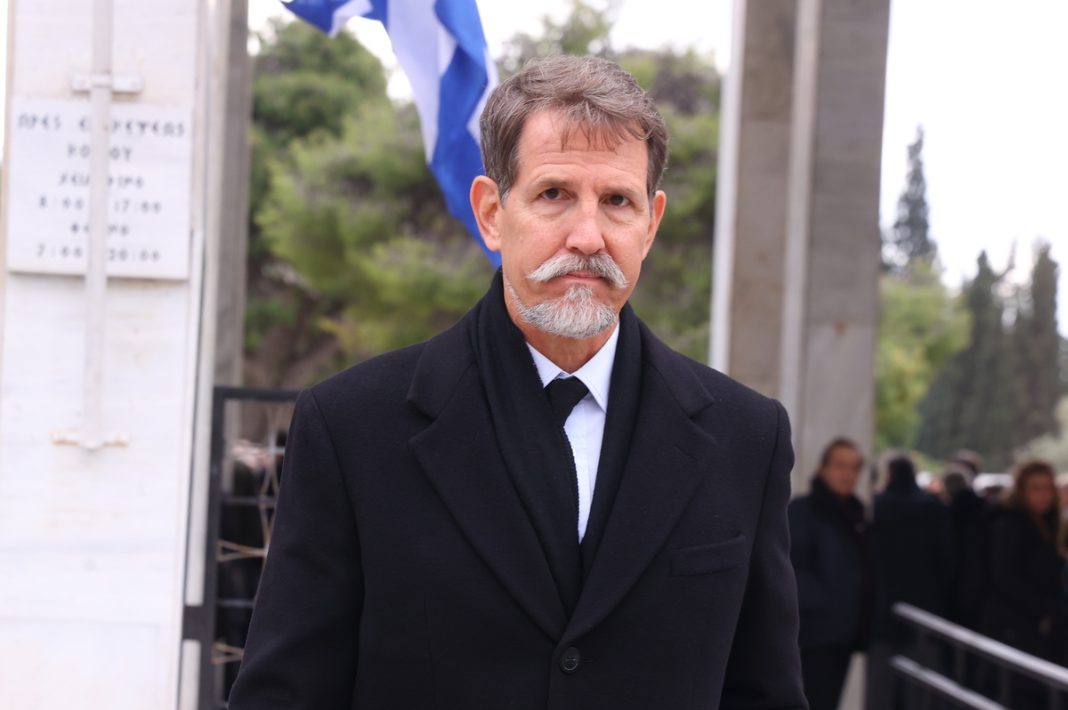
EDITOR’S NOTE (Nick Stamatakis). In this compelling sit-down on ANT1’s long-running talk show Ενώπιος Ενωπίω, Pavlos De Grece — the eldest son of the late former King of Greece — sits down with veteran journalist Nikos Hatzinikolaou for a wide-ranging interview that goes far beyond the usual headlines. Broadcast a week ago, the discussion touches on Pavlos’ personal journey, what life in Greece means to him now that he’s returned after years abroad, and how he views his role in contemporary Greek society.
Over the course of the conversation, he speaks candidly about growing up between cultures, adopting the surname “de Grèce,” and how his family’s history continues to shape his identity in the modern world. He reflects on public perceptions of his past as heir to a defunct throne and explains how he feels about carrying forward that storied legacy in a democratic Greece.
Politics, too, comes under scrutiny — not as a plan for power but as a question of service. While he clarifies he is not seeking political office or pushing for a restoration of the monarchy, Pavlos acknowledges that topics like civic engagement and national challenges are close to his heart. His approach blends personal conviction with respect for Greece’s constitutional order, offering viewers insight into how he navigates these complex waters.
Finally, the interview delves into his family life, his aspirations for his children, and how he balances tradition with the demands of the present — a narrative that resonates with many Greeks, whether royalist or republican at heart. It’s an intimate, revealing look at a figure often seen through the prism of history rather than as a private citizen.
BELOW YOU CAN WATCH THE INTRODUCTION TO THIS INTERVIEW- currently the full interview is not available outside of Greece…
========













A great man! My fervent hope is that the throne is restored and he is placed upon it.
George, who is the great man? He is just another leech that wants to live his family with the Greek tax payers money and without working…
I counted many lies when I watched the interview, I will mention a couple: He said that Glucksburg is not their family name, while all history books and even Wikipedia calls them like that:
https://en.wikipedia.org/wiki/House_of_Gl%C3%BCcksburg
He also said, like his dad used to say, “we the Greeks” and then he admitted that in their house they speak English! Actually they were never speaking Greek in their palaces since 1863, when they came from Denmark! And in these 163 years, only 2 members of their royal crowd married Greek women: King Alexander who married Aspasia Manos and Prince Nicholas who married recently Chrysi (golden) Vardinoyiannis… So, practically their DNA after 163 years has not much Greece in it…
I have to note here that their attitude and their behavior, even when it comes to their “Greekness” fares a lot better than most of the “Greek” politicians and esp. those who occupy the office of the Prseidency. Things become even worse when one considers that those who occupy the “highest office in the land” have to symbolize unity… Despite the many mistakes of the Royals in the past, they stand very good chances in symbolizing the unity of the nation and acting accordingly. Pavlos played this card very well and he has a chance when the appropriate circumstances develop. When will that time likely be? Probably when half the political class in Greece goes to jail… Unfortunately for him the modern Green history shows a very erratic relationship of the Greeks with the Royals: every 35-40 years or so a disastrous event brings back or destroys their position in the country…
The recent award of the Greek nationality by the Greek government and the continuous promotion from the systemic media shows that there is a plan… I hope mr Stamatakis we won’t have to suffer another major national catastrophe in order the Royal family to get back their throne… Anyway the royals are decorative, so what’s the point?
In all modern European countries (those who retain their royals) they don’t exercise real power. But symbols are important in any society and the highest office has to symbolise unity. In Greece this higher office – which also happens to have some limited authority – it rarely performs well its symbolic role of unifying the nation… Hence the opportunity for Pavlos.