


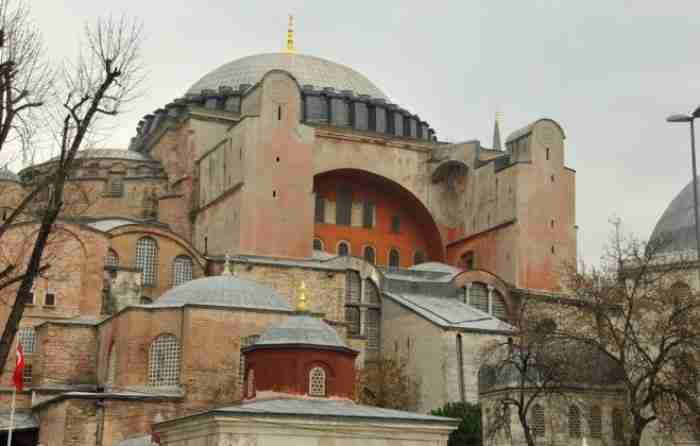
source – dinfo.gr
In January 1919, an event took place in Constantinople that most Greeks are unaware of.
Four hundred sixty-six years after the Ottoman conquest of Constantinople, Hagia Sophia—which had served as a mosque since 1453—was, for a brief moment, transformed once again into a Greek Orthodox church, where the Divine Liturgy was celebrated.
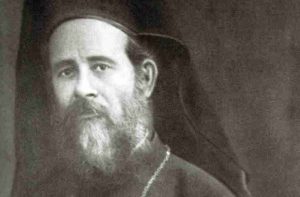
The central figure of this remarkable event was Father Lefteris Noufrakis from the village of Alones in Rethymno, Crete. He served as a military chaplain with the 2nd Greek Division, one of two Greek divisions participating in the Allied expeditionary force bound for Ukraine following the end of World War I.
On its way to Ukraine, the division stopped briefly in Constantinople, which at that time was under Allied occupation.
A group of Greek officers, led by Father Noufrakis and including Brigadier General Frantzis, Major Liaromatis, Captain Stamatiou, and Lieutenant Nikolaou, gazed upon the city and Hagia Sophia from their ship. Hidden in their hearts was a bold plan proposed the previous evening by the fearless Cretan priest: they would enter Hagia Sophia and celebrate the Divine Liturgy.
The officers hesitated. Hagia Sophia was still functioning as a mosque. Guards would surely be present, worshippers might arrive at any moment, and the act could provoke serious diplomatic repercussions with the Allied authorities or even embarrass the Greek government led by Prime Minister Eleftherios Venizelos.
Father Noufrakis remained determined.
“If none of you will come, I’ll go alone. I only need one chanter. Constantine (Liaromatis), will you chant for me?”
Major Liaromatis agreed, and eventually the others joined them.
The Greek transport ship was anchored offshore, so the officers hired a small boat rowed by a Greek resident of Constantinople named Kosmas. He guided them through the shortest route to Hagia Sophia.
The entrance stood open, almost as if waiting for them.
A Turkish guard attempted to speak but was silenced by the commanding stare of Brigadier General Frantzis.
The group entered reverently, making the sign of the cross. Father Noufrakis quietly recited:
“I will enter Your house; I will worship toward Your holy temple in reverence.”
Without hesitation he found the location where the sanctuary and Holy Table had once stood. Using a small table as an altar, he unpacked the sacred vessels from his bag, put on his stole, and began:
“Blessed is the Kingdom of the Father, and of the Son, and of the Holy Spirit…”
Major Liaromatis answered:
“Amen.”
The Divine Liturgy in Hagia Sophia had begun.
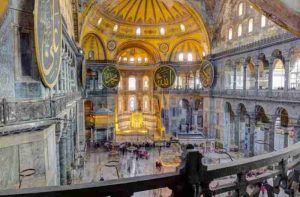
As the service continued, the officers stood in astonishment. After 466 years, the Divine Liturgy was once again being celebrated in Hagia Sophia.
The familiar hymns echoed through the building:
- “Lord, have mercy.”
- “Only-Begotten Son and Word of God.”
- The Little Entrance.
- “To You, the Champion General.”
- The Epistle, read by Brigadier General Frantzis.
- The Gospel, read by Father Noufrakis.
Meanwhile, increasing numbers of Turks entered Hagia Sophia. Father Noufrakis remained undeterred, continuing the service exactly according to Orthodox tradition.
He prepared the Proskomide (the preparation of the Eucharistic gifts), placing the antimension on the makeshift altar and arranging a small chalice, paten, knife, loaf of prosphora, and a small bottle of sacramental wine.
The Turkish crowd continued to grow.
The service reached the Great Entrance, during which Father Noufrakis proclaimed:
“May the Lord God remember all of you in His Kingdom…”
The Creed followed, recited by Brigadier General Frantzis.
Among the Turkish onlookers were many Greek residents of Constantinople, who watched in silence, deeply moved. Fearing possible consequences, they dared not openly express their emotions, though many quietly wiped tears from their eyes.
The Liturgy then reached its most sacred point—the Eucharistic Anaphora.
With emotion, Father Noufrakis proclaimed:
“Your own of Your own we offer unto You, on behalf of all and for all.”
The officers knelt while Major Liaromatis chanted:
“We praise You, we bless You, we give thanks unto You, O Lord…”
Soon the Eucharistic sacrifice had been completed—the first celebrated in Hagia Sophia in 466 years.
The officers received Holy Communion.
Father Noufrakis quickly consumed the remaining Gifts, instructed Lieutenant Nikolaou to pack away the sacred items, and concluded the service with the dismissal.
Their long-held dream had become reality.
As they prepared to leave, however, Hagia Sophia was now filled with angry Turkish spectators who realized what had occurred.
The five Greeks stood together and walked toward the exit as one body.
The crowd appeared ready to attack when a Turkish official arrived with his entourage and ordered:
“Let them pass.”
Although he spoke with obvious resentment, political realities prevented violence. Two fully armed Greek divisions remained anchored offshore, and Constantinople was effectively under Allied control.
The crowd stepped aside.
As the Greeks made their way back toward the waterfront, a large Turkish man attacked Father Noufrakis with a wooden club, striking him on the shoulder. Though badly hurt, the priest recovered and continued walking.
Major Liaromatis and Captain Stamatiou disarmed the attacker.
The officers reached their boat, boarded safely, and were rowed back to the Greek warship.
The incident caused a diplomatic dispute.
The Allied powers protested strongly to Prime Minister Eleftherios Venizelos, forcing him publicly to reprimand Father Noufrakis. According to the article, however, Venizelos privately contacted the priest afterward, praising him for briefly restoring “the holiest dreams of our nation” within Hagia Sophia.
The article concludes by lamenting that Father Lefteris Noufrakis has received little public recognition in Greece. It notes that there is no statue of him in his village or city, no monument in Crete, no street named after him, and little mention of his life in local or national history. It argues that honoring such figures is important not for their own sake, but because societies need heroic examples to preserve their identity, ideals, and historical memory.
Note: This article presents a patriotic Greek account of the event. Historians generally agree that Father Lefteris Noufrakis and a group of Greek officers entered Hagia Sophia and conducted a brief Orthodox service in 1919 while Constantinople was under Allied occupation, but some details of the narrative (such as the exact sequence of events, dialogue, and reactions) come from later retellings and are difficult to independently verify.










A truly inspiring story!
Axios!
I have visited Agia Sophia twice in my lifetime. After the first visit, I promised myself that my next visit would only be when she was functioning as a church again. Unfortunately, that did not turn out to be the case. Although magnificent, the entire building is in mourning, and my heart mourns with her. My dream now is the same as Father Lefteris Noufrakis’, namely to participate in the first next divine liturgy in Hagia Sophia. I believe all true Orthodox believers, whether Greek or not, have this dream.
Truly inspirational! I had read this account in Greek a number of years ago, and again in English about a year later. Every time I come across the article (whether in Greek or in English), I always re-read it. If the Turks were smart, they would actually RETURN Hagia Sophia back to the Ecumenical Patriarchate. No doubt, the Greeks would certainly foot all expenses to take care of it. There would be a Divine Liturgy there every single day. Do you know how much tourism would be generated in Turkey just by this alone?? To the Turks, Hagia Sophia is nothing more than a “prize”… a “booty” from a conquest that occurred over 570 years ago. That’s really all it means to them. To US, however, to the Greeks and to the Orthodox Church, it is FAR MORE meaningful. Erdogan’s move relatively recently to turn it back into a mosque is just Erdogan being an ass. He had no business to do that and didn’t NEED to do that. It could have remained a historical museum and even WE would have been happy with that. (That is, for the time being, when we DO ultimately take it over again “when the time comes.”
Magnificent!